University of North Carolina Athletics
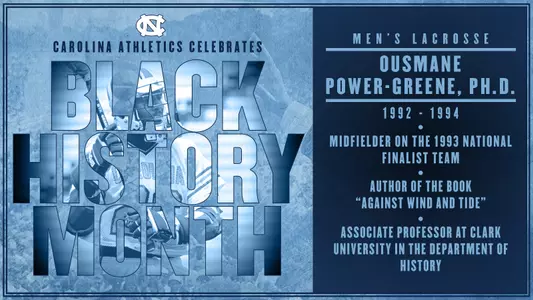
Black History Month Honoree: Ousmane Power-Greene
February 21, 2017 | Men's Lacrosse
By Turner Walston, GoHeels.com
CHAPEL HILL, N.C. - Ousmane Power-Greene came to North Carolina from one of the most storied programs in lacrosse, Yorktown (N.Y.) High School. That program has produced 39 section championships, seven state championships and countless collegiate athletes. "We sent a lot of guys to Syracuse, Hopkins, Maryland . . . the top lacrosse programs, regularly, but no one had gone to Carolina except for one guy in the 80s, and then after me, a whole bunch," said Power-Greene.
But his path to Carolina wasn't direct. A three-sport athlete in high school, Power-Greene wasn't sure whether he wanted to pursue football, basketball or lacrosse. He spent a year after high school at Guilford College in Greensboro, then decided that he could play Division I lacrosse. He visited with his high school coach and with Charlie Murphy, 'the godfather of lacrosse in Yorktown.' "I went to Mr. Murph's house and said 'I think I want to transfer, and I want to hear your opinion about it.' He said, 'Ousmane, you can go play anywhere in the nation."
Power-Greene's high school coach said the same thing. His son was being recruited by colleges as well, and so was in contact with Tar Heel head coach Dave Klarmann. Power-Greene visited some of the top lacrosse programs in the nation, but not Carolina. Not really. "I really didn't visit Carolina," he said. "I was already in Carolina. I'm like a lot of guys who loved Carolina and Michael Jordan in the 80s. We all had in our heads how great Carolina was."
Klarmann reached out to Power-Greene's coach at Guilford to find out what kind of player and young man he might be getting, and Power-Greene came to Chapel Hill the next fall.
And while Power-Greene played on two conference championship teams and made a Final Four run, he was taking full advantage of what Carolina offered in the classroom. "When I was there, I met two people that shaped me fundamentally," he said. Colin Palmer was one of the first black chairs of the history department. "He inspired me and gave me confidence," he said. "Our meetings after class really helped nurture my love of history, and my interest." Genna Rae McNeill taught Power-Greene's junior seminar and mentored him. "I wrote my thesis under her direction. Professor McNeill sat me down and talked to me about what I would need to do to be a successful professor and writer. She gave me great feedback on my thesis, critical feedback, which you expect from your professors.
"I was a very average student, but by my senior year at Carolina, I began to excel a bit. For a guy like me, being able to be mentored by these professors at Carolina is everything," he said.
Power-Greene also learned creative writing with James Seay. "I remember taking poetry with him, and him reading my poem in the second class when we turned in our work," he said. "He was a person who really encouraged me as a writer."
Today, Ousmane Power-Greene is an associate professor of history at Clark University. After graduating from Carolina, hea earned a Ph.D. from UMass Amherst. He teaches American history courses with a focus on African American internationalism. In 2014, he published Against Wind and Tide: The African American Struggle against the Colonization Movement. "It was very gratifying to mail a copy of my book to Professor McNeill, and just to thank her for encouraging me and being a person who gave me advice. She was critical with my work but supportive, and she believed in me."
He has recently finished a novel and is working on a book on the life and legacy of Hubert Harrison.
The lessons Ousmane Power-Greene learned at Carolina, both in the classroom and on the lacrosse field, continue to resonate today. "I always wished I could be one of those natural athletes, but that was not me," he said. "I had to work hard to get where I wanted. I was a good player; I wasn't great. I had to work hard, and the people at Carolina pushed me. I am that narrative of the underlying values that go into a place like Carolina, the ones that are going to sustain you. Not the grades you got in high school or the superstar athlete you were in high school. It's those values of working hard and understanding sacrifices, the sacrifices you have to make to be successful."