


University of North Carolina Athletics
August 13, 2018 | Football, Featured Writers
By Lee Pace
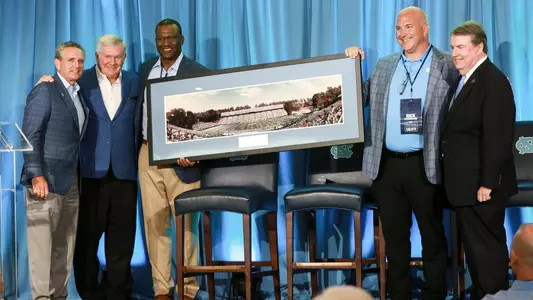
Former Tar Heel Coach Mack Brown returned to Chapel Hill Saturday for a day's festivities saluting him for his impending December induction into the College Football Hall of Fame. Brown attended practice Saturday morning and afterward addressed the 2018 Tar Heels, telling them it was a "privilege" to play in an historic and winsome venue like Kenan Stadium and that he was pulling for them each Saturday from his ESPN studio vantage point.
The stories flowed later at a dinner function from his Tar Heel players of taking a program from a 2-20 start in 1988-89 to a 21-3 finish in 1996-97 and back-to-back Top 10 finishes, of posting a 67-26-1 record after that abysmal start and every starter on those vaunted defenses of 1996-97 of getting a chance in the NFL. Brown's Tar Heel tenure was a prelude to moving to Texas in 1998 and building a moribund Longhorn program into a national power and 2005 national champion with the same template he used at Carolina—relentless recruiting, building a rock-solid support family and bird-dogging every element with a CEO approach equal to Jack Welch or Bill Gates.
But as Carolina Athletic Director Bubba Cunningham noted, Brown's legacy wasn't just about winning, it was about developing young men to be successful after football. And as Hall of Fame Executive Director Steve Hatchell added, induction for a coach wasn't just about hitting a certain winning percentage, it was about "making a difference in young men's lives."
Toward those points, a panel of four Tar Heel greats from the 1990s painted the Brown legacy with poignant stories.
Cornerback Dré Bly spoke of getting a sideline dress-down in his first game as a Tar Heel in the 1996 season opener against Clemson, a 45-0 Tar Heel landslide that laid down the gauntlet for the coming two years.
"The play was on our sidelines, a ball into the flat," Bly said. "I made a big hit. I was high-stepping and celebrating. Coach Brown grabbed my facemask and had a few select words for me. He said, 'We don't do that here.' I knew then and there, I had to remain humble. I learned the importance of being humble. I saw the big picture, I understood what's important. We had a very talented team. I couldn't be the one to mess it up. I needed to remain humble, and I've used that my whole life."
Center Jeff Saturday, who played 13 years with the Indianapolis Colts and now is a studio personality for ESPN, remembered the consequences of refusing to leave his Ehringhaus Dorm room for a late-night fire drill.
"The fire marshal banged on our door and my roommate and I decided we were above going out for the fire alarm," Saturday said. "Coach Brown called me in the next morning and said, 'This will never happen again or you won't be a Tar Heel. You will treat everyone on this campus with respect. They've earned it, and you haven't.' I had to write a letter of apology to the fire marshal and got about six extra weeks with [strength coach Jeff Madden] Maddog. I am grateful Coach Brown cared that I was not just a good football player and gave me a pass. The pass would have destroyed me as a man."
Linebacker Dwight Hollier, who was recruited by previous Coach Dick Crum and redshirted during Crum's final year of 1987, told of taking the field against Oklahoma as a redshirt freshman in the second game in 1988 with a deer-in-the-headlights look.
"I was a 205-pound linebacker and lined up against linemen outweighing me by 70 to 80 pounds," says Hollier, today the vice president of wellness and clinical services for the NFL. "Coach Brown believed in me when I didn't believe in myself. Because of that, I've taken chances and taken steps I wouldn't otherwise have taken. I absolutely appreciate that. One-and-10, one-and-10 at the University of North Carolina? Trust me, those were some difficult years. But we had a coaching staff that believed in us. Coach Brown shed real tears, authentic tears, he wanted to win so badly. And it made us want to win for him and for the coaching staff."
And tight end Alge Crumpler told of how he and his father were won over in the mid-1990s by Brown's recruiting pitch. Crumpler grew up in Greenville in the shadow of East Carolina University, where his dad Carlester had been a record-setting tailback. He spoke of the pride he felt as a native North Carolinian to have been a part of teams that from 1993-99 never lost to an in-state rival.
"With Coach Brown, it wasn't just about football, it was about growing up and being a man first," says Crumpler, today retired from the NFL, living in Atlanta and a regular traveler to Tar Heel football game in his Fleetwood motor home. "Dad said you can play football anywhere in the country. The question is, who can help you grow up and become a man that carries the Crumpler name in the right way? We both gravitated to coach Brown."
Toward the end of the hour-long program in the Blue Zone Saturday night, Brown took the dais and acknowledged many in the audience. There was John Swofford, the Carolina athletic director who hired him and then after those 1-10 seasons gave him a contract extension. There were former assistant coaches like Darrell Moody and Dan Brooks, who had been so important in those early recruiting efforts. There were former Tar Heels from eras before Brown arrived as a 36-year-old head coach.
"You guys were the ones who made this place special and gave us something we could sell," Brown said.
And there were some 50 Tar Heels total from Brown's regime in Chapel Hill in the audience, among them fellow Hall of Famer Don McCauley.
"I'm not going into the Hall of Fame, I am presenting you all in the Hall of Fame," Brown said. "Football is the ultimate team sport, and no one person is ever the one that wins a football game. When I take that oath in December and I say 'thank you' to the Hall of Fame, I'm doing it for each one of you. Your name in my mind will be in the Hall of Fame forever."
Lee Pace began writing "Extra Points" during the 1990 season, Mack Brown's third at Carolina. He continues to cover the Tar Heels and report from the sidelines for the Tar Heel Sports Network. Write him at leepace7@gmail.com and follow him @LeePaceTweet.
Former Tar Heel Coach Mack Brown returned to Chapel Hill Saturday for a day's festivities saluting him for his impending December induction into the College Football Hall of Fame. Brown attended practice Saturday morning and afterward addressed the 2018 Tar Heels, telling them it was a "privilege" to play in an historic and winsome venue like Kenan Stadium and that he was pulling for them each Saturday from his ESPN studio vantage point.
The stories flowed later at a dinner function from his Tar Heel players of taking a program from a 2-20 start in 1988-89 to a 21-3 finish in 1996-97 and back-to-back Top 10 finishes, of posting a 67-26-1 record after that abysmal start and every starter on those vaunted defenses of 1996-97 of getting a chance in the NFL. Brown's Tar Heel tenure was a prelude to moving to Texas in 1998 and building a moribund Longhorn program into a national power and 2005 national champion with the same template he used at Carolina—relentless recruiting, building a rock-solid support family and bird-dogging every element with a CEO approach equal to Jack Welch or Bill Gates.
But as Carolina Athletic Director Bubba Cunningham noted, Brown's legacy wasn't just about winning, it was about developing young men to be successful after football. And as Hall of Fame Executive Director Steve Hatchell added, induction for a coach wasn't just about hitting a certain winning percentage, it was about "making a difference in young men's lives."
Toward those points, a panel of four Tar Heel greats from the 1990s painted the Brown legacy with poignant stories.
Cornerback Dré Bly spoke of getting a sideline dress-down in his first game as a Tar Heel in the 1996 season opener against Clemson, a 45-0 Tar Heel landslide that laid down the gauntlet for the coming two years.
"The play was on our sidelines, a ball into the flat," Bly said. "I made a big hit. I was high-stepping and celebrating. Coach Brown grabbed my facemask and had a few select words for me. He said, 'We don't do that here.' I knew then and there, I had to remain humble. I learned the importance of being humble. I saw the big picture, I understood what's important. We had a very talented team. I couldn't be the one to mess it up. I needed to remain humble, and I've used that my whole life."
Center Jeff Saturday, who played 13 years with the Indianapolis Colts and now is a studio personality for ESPN, remembered the consequences of refusing to leave his Ehringhaus Dorm room for a late-night fire drill.
"The fire marshal banged on our door and my roommate and I decided we were above going out for the fire alarm," Saturday said. "Coach Brown called me in the next morning and said, 'This will never happen again or you won't be a Tar Heel. You will treat everyone on this campus with respect. They've earned it, and you haven't.' I had to write a letter of apology to the fire marshal and got about six extra weeks with [strength coach Jeff Madden] Maddog. I am grateful Coach Brown cared that I was not just a good football player and gave me a pass. The pass would have destroyed me as a man."
Linebacker Dwight Hollier, who was recruited by previous Coach Dick Crum and redshirted during Crum's final year of 1987, told of taking the field against Oklahoma as a redshirt freshman in the second game in 1988 with a deer-in-the-headlights look.
"I was a 205-pound linebacker and lined up against linemen outweighing me by 70 to 80 pounds," says Hollier, today the vice president of wellness and clinical services for the NFL. "Coach Brown believed in me when I didn't believe in myself. Because of that, I've taken chances and taken steps I wouldn't otherwise have taken. I absolutely appreciate that. One-and-10, one-and-10 at the University of North Carolina? Trust me, those were some difficult years. But we had a coaching staff that believed in us. Coach Brown shed real tears, authentic tears, he wanted to win so badly. And it made us want to win for him and for the coaching staff."
And tight end Alge Crumpler told of how he and his father were won over in the mid-1990s by Brown's recruiting pitch. Crumpler grew up in Greenville in the shadow of East Carolina University, where his dad Carlester had been a record-setting tailback. He spoke of the pride he felt as a native North Carolinian to have been a part of teams that from 1993-99 never lost to an in-state rival.
"With Coach Brown, it wasn't just about football, it was about growing up and being a man first," says Crumpler, today retired from the NFL, living in Atlanta and a regular traveler to Tar Heel football game in his Fleetwood motor home. "Dad said you can play football anywhere in the country. The question is, who can help you grow up and become a man that carries the Crumpler name in the right way? We both gravitated to coach Brown."
Toward the end of the hour-long program in the Blue Zone Saturday night, Brown took the dais and acknowledged many in the audience. There was John Swofford, the Carolina athletic director who hired him and then after those 1-10 seasons gave him a contract extension. There were former assistant coaches like Darrell Moody and Dan Brooks, who had been so important in those early recruiting efforts. There were former Tar Heels from eras before Brown arrived as a 36-year-old head coach.
"You guys were the ones who made this place special and gave us something we could sell," Brown said.
And there were some 50 Tar Heels total from Brown's regime in Chapel Hill in the audience, among them fellow Hall of Famer Don McCauley.
"I'm not going into the Hall of Fame, I am presenting you all in the Hall of Fame," Brown said. "Football is the ultimate team sport, and no one person is ever the one that wins a football game. When I take that oath in December and I say 'thank you' to the Hall of Fame, I'm doing it for each one of you. Your name in my mind will be in the Hall of Fame forever."
Lee Pace began writing "Extra Points" during the 1990 season, Mack Brown's third at Carolina. He continues to cover the Tar Heels and report from the sidelines for the Tar Heel Sports Network. Write him at leepace7@gmail.com and follow him @LeePaceTweet.

Sunday, October 25
Sunday, October 25
Sunday, October 25
Sunday, October 25