University of North Carolina Athletics
DeWitt: Heels Will Try To Tame The Tigers
March 14, 2001 | Men's Basketball
March 14, 2001
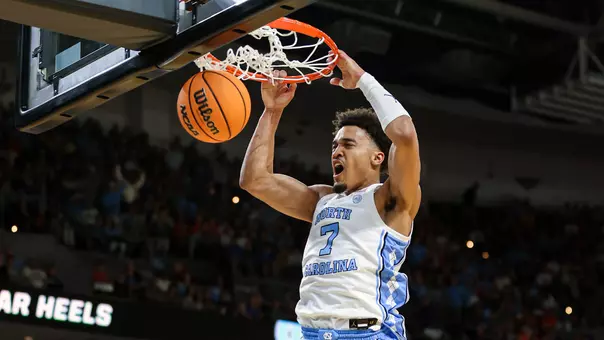
Momentum, says Carolina coach Matt Doherty, can come at any time. It can start with one play in a game -- a steal and breakaway dunk, for example -- and suddenly, it's there, picking a team up and pushing it along like a tidal wave. Shots start going in and the defense gets stingier.
"We've got good players," Doherty said Tuesday. "They just need to start clicking again."
Doherty has used every motivational technique in the book -- and some not written down anywhere -- to try to find the right buttons to push to get the Tar Heels on track again as they enter the NCAA Tournament this Friday against Princeton in New Orleans. After winning 18 consecutive games and rising to the No. 1 spot in the AP poll, Carolina has lost 4-of-8, including the ACC Tournament championship game to Duke last Sunday.
He's given the players highlight tapes -- one of the entire team and an individual one for each of the regular contributors -- set to current rock and rap music. He's watched tape. He's pointed out mistakes. But most importantly, he's talked and listened.
"Communicating is the key," Doherty said. "A team goes through a lot of ups and downs in a season. Look at Maryland. But it's important to keep talking to your players and to have them communicate with you and each other."
If the Tar Heels are to find their momentum against Princeton, they will have to do it against a team that makes very few mistakes and will punish you every time you happen to make one. Most basketball fans hear "Princeton" and immediately conjure up images of intelligent, undersized players who can hit stand-still threes and will back-door more talented teams to a slow, agonizing death.
If Carolina hopes to not only defeat the Tigers in the first round but to play well and, just maybe, get their swagger back, here are five things they will have to do in the Superdome:
Shots, Shots, And More Shots:
In general, college basketball games have between 60 and 70 possessions per team. Princeton, however, will run its offense for 20-30 seconds per possession, cutting by one-third the number of times Carolina will have the ball -- and an opportunity to score. Therefore, aspects of the game such as turnovers and offensive rebounds -- aspects that either take away or add to the number of shots you will get -- become critical.
First, Carolina will have to take care of the ball. Since the Tigers rarely press or trap in the half-court, that means limiting offensive fouls and violations, neither of which have plagued the Heels (too much) this season.
Second, each shot must be followed by four players racing to the rim for a potential offensive rebound. Princeton, on the season, gives up just under ten offensive rebounds per game. Carolina will try to get at least 15 to 17, unless the Heels shoot such a high percentage that there simply aren't that many boards to get.
The Inside Story:
As it has for many games this season, Carolina has a distinct size advantage. If Princeton matches up in a man-to-man defense, pay close
attention to how Tigers' center Luke Walton (6-7, 215 pounds -- at least 3
inches and ten pounds of which is hair) guards Brendan Haywood (7-0, 268
pounds -- very little hair).
If Walton tries to front Haywood (play between Haywood and the ball and push him under the basket with his lower back) Walton will be giving up potential lobs and offensive rebounds, if Walton tries to play behind, Haywood should be able to catch the ball and shoot jump-hooks all day. Same goes for Carolina's other post players.
Princeton is most likely to double team inside, as many other teams have versus the Heels this season. But unlike other opponents -- who doubled with players much bigger and quicker -- the Tigers will be doubling with smaller players who are not as accustomed to going for steals or blocks. Princeton averages just 6.5 blocks and 2.3 steals per game. Even if doubled, Haywood and Lang should be able to get shots off and be in position for offensive rebounds.
The Outsiders:
For every size advantage on one end of the floor, there is invariably a
quickness disadvantage on the other. Princeton's best offensive player is
Walton, who has his father's understanding of the game and love of passing.
He leads the Tigers in both scoring (10.5 pointer per game) and assists (108
total), the latter a true rarity for a center. In other words, the offense
goes through him. Can Haywood go out on the floor and stop Walton from
shooting uncontested three-pointers (20-55, .364 percent for the season)
while at the same time not getting beaten on drives or back-door cuts? That
is question 1A heading into this game.
Peek-A-Boo, I See You:
Some coaches teach the "head-on-a-swivel" method of a defensive player
seeing both the man they are guarding and the ball. Others teach players to
get into a position where they can see both the man and the ball without
moving their head, but keeping both in their peripheral vision. The former
technique gets teams into trouble against Princeton, as the Tigers'
offensive system, developed originally by Pete Carril, teaches offensive
players to read defensive players and make plays as they turn their heads.
An example: a player on the wing has the ball while an offensive teammate moves toward the top of the key from the opposite wing. The defensive player is in good position -- between the man and the ball, but closer to his man -- with his hand in the passing lane. A ball fake from the passer causes the defensive player to turn his head for just a split second. Coach Carril (and ill Carmody and John Thompson III after him) taught his players (both the one with the ball and the one without it) to read that head-turn and immediately initiate a cut to the basket. As the defensive player turns his head back to find where his man was, the pass is delivered to where the player now is (cutting to the basket) and -- because the constant motion of the other players has removed the helpside defense -- the Tigers get a layup.
It sounds like a tiny little fundamental error, but made repeatedly, it can be devastating. The key to the Tar Heels' defense may rest on something as simple as not turning their heads.
The Run And Shoot:
Like a ground attack team in football that gets behind and doesn't have
the quick-strike passing game to score points in bunches, Princeton's entire
scheme is based on being in control of the tempo for 40 minutes. If the
Tigers get behind, they tend to get in trouble. Only twice this season have
they scored in the 70s and they have lost four games by double-digits. That
doesn't mean the Tigers can't score points -- over 51 percent of their made field
goals are three-pointers, and all of their starters have hoisted up at least
30 this season.
ut if the Tar Heels can be effective offensively early, it will put Princeton in a chase mode and perhaps they will get impatient and break its usually effective offensive system. This is a younger than usual Tigers team that plays two freshmen and two sophomores in its top seven players.
An early lead will not only get Princeton out of its normal tempo, but it might also give Carolina something it is adamantly searching for.
Momentum.
Dave DeWitt is the basketball analyst on the Tar Heel Sports Network.