University of North Carolina Athletics
LEE PACE'S EXTRA POINTS: 'Tar Heel Pursuit' Sets Tone For Lively Spring
April 22, 2002 | Football
April 16, 2002
NOTE: Readers are encouraged to view this week's Extra Points in the convenient PDF Format. PDF Format contains all material seen below, as well as additional content that is only available through PDF. 
 Download Free Acrobat Reader
By Lee Pace
 | |
| John Bunting and the Tar Heels enjoyed a productive spring football season. |
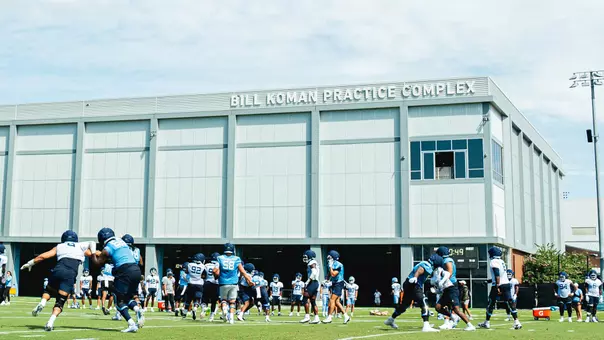
You kind of had to be there to appreciate its nuances, but the gist of it was this: Sprint from the sideline to the line of scrimmage (sort of a faux sudden-change situation), assume stance and alignment, react to the snap of the football, run in place, hit the ground, bounce back up (without using your knees to lift you off the ground), sprint some more, hit the ground again, sprint downfield, run in place, sprint again, hit the ground, bounce up-all the while whistles shrieking and little orange cones in the way and coaches yelling and rockets' red glare whizzing through the sky.
Elapsed time -- about 30 seconds per drill.
Ground covered -- almost a hundred yards.
Repetitions -- usually two for each of the first and second team defenses, though mistakes in running to the correct spots or lack of Herculean effort could warrant a total rewind.
Defensive tackle Will Chapman viewed the proceedings from the sideline on the opening day of spring ball back in mid-March, considered the sutures and ligaments healing in his left knee and thought, "I'm glad I'm hurt. I don't have to do that."
End Issac Mooring remembers that first day as well. "There was a lot of huffing and puffing going on," he says.
As the month wore on, however, the Tar Heel defenders began to see a method to the madness of new defensive coordinator Dave Huxtable.
"You didn't see the offense getting many yards after the first hit," linebacker Sean Williams says.
"There were always 11 hats around the football," linebacker Clarence Gaddy says. "We swarmed the football on every snap."
"Watching film, you'd see a guy get knocked down and get right back up and try to make a play," Mooring adds.
Implementing the pursuit drill was one of Huxtable's first imprints on the practice plan after taking over for Jon Tenuta, the defensive coordinator in 2001 who left in February for Georgia Tech. Variations of the drill have been a favorite of defensive specialist Tim Rose, now at East Carolina, and Huxtable knew the drill from his days with the Pirates. It's a personal favorite that he carried with him to Oklahoma State and now to Carolina.
"Football is a game of straining, of second, third and fourth efforts," Huxtable says. "You won't always get the job done with one effort. It takes a series of efforts. The drill teaches you to strain to run, to hit the ground and get up and keep coming. For us to be good, we'll have to play fast and with great effort -- not just one great effort, but a series of great efforts.
"I think the kids started to buy into what we were preaching. You could see the carryover in our nine-on-seven, our 11-on-11 drills. Later, you'd point something out on film and ask, 'What was that?' They'd say, 'Tar Heel Pursuit, Coach.'"
Of course, whether this will help put Chris Simms or Philip Rivers on their collective rears next fall, whether it will clamp down on Alvin Pearman in Char- lottesville, whether it will usher Carolina to a positive turnover ratio for 2002 after a horrific minus-11 last fall is anyone's guess.
The point is that the vision, the idea, the direction, the motivation is there. The players are sharp enough to look at the roster and see the absence of Julius Peppers, Ryan Sims, Joey Evans, David Thornton, Quincy Monk, et al, and to know that it will take supreme effort -- and more -- to offset the losses.
"Individually, we're not there yet," says Mooring. "Collectively, we can get the job done."
"We don't have a Peppers, we don't have a Sims, but if we have 11 guys come together and play as a team, we can fill that void," tackles coach Rod Broadway says.
The defensive side of the ball was just one of the interesting storylines the last month as coach John Bunting directed his second edition of Tar Heels through their off-season regimen. There's a new quarterback and a going-and-coming quarterback. There's more experience and ability on the offensive line than any time in recent memory. There are questions in the kicking game. There are opportunities for incoming freshmen. And there are a half a dozen or so players recovering from injuries who hope to be full-speed come August.
"It was a productive month for us," Bunting says. "We got a lot of things accomplished. We're far beyond where we were a year ago, in terms of our system and our way of doing things established. The thing I'm most concerned about is our numbers. We're short of bodies. But I'm excited about some new players getting opportunities to show what they can do."
The Tar Heel defense was not the only major question facing Bunting & Co. entering Spring 2002.
The issue of quarterback was front-and-center as well.
With Darian Durant, the productive wunderkind from 2001, announcing in February that he planned to leave Carolina for reasons he chose not to articulate, the mantle fell to Florida transfer C.J. Stephens.
Stephens, a junior, assumed the No. 1 job from the beginning of spring ball, backed up by red-shirt freshmen Matt Baker and Terrance Highsmith, and provided every indication that he would be a productive quarterback at the upper reaches of Division I football. He's tall, strong-armed, accurate, smart, reasonably quick and well-schooled in throwing mechanics. He's also articulate and outgoing, providing a hint that he would be a quality leader on the field and in the locker room.
"I've been pleased with him," offensive coordinator Gary Tranquill says. "He has the tools physically. He's very bright. He picks things up quickly. Now, he just needs to play. He needs to see blitzes and pressures and learn to react at game-speed. "
Stephens, for his part, is delighted to be in Chapel Hill. The son of ex-Gators offensive line coach Jimmy Ray Stephens, C.J. opted out of the Florida program in 2001, sensing perhaps a logjam of players at quarterback with Rex Grossman and Brock Berlin ahead of him on the depth chart. Rod Broadway, who left Florida to join Bunting's staff last winter, suggested Stephens look at Carolina.
"I'm thankful God led me up here," Stephens says. "It's an absolutely wonderful place. I couldn't be happier here."
The deal was done last August, and Stephens spent his transfer year running the scout team against the No. 1 defense. He certainly caught the boss's eye.
"At times, C.J. would rip our defense," Bunting says.
 | |
| C.J. Stephens was the No. 1 QB from the start of spring ball. |
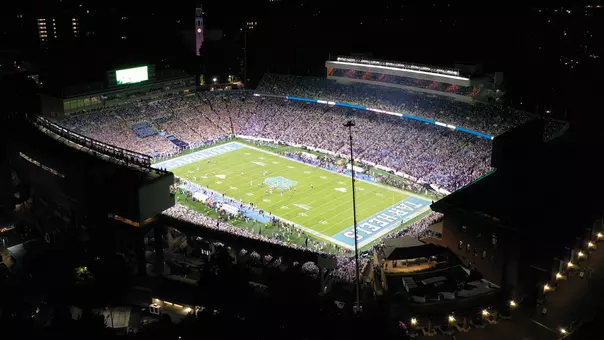
Some 6,000 Tar Heel fans in Kenan Stadium Saturday for the annual Blue-White scrimmage saw for themselves as Stephens hit Sam Aiken on a perfectly timed corner-route for one touchdown and would have had another on a go-route had Aiken not dropped the football.
"I'd rather talk about the one he did catch," Stephens says charitably. "Everyone drops one now and then. Sam's a great receiver. That won't happen often."
Stephens is also charitable toward the return of Durant, who announced on Feb. 25 that he was leaving Carolina but reversed field on Easter weekend and asked if he could return. This was a curious affair from the beginning. For whatever reason or combination of reasons, the Carolina and Chapel Hill experience failed to put Durant under its spell as it does most people. That's fine. It's happened to others as well (the aforementioned Jon Tenuta among them, who's done the right thing and moved on). Durant had seriously considered leaving at least once before, just prior to the 2001 season.
It turns out this has been nothing more than a confused 19-year-old who has struggled to decide exactly what he wants and where he wants to be. He's not the first teenager to stare that impasse in the eye and blink. He certainly will not be the last. He's not the first to love to play a game while being slow to embrace the difficult stuff -- i.e., classwork and conditioning work. Hopefully, the experience has been a maturing one and a learning one. One suspects Bunting understood exactly what was going on when he said upon Durant's original departure, "I'm leaving the door open for him."
Durant dipped his toe into the marketplace and learned the water wasn't as warm as he might have thought. South Carolina did not barge his door down, what with five quarterbacks on scholarship already in Columbia and the Gamecocks hot on the trail of a rising senior high-school prospect. He watched his former teammates practice from his dorm room and the urge to play tugged at his competitive strings. His father and his high school coach suggested he reconsider.
It all added up to Durant knocking on the door Bunting left open after a week-and-a-half of spring drills. Bunting ran the idea by a leadership committee -- a cross section of players of various positions and academic classe -- and the committee voted to give Durant a second chance. Bunting's stipulations were that he would have to compete to regain his starting position and that he'd have to work just as hard as anyone else in the off-season program. Durant agreed and returned for two weeks worth of practice, running behind Stephens on the depth chart. He wore an orange jersey in the Blue-White scrimmage to signal the defense that he was off-limits for full-speed tackling. Durant got a nice round of applause from the fans when he took the field for the first-team offense's third possession of the scrimmage.
"I'm glad people are behind me," Durant says. "I hope they realize I made a mistake. Now I just want the opportunity to compete. It's kind of hard to get back into the flow, but I think I've improved. I'm looking forward to working hard over the summer and being ready when August comes."
Stephens says there is no "controversy" over the starter's job. "That would just be detrimental to the team," he says. "We 'll all work hard for the job. Whoever gets it will have the support of the other guys. I understand what Darian's been going through. It's difficult sometimes knowing what's best. If this is the best decision for him, I'm happy for him."
Regardless of who plays quarterback for the Tar Heels, rest assured he'll be good. Put an improved supporting cast around him, and the offense should be able to move the ball and score points in the fall.
Carolina has three capable tailbacks in Willie Parker, Jacque Lewis and Andre Williams (who missed spring with a shoulder injury). Madison Hedgecock at fullback and Zack Hilton at tight end are good blockers and good bets to touch the football more this fall. Kentucky transfer Bobby Blizzard is now eligible and provides another viable target at tight end. The receiving corps should be strong, particularly with the return from disciplinary action and a foot injury by Bosley Allen. Aiken is a future pro. And Jarwarski Pollock, a 5-8 bolt of lightning, showed in the Blue-White scrimmage that he has explosive, big-play capability in the mold of former Tar Heel Marcus Wall.
The offensive line continues to be a work-in-progress as Carolina attempts to rekindle a tradition that saw numerous Tar Heels advance onto all-star rosters and into the pros in the 1970s and 1980s. Sophomore Jason Brown has moved from tackle to center and, says Bunting, "has all-star written all over him." Skip Seagraves moves into Greg Woofter's spot at left tackle and mainly needs a productive off-season in the weight room to be ready to play. Guards Jupiter Wilson and Jeb Terry and tackle Willie McNeill are returning starters.
Hal Hunter, the new line coach who replaced Robbie Caldwell, likes what he sees in the personnel at offensive line, which now includes the transfer of sophomore Jonas Seawright from defense.
"We're going to have the people we need upfront," Hunter says. "It's a matter of honing them, coaching them, getting them in the right positions. It's a six-to-seven month process until September. But we have the athletes, and we have the toughness and the work ethic to succeed. After my first week at my last job, I was ready to pack up and leave. I'm excited about this group."
John Lafferty returns at punter, and three newcomers were given the opportunity to audition at place-kicker in the breach of departed Jeff Reed. Transfer Dan Orner led the way with Jonathan Cork and Topher Roberts next in line. They'll mix it up in August with freshman David Woolridge. Lafferty is now the holder on place-kicks, and sophomore Greg Warren returns as deep snapper. Michael Waddell and Pollock will be candidates for kick-return duty along with Allen upon his return.
Waddell at cornerback and Dexter Reid at safety are the only returning starters on defense. Joining them in the backfield coming out of spring are sophomore Chris Curry at safety and Kevin Knight at cornerback. Derrick Johnson is the nickel back and will get plenty of playing time if depth problems at linebacker force Huxtable to go with a five-back scheme more than usual.
Malcolm Stewart played two years at defensive end before moving to outside linebacker last fall and now is expected to be a leader and playmaker as he enters his senior season.
"Malcolm will be hard to block rushing the passer this year," Bunting says. "My expectations of him are high. I think he' s going to have a breakout year."
It's also time for sophomore Clarence Gaddy to break out after a red-shirt year in 2000 and playing understudy last fall. He has the physical tools. It's a matter of the light popping on in terms of grasping assignment football and the commitment needed to be successful in college football.
Meanwhile, red-shirt freshman Doug Justice has moved into the No. 1 slot at middle linebacker, though Sean Williams had a good spring and will challenge for the job in August. They became the starting candidates by default when Robert Harris injured a knee in an off-season conditioning drill. Linebacker is a position where Bunting and Huxtable hope a true freshman might contribute, Victor Worsley and Xavier Rainey are two possibilities. There is also a chance that incoming freshman Tommy Richardson could develop into a linebacker rather than a safety.
The defensive line was without Chapman, whose knee was injured at Clemson last fall but is recovering nicely and will be on the field in August. Eric Davis and Donti Coats ran with the No. 1 defense in spring. Chase Page has moved from offense to defensive tackle and seems to have found a home. Darryl Grant will be a key reserve, and South Carolina transfer Carl Smalls is now eligible and is ready for his chance.
"If Will comes back, we'll be pretty good inside," Broadway says. "Chase has good speed, quickness and good hands. He has a lot of the natural things you want to have inside. Now he just needs to learn the speed of the game. But he has a chance to be real good. Donti has a lot of ability. He can be a lot better than average if he wants to be. Eric had a good, steady spring."
The Tar Heels lost two veterans at end with the jump to the NFL by Peppers and the graduation of Evans. Mooring and sophomore Jocques Dumas are now the starters with sophomore Jermicus Banks and freshman Tommy Davis as the top backups. Larry Jessup will challenge for a backup role as well.
"Issac's had a very good spring," ends coach James Webster says. "I'm putting a lot of pressure on him to be the leader of a very young group. He's been aggressive and attacking. I have high expectations for him."
The truth is that this defense will probably not drop off as much from 2001's as fans and media covering the team figure. If it stays healthy, gets from help from newcomers and develops as Bunting and Huxtable hope, it could be very respectable.
"I'm seeing in this defense an extension of Dave Huxtable's personality," Bunting says. "They're hustling, flying around, making things happen. I think we'll be a takeaway team. I think we'll be faster on defense. We won't be as strong up front, and we don't have the depth at linebacker we need. Still, I think we'll run better."
And you can rest assured the Tar Heels will pursue with second, third and fourth efforts.

Pinehurst Resort recently made the most significant addition to its amenity package in many years (beyond the opening of a new golf course) with the christening of its 31,000-square foot, $12 million spa. Now golf widows have the ultimate facility to enjoy while their spouse is playing golf. Included in the state-of-the-art spa, built adjacent to the historic Carolina Hotel, are women's and men's locker rooms with whirlpool, sauna and steam facilities, a three-lane lap pool with cascade whirlpool, fitness center with free weights and weight machines, treadmills and stationary bicycles, and more than 40 massage, bath, body and skin treatments in 28 private treatment rooms. Expert professionals round out a truly memorable experience.>
Many Tar Heel fans enjoyed Lee Pace's six-part series chronicling the playing and coaching careers of coach John Bunting that appeared at TarHeelBlue.com last spring. Now those same stories are available with new material in a book that promises to be a collector's item in the future.
Born & Bred is now available. It is on sale at a variety of venues around campus and Chapel Hill, as well as in the TarHeelBlue.com FANStore and by mail order.
New chapters cover Bunting's coaching staff, his visit in May to Tar Heel legend Charlie "Choo Choo" Justice, and efforts to improve the game-day experience in Kenan Stadium. In addition, there are sidebars on the 1980 Carolina championship team, led by Kelvin Bryant, and Bunting's key role in the 1982 NFL players' strike. Contact Lee Pace today at lpace@nc.rr.com for ordering information.
NOTE: Readers are encouraged to view this week's Extra Points in the convenient PDF Format. PDF Format contains all material seen below, as well as additional content that is only available through PDF. Download Free Acrobat Reader
Players Mentioned