University of North Carolina Athletics
A Candid Conversation With Matt Doherty: Part 2
August 6, 2002 | Men's Basketball
Aug. 6, 2002
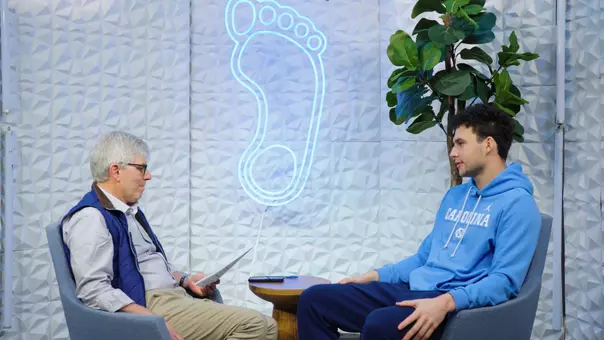
In June, Tar Heel Monthly subscribers read the first installment of a two-part exclusive interview with head basketball coach Matt Doherty. This month, we have the conclusion of that conversation, which includes Doherty's thoughts on the Carolina basketball legacy, the changes in college basketball in recent years, and much more. We want to hear your thoughts on this interview, so drop us a line at alucas@tarheelmontly.com or via regular mail at PO Box 9200, Chapel Hill, NC 27515.

 |
|
MD: If you told me I could coach Rasheed Wallace for four years, or James Worthy or Eric Montross or Brendan Haywood or Sam Perkins for four years, then our focus would be going inside on a regular basis. But those guys don't play college basketball very long anymore. Some of those guys, if they were high school seniors today, may not even be going to college. As a result, the game has to change. You don't have those seven-footers that are as skilled as those guys were. That gap in talent that Carolina used to enjoy has shrunk. There are a lot of good players out there. Look at Brandon Hunter, who played at Ohio this year. He would have been a first team All-ACC player if he played anywhere in this league, and he's playing at Ohio. There are a lot of good players out there and gap isn't as wide as it used to be.
AL: With the 5/8 rule and the NBA departures, is great depth a thing of the past?
MD: I think it's tough to have great depth now. Several factors come into play. We used to have 15 scholarships and now we have 13. We have the 5/8 rule, and now if you have a couple kids leave to go pro or transfer, you're trying to play catch-up. It's tough to do that when you're handcuffed by only being allowed to give five scholarships one year and a maximum of eight over two years. It's tough to catch up. We'll have nine scholarship players this year, so there are four scholarships left on the table that we can't do anything about. It's tough to get back to a full roster. The 5/8 rule was put into place to prevent coaches from running off players or encouraging kids to turn pro. We don't have that kind of control. Even though Shane Power played at Iowa State and averaged 37 minutes per game, he still transferred. Odartey Blankson started for Marquette and left because he wanted bigger role. I didn't want any of our three guys [Neil Fingleton, Adam Boone, and Brian Morrison] to transfer, but they did. I didn't want Joe to go pro, but he did.
AL: How much steeper is the learning curve for freshmen than it used to be?
MD: It's a lot steeper. Some kids are ready and some aren't. Last year we had to rely on Jackie, Melvin, and Jawad, and it hurt their confidence to be thrown into the fire so quickly. We lose a couple games, the basket gets a lot smaller, and it takes them a while to recover from that. The same thing will happen this year. I think we'll have the youngest team in history of Carolina basketball this year. We'll have nine freshmen and sophomores and only two seniors and juniors.
AL: Did anything, whether it was the record or the transfers or anything, about the 2001-02 season surprise you?
MD: No, not really. I knew going into the season and after our first few games that it could be a rough year. Certainly we were trying to win every game, but you have a sense going in about where you stand. And I know after a rough season there will be fallout. If you go 8-20 anywhere, but especially at Carolina, there will be fallout after the year. Once the season is over rumors start flying.
AL: You were successful in the ACC Tournament against Duke by slowing the tempo. Should that have been the philosophy all season?
MD: The reason we didn't do it before is because we didn't have enough time to install it. For the ACC Tournament, we had about four days to prepare. When we played Duke in the last game of the regular season, we only had two days to prepare. You have to get kids to buy into a system. Kids are not coming to North Carolina to hold the ball. If they're not going to believe in it, it will be hard to execute. But at the end of season when you have lost to Duke by an average of 20 points, they can see it's time for a change and they bought in. That's why it almost worked.
AL: Carolina hasn't really been successful in creating turnovers for several years. How can that be remedied?
MD: My first year we were pretty darn good defensively. It wasn't necessarily through steals, but it was through field goal percentage defense. We didn't have the bodies to create steals. We were a big team and fairly athletic out front and in the post, but we didn't have the overall team quickness to get out in the passing lanes and create steals. This year, we weren't quick enough to get out and create tempo with our defense. Next year we're going to try and do that. The question is depth. When Vince Carter and those guys played we were only playing six guys, and it's hard to get after people because you risk foul trouble and fatigue. But this season coming up we hope we can pressure people with our defense and create some turnovers.
AL: In hindsight or even at the time, did you see a change in your team before the road Clemson game your first year?
MD: I sensed it. I sensed complacency, an overconfidence. I tried to shake that up before we went down to Clemson, but you can only do so much. Even though we were winning, I felt the sliding with our execution and fundamentals. That's always dangerous, because you want to tighten the screws when you're winning, but people start believing we're good and forget what got us there. The Clemson game hits and then it's tough to get it back. You can't just turn that switch on and off. We never really got it back after that.

|
|
MD: Sure, because you take that stuff seriously. I was a little disappointed that people spoke up through the media, because some issues we need to take care of behind closed doors. We need to look out for each other. If we deal with each other directly, everything will be fine. But I understand after an 8-20 season that there are going to be some frustrations.
AL: Have you been surprised at the way people have responded to your intensity?
MD: That goes back to before when we were talking about the scrutiny of this place. My first year, intensity was good. Everybody loved intensity. Now all of a sudden it's a bad thing. I am who I am. Every year I'm trying to get better, just like Coach Smith told me he tried to get better every year, right up to his 36th year. I ask our players to try and get better. A lot of it is getting comfortable. But I'm always going to be pretty intense. Is Mike Krzyzewski intense? Is Gary Williams intense? Tell me a coach in our league who is not intense. I wear my emotions on my sleeve a little bit more than other people, and I'm not going to apologize for that. That's who I am. Kids will either like it or they won't like it. I've played, and I think you have to play with emotion to win. You have to have toughness. If you don't have that toughness, you're not going to be successful here or any other place. If you give me a choice between toughness and talent, I'll take toughness every time. Mental toughness is what we need more of. That's what wins championships. As talented as Michael Jordan was, it was his toughness that really separated him from other players in the NBA.
AL: Are you doing anything specific to make former players come back to Chapel Hill this summer?
MD: I've written them. Nowadays, with former players, once they get married, they're not going to leave their families. They may visit, but they're not going to leave for the whole summer. Plus, NBA teams are more of a year round thing now. There are NBA summer leagues that didn't exist when I was in school and we used to play pickup games with our pros. Brendan is going to stay in Washington, D.C., and work with the Wizards' strength coach and Kwame Brown. We do have some guys here working out. I welcome them and I invite them, but they have so much going on, it's not like it was 20 years ago when guys were making $250,000 and didn't have NBA summer leagues and extensive offseason conditioning programs or celebrity golf outings. I'd love for them to come back, but they have their lives to lead too.
We are in the infancy stages of planning a reunion in the future. I've met with Coach Smith and Coach Guthridge and Dick Baddour, who are all in favor of it. We just have to confirm the best time to do this and how we want to proceed with the details.
AL: Have you been surprised by the amount of flack you've gotten from people you might have thought were within 'the family '?
MD: That's been one of the biggest disappointments. But that's human nature, and human nature is a powerful thing. Hopefully, time will heal things.
AL: Have you had to make a conscious effort to involve the former players?
MD: No question, most of our former players support our program. That's the case at any school. Some may not and that's OK. I don't expect everyone to love me. If I do my job and we play well, they will be fine. Not everyone loved Coach Smith when he first got here. I can't live my day thinking that I've got to win over everyone. If I do my job, people will come around. If they give my staff and me a chance, they'll see that we're pretty good guys and we work hard and we love the University of North Carolina. I'm reaching out the best I can to them. People don't see the phone calls I get from guys like Eric Montross, Mitch Kupchak, John Kuester, Dave Hanners, Larry Brown, or George Karl. They are very supportive.
AL: What are your expectations for the upcoming season?
MD: I feel this season coming up could be a challenging year. We're talking about maybe the youngest team in Carolina basketball history. We're going to need a little dose of patience. But the next season, as guys get older and more mature, we'll get back to where people are used to Carolina basketball being, assuming everything goes right with kids staying and recruiting. Our schedule is brutal this year. We've got Kentucky, UConn, at Illinois, at Miami, the Holiday Festival with St. John's, and it's going to be tough. The way the fans were last year was unbelievable. We were third in the country in attendance. If we can get through this season, people will see us getting better at the end and hopefully we'll be really good at the end. Then the year after that, as we get more experience, we'll get closer to where we want things around here.