University of North Carolina Athletics
Lucas: MBB Asked & Answered
February 4, 2003 | Men's Basketball
Feb. 4, 2003
By Adam Lucas
Just got finished watching the UNC-Wake game and the off night for Rashad McCants. Can you explain to me why Coach Doherty would put the leading scorer of ACC on the bench for the first five minutes of each half. This is crazy! Does he not understand that you can't put Rashad into the game cold, he has no rhythm and it was apparent in this game. Rashad even said after the game that he was "nervous" and you can tell he was over playing on defense to win some approval. With the absence of Sean May and the poor shooting this team already has so far this year, we need all the firepower we can get each night to make a difference.
Dustin Powell, Greensboro, NC
McCants is a popular figure in the email inbox this week, so we might as well start off with him. This is what Matt Doherty said after the Wake Forest game about his decision to start David Noel instead of McCants: "I talk about starting as a reward for different things. I preach defense and I have to back it up. David Noel is one of our best defenders and it was time that I needed to reward David for his defensive effort." Doherty later noted that the things he looks for in judging whether players are putting forth the effort he requires are, "Did he dive at a loose ball? Did he sprint back? Did he box out? Did he do the little things that it takes to win games?"
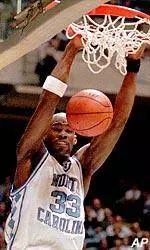
Does that sound eerily familiar, Carolina fans? It should. Seven years ago there was a freshman at Carolina who was wildly popular with Tar Heel fans by the name of Vince Carter. He could score from almost anywhere on the court and often displayed dazzling dunking ability. However, he wasn't playing very much, and on one occasion, when Dean Smith removed him because of a defensive mistake from a home game against Maryland in Carter's freshman year after just 17 seconds of playing time, there were audible boos in the Smith Center. "Consistency is extremely important," Smith said after that game. "He can be spectacular, there's no doubt...Minutes have to do with a lot of things. It's not whether you're shooting well. Everybody goes by shots too much. Sometimes it's defensive, sometimes it's taking care of the ball. If somebody else is playing well, you can't play six-on-six."
So as you can see, the McCants issue isn't an isolated phenomenon. Carter eventually played himself out of the starting lineup as a freshman and did not play over 20 minutes in any game during the season's final month and a half. Last we checked, he turned out to be a decent player.
McCants has said in the past that he looks up to Carter, so the trick is getting him to respond the same way the Daytona Beach product did during his career. His defense seems to feed off his offense, and one way he could generate more offensive energy is by slashing into the lane more often. In Carolina's four Preseason NIT games, McCants shot 17 free throws, and 13 of his 53 field goal attempts (about 25 percent) were three-pointers. In his last four games, he has attempted just 10 free throws, and 35 of his 71 field goal attempts (about 50 percent) have been trifectas. It's tempting to blame that difference on the absence of Sean May, which has focused more defensive attention on McCants and might force him to shoot from the perimeter more often. But in the four games immediately following May's injury, McCants shot 20 free throws and 19 of his 52 shots (roughly 37 percent) were three-pointers. Although it's not a defensive adjustment, it's a good bet that getting back to the free throw line and becoming less willing to settle for jump shots will kick the talented freshman back into gear.
It seems like opponents are blocking more of Carolina's shots this year than in recent seasons. Is there any truth to this?
Matt Warren, Gainesville, FL
Last year, opponents blocked 99 shots in 28 games, an average of about 3.5 blocks per game. The year before, they blocked 108 in 34 games, an average of 3.2 per game. So far this year, they've blocked 103 in 20 games, an average of just over five blocks a game.
So the short answer is yes, opponents are blocking more shots. What's the explanation? Some of it has to do with who keeps the stats. The two biggest block parties were at Florida State (the Seminoles were credited with 14 blocks) and Iona (11 blocks). Not coincidentally, both of those were on the road, where statisticians can sometimes be more inclined to see a deflection by the home team as a block. But it clearly doesn't explain the fact that this year's team has almost doubled the per-game block average of past years.
One reason, although it seems elementary, is that in many situations shorter Carolina players are taking shots against taller opponents. Georgia Tech's Chris Bosh picked up four blocks last week, usually by virtue of his octopus-like reach that allowed him to swat away shots by an undersized Tar Heel lineup on which most of the frequent shooters are 6-foot-8 and under. If you watch how often shots are nearly blocked in major college basketball, you'll see that a three-inch height deficit can make a big difference.
In addition, other than McCants, this year's team doesn't have many strong finishers around the basket. Even big Damion Grant had a near-dunk blocked against Wake, although how a seven-footer can be dropping the ball in the basket and have it blocked without it being goaltending is anyone's guess. Carolina's free throw numbers seem to bear out the conclusion that being aggressive around the basket isn't a strong suit of this team, especially without May. The Heels are averaging 18.8 free throw attempts per game this year, down from an average of 21.5 over the previous three seasons.
With the Heels looking to have a sub-.500 ACC season, do you think that their wins over KU, Stanford, and UCONN and the fact that they're playing the third hardest schedule will be enough to get them into the NCAA tourney?
Dustin Souther
Ah, the ever-popular postseason question. Predicting the NCAA Tournament's field of 64 in early February is almost as easy as prognosticating the 2004 Olympic gold medal winner in rhythmic gymnastics, but it's a good bet that this year's Tar Heels must finish 7-9 in the ACC to have a shot at the NCAA Tournament. To make the NIT, a better-than-.500 overall record must be achieved.
That means Carolina must find five more league victories to have a shot. After Wednesday's trip to Durham, they have five home ACC games left on the schedule plus road trips to Maryland, Clemson, and Wake Forest. If May comes back, there's potential for five wins in that group. If not, it's going to be a difficult challenge, despite the rigorous nonconference schedule and quality wins.
And yes, the players are aware of their precarious postseason situation. "We know that the pressure is on," Jackie Manuel said after the Wake game. "We have to win. We have to buckle down and start taking advantage of these home games." And that, of course, leads into the next question...
When will Sean May return?
Robert, Boca Raton, FL
We've been over in previous columns why it's more difficult this year to get updated medical information. That's why you haven't been reading daily reports from the training room about May's progress. The word from the coaching staff has been very cautious, as you would expect them to be. At the time of the injury, his predicted absence was eight to ten weeks. The injury occurred on Dec. 27, so that window would put the week of Feb. 24 as the earliest possibility. As Matt Doherty has been careful to consistently say, it's not a rock-solid certainty that May will play again this season. It's unfair to May's terrific potential to expect him to play at anything less than 100%.
If he does come back, however, keep in mind that he's not immediately going to be the same Sean May you remember from November and December. There will be a certain adjustment period, both for May and his teammates, as he gets back into shape and integrates with the offense.
I recently read the list of the ACC's Top 50 Male Athletes announced on Tuesday. I saw several great Tar Heels on that list but was alarmed to see that Antawn Jamison was left off. Jamison was National Player of the Year and led a UNC team that finished the season #1 in the nation. He is easily one of the greatest players ever to play at Carolina and had a career I thought paralleled that of Shane Battier from Duke, a player on the list. Am I the only one thinking Jamison got ripped off?
Bryan Weynand, Charlotte
Jamison is rapidly moving up the list of most underappreciated Carolina players of all time, which is currently headed by James Worthy. Let's take a look at the career stats of Battier and Jamison.
In head-to-head matchups between the pair, during which Battier frequently guarded Jamison, Jamison put up 35 points and 11 rebounds in the first meeting, 23 points and 13 rebounds in the second meeting, and an amazing 22-point, 18-rebound performance in the ACC championship game. Battier's cumulative totals in those three games were 10 points and 11 rebounds.
Jamison was a first-team All-ACC selection in all three of his Carolina seasons. Battier was a third-team pick in 1999 and a first-team selection in 2000 and 2001.
Adam Lucas will answer your questions about the Carolina men's basketball program this season in an exclusive column published each Tuesday. Lucas, editor of the Tar Heel Monthly, will answer your questions on personnel, strategy, opponents and anything on your mind about the Tar Heels OTHER THAN RECRUITING SPECIFICS. Please send your questions to Adam at alucas@tarheelmonthly.com, and include your first and last names and your hometown.