University of North Carolina Athletics
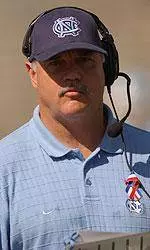
Lucas: Bunting Q&A - Part II
March 20, 2003 | Football
March 20, 2003
Tar Heel Monthly is the premier magazine devoted to the stories and personalities behind UNC athletics. Click here for subscription information.
The following is Part II of a two-part interview that appeared in the April issue.
By Adam Lucas
THM: What battles are you looking forward to in spring ball?
JB: Number one, we have got to improve our run defense. Number two, we have to improve on special teams. Number three, we need to improve our running game on offense. Those three things are very important. We need to be a fundamentally sound team. We still don't have enough depth in the spring to get out and scrimmage every day like maybe I'd like to in order to improve on our toughness and teamwork. We're a year away from having those types of numbers. So we have to get into group situations and individual situations and work on fundamentals and techniques and getting better.
THM: Does the lack of depth that you mentioned also hurt you on special teams?
JB: It hurts you with the coverage aspect. But we're not good enough in the punting game, either. Our punting situation has to improve. There will be more competition at that position this spring and this summer.
THM: What did Darian Durant learn watching from the sidelines when he was injured that he might not have learned on the field?
JB: Darian is a young player and a very bright person. He continues to learn just how important football at North Carolina is to him and to his growth. He learned how much he missed it when he was out. When you're involved with the day to day grind, sometimes you get caught up in that, and that's particularly true for a quarterback, because he has a lot to think about. When he's off the field, he's still thinking about football. When he's not in a meeting, he's still thinking about football. But now Darian really appreciates how much the game means to him and how much better he was playing and how much better he can play as he learns more.
THM: What will be done to improve the running game so that Darian isn't the only offensive option?
JB: With [transfers] Chad Scott and Rikki Cook and [freshman spring enrollee] Ronnie McGill coming into the picture, we're going to have a more dangerous running attack. The offensive line being a year older and a year better will make us a more dangerous running team. We have to run the ball. That is a big emphasis for us.
THM: Do you want to come out of the spring with a clear-cut starter at tailback?
JB: I expect that we'll have one or two or three. It's not a concern to me to have a clear-cut winner. I do believe something will evolve between now and next season.
THM: What can we expect from the o-line this year?
JB: They'll be good. There's talent there and some toughness there that we haven't had since I've gotten here. Therefore, they will be better. You can't run the football if you're not tough, and I think we're going to be tough.
THM: Sam Aiken and Chesley Borders are gone, who is going to step up at wide receiver?
JB: Brandon Russell is back, and this is his last year. Jarwarski [Pollock] could play a big role, as could Derrele Mitchell. It's time for Danny Rumley to step up and play. I'm excited to see what the younger players, whether it's Daunte Fields or Michael Gilmore or Ian Firestone, can do. The three receivers we're bringing in as freshmen are not coming in to redshirt. We brought them in to play.
THM: How is Michael Waddell's recovery going?
JB: I think he is close to being 100 percent. We're hopeful that he will have a full recovery from that injury and that he'll be ready to play the best football he's ever played this year. We need him. He has talent. If he can put together a great spring and summer camp, he'll have an explosive year.
THM: What is the solution to getting more pressure on the opposing quarterback this year?
JB: The solution there is a combination of the front four rushing better and getting better coverage. We blitzed at times last year and got some sacks and some pressures. But we need to be better at the back end and better on the front four. I think that because of the recruiting situation, you'll see a [true freshman] Terry Hunter out there on the field. You'll see Isaiah Thomas, Kyndraus Guy, and Donnell Livingston making some plays. They're not going to sit. They're going to play.
THM: People seem to have forgotten about the class of freshmen that redshirted last year. Do you expect some of them to contribute on defense?
JB: I'm expecting that the Alden Blizzards and the Brian Rackleys and the Xavier Raineys will have an impact. And that means they have to have great springs. The individual drills and group drills we do this spring will be geared towards being better fundamentally so that by the summer we can do more hitting. Number one on defense, we have to learn how to tackle better. Number two we have to learn how to pressure the quarterback more, and that means a lot of individual pass rushing work, which will help our defensive ends and defensive tackles and also help our offensive line. It will be a full speed operation, it just won't be in a team setting.
THM: There was some talk when you came in that you were a proponent of the Gulf Coast Offense. Is that still an accurate way to describe your philosophy?
JB: Gary Tranquill likes to throw the ball deep, and so do I. If we have players who can run, and we do, we're going to throw deep more. Darian is strong enough to get it downfield and C.J. [Stephens] has a cannon for an arm. We're going to stretch the field more with this recruiting year we just had. I like to run the football, too, there's no doubt. We're going to make a conscious effort this spring to run the football.
THM: What was a bigger adjustment for you as a coach: going from a small college to the pros or going from the NFL to a Division I college?
JB: Each had its learning curve. When I went from a small college back to coaching pro football, the pros had changed in just a very short amount of time in terms of money and free agency. The difference between dealing with the pro player in 1983 or 1985 when I last coached there and then in 1993 was dramatic. Things had changed. Money had changed a lot of players. Going from the pros into Division I college football was something that I knew would be difficult because of the recruiting aspect. Until you experience it, you never know. It's impossible to know how grueling it can be and how important it is. I think about NFL Drafts, they happen and they're over with. In college recruiting, you have a signing day and that just signals the end of that class and you're recruiting the next day. It's not over.