University of North Carolina Athletics

THM: Basketball Staff Profile: Steve Robinson
July 23, 2003 | Men's Basketball
July 23, 2003
Tar Heel Monthly is the premier magazine devoted to the stories and personalities behind UNC athletics. Click here for subscription information.
The following is a story from the most recent issue of the magazine.
By Adam Lucas
Something about the walls in his new Smith Center office looked achingly familiar to new Tar Heel assistant coach Steve Robinson. He's into his third decade in coaching, having made stops at places as diverse as Cornell, Radford, Florida State, and Kansas, but those bluish-gray Chapel Hill walls seemed to stir a memory.
Then he realized it. It was sitting in this very office that he first made contact with Roy Williams, a meeting that led him--in that roundabout path the coaching profession always seems to take--from Lawrence to Tulsa to Tallahassee to Lawrence again and then, eventually, to Chapel Hill.
"I sat right here in this same office in that chair right there a long time ago when Coach Williams first got the job at Kansas," Robinson says one warm Chapel Hill afternoon. "I knew Jerry Greene, and he was the first assistant Coach Williams hired when he took the job at Kansas. Jerry told me Roy hadn't finished his staff. I got a number for him and called him while he was packing up his office at Carolina. He told me he didn't have a lot of time, but said maybe I could stop by for 30 minutes. Our 30 minutes turned out to be an hour, and a couple days later he called and offered me the position."
Fifteen years later, Robinson is sitting on the other side of the desk in that same office, while Williams has moved down the hall to the big office with the keypad lock. It's one of those coincidences that frequently occur in coaching, where almost anyone can go home again.
And although he still has boxes left to unpack from his last move--after being removed at Florida State last spring, he went back to Kansas as an assistant--Robinson doesn't mind the frequently changing surroundings that come with his chosen profession. After all, it's something he always knew he wanted to do.
"Even in junior high, I was the guy in PE class who orchestrated what we would play and pick the teams," he says. "I had a good relationship with my high school coach and I liked the dynamics of coaching. I like formulating a plan and putting a team together."
He also was a talented player, and was one of the first scholarship athletes at Radford. The school was making the transition from its former incarnation as a women's college--with a 25-1 female-to-male ratio, Robinson smiles and says, "You knew somebody had to feel sorry enough for you eventually"--and he and two other athletes blazed the scholarship trail.
After two years in the high school ranks, Robinson got his first college job as an assistant at Radford, which led to a two-year assistant's position at Cornell. His next stop was Kansas, where he picked up much of the blueprint that would make up his coaching DNA.
"I like to think that time at Kansas was the time period when I had my biggest growth in coaching," he says. "I felt like I was learning so much and we worked so hard, and all of a sudden the philosophy meshed. You're out there trying to find a style that will suit you best, and being around Coach Williams and working with him seemed to make it all come together.
"I liked his style of play, with pushing the ball up the floor and playing in transition. And I also wanted to have a team that plays extremely hard and defends and is unselfish. I think he has the whole package that way, and that fit with who I wanted to be."
His first chance to try it on his own came at Tulsa, where he won 46 games in two years as the head coach. That led to a job offer from Florida State. Robinson, wary of leaving his Tulsa players, hesitated to accept the job at first. Eventually, won over by the opportunity to coach in a big-time conference at a national school, he accepted.
But Florida State wasn't always as big-time as its prestigious conference might imply. The Seminoles played in a civic center entirely devoid of atmosphere rather than a raucous on-campus arena, and when tournament play was heating up much of Tallahassee was fixated on spring football.
"I thought Steve did a great job at Florida State under very difficult circumstances," former Carolina head coach Bill Guthridge says. "It was almost impossible there. They played in the Leon County Civic Center, and we played down there one year and they were doing construction work and it was so cold in there I almost didn't play the game. I felt sorry for Steve, because he had no control over things like that."
The Seminoles made yearly trips to Chapel Hill during Robinson's five years at FSU, with four ending in defeat. The Tar Heels averaged a ten-point margin of victory in those five games, making it fairly easy for the new assistant to adjust to his new seat on the home side rather than the uncomfortable spot at the head of the visiting team's bench.
"That won't be hard to do at all," he says. "In fact, I told some Rams Club groups this spring that it would be nice to have them cheering for me rather than against me. I told them that I recognized every single one of the people in those rooms. They were the ones who were yelling at my back the whole time I was on that other bench."
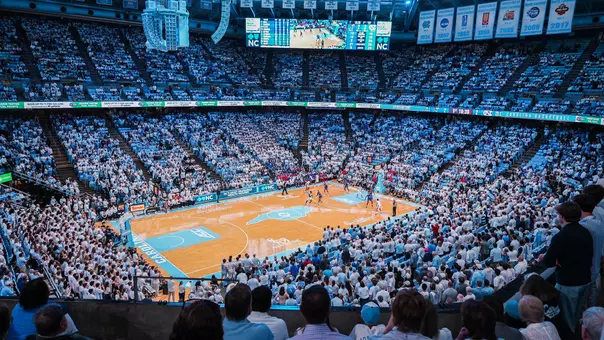
Now, however, Robinson is on the good side of the Smith Center court--and back in familiar surroundings in his new office.
Adam Lucas is the publisher of Tar Heel Monthly and can be reached at alucas@tarheelmonthly.com. To subscribe to Tar Heel Monthly, click here.