University of North Carolina Athletics
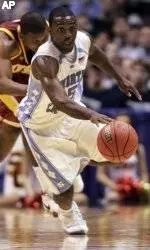
Lucas: Faster, Stronger Lawson Expanding Role
October 8, 2007 | Men's Basketball
Oct. 8, 2007
By Adam Lucas
With a sigh of resignation, Danny Green admits he has relinquished his crown.
Last summer, he was the king of Carolina pickup games. Players kept their own winning percentage stats in those games; he led the team by a healthy margin.
This year, though, he finds himself in second place.
"My winning percentage isn't as high as it was the last two years," he says.
Why not?
"Because Tywon is here now."
He says this as if it is one of those inarguable truths that everyone knows. Tyler Hansbrough is a good post player. Wayne Ellington is a good shooter. Ty Lawson is winning.
"He's become more of a complete player," Green says. "He's smarter and more experienced. He's got speed and strength and when you have both, it's very hard to stop you. He can run by people, but he's also strong enough to finish the play."
As a freshman, Lawson sometimes relied too much on those natural gifts of speed and strength. He played at least 30 minutes in five of Carolina's last six games, including an exhausting 40 in the overtime regional final against Georgetown.
His stats in that game against the Hoyas: 2 for 9 from the field, 5 fouls, 6 assists, 5 turnovers.
"By the end of the year, I definitely felt tired," Lawson says.
To help recover from the most taxing season of his career, the point guard declined to try out for the Pan Am Games squad, preferring instead to work on his individual game at home after attending summer school. Even while at home, however, he couldn't get away from basketball, and spent some time in pickup games with older NBA veterans such as Steve Francis, Gilbert Arenas, and Juan Dixon.
Watching the older players reinforced what Roy Williams had told him after the season: point guards can't just play, they also have to lead.
"Coach wants me to talk more on the court and lead my team," Lawson says. "He puts a lot of trust in his point guard. He wants them to run the show and get a feel for when to push the ball and when to slow it up."
That's a feel he says he became comfortable with only in the last month of his freshman season. But merely the way he refers to the Tar Heels is subtle progress: on the eve of his sophomore campaign, he's now calling them "my" team.
Those types of intangibles are important, because of the past is any indication, Lawson's on-court measurables will take a significant jump this year. Over the past 15 years, every long-term Tar Heel starting point guard--Derrick Phelps, Jeff McInnis, Ed Cota, Raymond Felton, and Bobby Frasor--has seen their assist/turnover ratios improve by an average of almost 50 percent from their freshman to sophomore season.
"As a sophomore, you're so much more comfortable," says Frasor. "Sometimes last year Ty tried to make great plays when simple plays would have worked. But in pickup right now, he's almost unguardable at times. If he can bring that same thing every play of every game, he will be special."
Lawson's baseline is higher--his freshman year A:TO ratio of 2.6 is already well above any of the other players' first-year marks--but he still believes there's room for improvement.
Last year's team leader in three-point percentage, Reyshawn Terry, has graduated, as has outside marksman Wes Miller. That means opponents are likely to clog the post until the Tar Heels prove they can beat them from outside.
In an effort to improve on his freshman percentage of 35.6 beyond the arc, Lawson has moved the release point higher on his outside shot and is focusing more on his follow through. He also plans to use some of the savvy he gained in his college basketball indoctrination to become a more effective scoring option.
"Coach told me I passed up a lot of shots last year," he says. "I would come off the ball screen and pass that shot up. If I can get into the key area or free throw area, Coach wants me to shoot that shot. That will make our offense better and it will make defenders respect us more because they know I can get inside."
There's little question about his scoring or his passing. After one year at Carolina, the only question about his offensive game is how long he can maintain the frenetic pace required of a Tar Heel point guard.
As he relaxed in the Smith Center last week before an individual workout, he brightened noticeably when the topic of his conditioning was raised.
"I did the mile today," he says.
He's referring to the Carolina Mile, when all players must finish with a time of less than six minutes. And his results?
"Last year I barely made it. I think my time was 5:55. This year I've taken conditioning much more seriously. I'm running my 33's (sprints) really hard. I'm trying to get my wind up. And this year I made my tough time. I did it in 5:29.
"I barely made the tough time," he acknowledges with a grin. "But I made it."
Adam Lucas most recently collaborated on a behind-the-scenes look at Carolina Basketball with Wes Miller. The Road To Blue Heaven will be released on October 1. Lucas's other books on Carolina basketball include The Best Game Ever, which chronicles the 1957 national championship season, Going Home Again, which focuses on Roy Williams's return to Carolina, and Led By Their Dreams, a collaboration with Steve Kirschner and Matt Bowers on the 2005 championship team.