University of North Carolina Athletics
Lucas: Fifty Years Ago, Tar Heels And Spartans Played NCAA Classic
March 17, 2007 | Men's Basketball
March 17, 2007
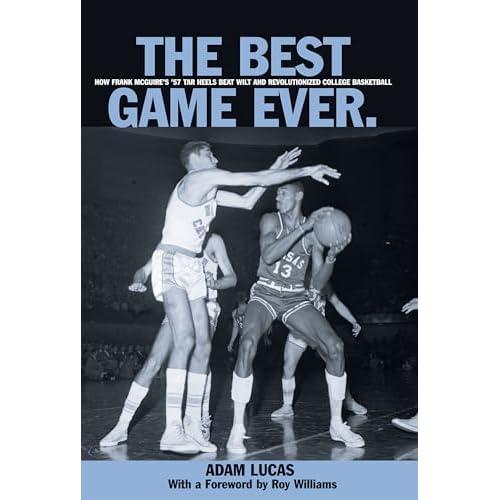
The below is excerpted from Adam Lucas's book on the 1957 undefeated national champions, The Best Game Ever.
By Adam Lucas
Carolina fans were willing to pack Woollen Gym to watch their Tar Heels. They were willing to travel to Reynolds Coliseum and beg or plead for tickets to the Dixie Classic or ACC Tournament.
But this was 1957, and the world still seemed much larger. Commercial air travel had exploded since the introduction of the DC-3, as the amount of Americans flying commercially had risen from three million in 1940 to 55 million in 1956. But many of those trips were by businessmen flying on corporate expense accounts or upper-class families who planned their trip well in advance. Raleigh-Durham Airport's first terminal had just opened in 1955; it handled approximately 30 flights per day. The average North Carolinian, even if a crazed basketball fan, simply couldn't arrange to fly from Raleigh to Kansas City with only six days notice to watch the Tar Heels take on Michigan State in the national semifinals (it wasn't yet known as the Final Four).
With the potential of playing in a hostile arena against an intimidating foe, plans were made for a charter bus trip from Chapel Hill to Kansas City. The trip was marketed almost exclusively to Carolina students; the cost was a steep $43.12 apiece.
With the semifinals played on a Friday evening, the trip would mean missing classes, but interested students had a handy excuse. The head of the institution had already provided his blessing.
"I strongly urge all students who are in proper academic standing and who have the desire to make the trip to Kansas City and help to push our Tar Heel basketball team over the top," chancellor Robert B. House said.
But the encouragement didn't spark the interest of many Carolina fans. The school sold a total of 86 tickets for the two-day event--teams were guaranteed two games because of the existence of the third-place game, which matched the losers of the two semifinals. None of the parents of Carolina's starting five attended.
So there were few distractions for the Tar Heels in Kansas City. The night before the semifinal against Michigan State, Frank McGuire gathered his team at the hotel and took the unusual step of showing them game film of the Spartans. The overall scouting report was minimal--some basic information about the offense Michigan State would run and some brief information about their best offensive players--but the film had an unintended impact. The clip featured MSU's narrow victory over Notre Dame in the NCAA Tournament.
"Showing us that film was one of the only mistakes Coach McGuire made," Lennie Rosenbluth said. "Michigan State looked terrible in that game. After we saw that film, we didn't think much about them. We weren't awed at all, and maybe we should have been."
The Tar Heels also weren't awed by the arena. Municipal Auditorium was large--capacity was 9,287--but dark. Seats along the sidelines were limited, but an upper level jutted out over the lower level and provided more sideline seating. In some ways, it resembled Reynolds Coliseum, except without the vast expanse behind the baskets.
One of the largest media contingents in history was in attendance. McGuire, recognizing a public relations opportunity when he saw one, took the entire media contingent out to dinner on the night before the semifinals.
Wilt Chamberlain and the Jayhawks were assigned to the night's first semifinal. The seven-footer was the evening's star attraction, and there were rumors of tickets changing hands for the exorbitant sum of $50 apiece.
The Jayhawks blitzed San Francisco 80-56 and advanced to what was expected to be a coronation the next evening. The Tar Heels were already in the arena but saw little of the first game.
"We didn't watch much of it because we didn't want to see it," Cunningham said. "Wilty was out there doing his thing and all we could hear was the crowd roaring. We're down in the locker room getting dressed and we just hear these periodic roars. We know what that means. We didn't have to see it. If you're going to fight Cassius Clay, you don't want to watch him too long, because you know what you're getting into."
Most fans in the crowd were curious about the undefeated North Carolina team they had heard so much about, so they stayed to watch the second semifinal.
The Kansas team, however, was not in that group.
"Kansas has always been a family," Waugh said. "The coaches and trainers and players were very close. We did things together. So we were going to go out to eat, we weren't going to sit around and watch some other team play."
They missed a classic. Just before game time, a DC-3 owned by Burlington Industries touched down in Kansas City. It carried an illustrious list of North Carolina politicos; governor Luther Hodges, lieutenant governor Luther Barnhardt, and state representative Carl Venters were among them.
A Greensboro entrepreneur named C.D. Chesley was not among the contingent in Kansas City. He didn't have time--he was too busy at home organizing a revolutionary television package. Chesley had noticed the fever surrounding Carolina's undefeated basketball season. Limited television coverage had been available of the win over Canisius, but he envisioned something bigger. He arranged for a five-station network that would broadcast the semifinal game across the state.
Response was overwhelming. Viewing parties sprouted all over the state. In Chapel Hill, the Rendezvous Room in the student union set up an enormous 32-inch television for students to watch the game. At the Goody Shop on Franklin Street, Spiro Dorton and a host of students packed into the campus favorite to cheer on the Tar Heels. The picture was not especially sharp, but the fans didn't care--they were able to watch their team, live, as the game was being played in Kansas City. This truly was the miracle of television.
The only dissenting voice came from the student paper, where the editorial board fancied itself as the lone voice of intellectual reason. In a page-two staff editorial that ran the morning of the Michigan State game, the writers moaned about a lack of attendance at recent campus events that included speeches by Robert Frost, Dame Edith Sitwell, and Don Shirley. "Not many had enough energy to give education a try," the writers sniffed, "or even to seek a little entertainment more substantial than getting drunk over a winning ball team."
If the Tar Heels thought they were breezing to a meeting with Kansas the next day, they found out otherwise on one of the first possessions of the game. Carolina went to their favorite offensive play: get the ball to Rosenbluth. The All-American was being guarded by Michigan State's "Jumpin'" Johnny Green. Rosenbluth wiggled free, prepared to fire a shot and score his first two points...and suddenly Green was soaring through the air. He swatted the shot away--two points denied and a message sent.
"I had figured this Green kid was just another guy who could jump high," Cunningham said. "But then he jumps and blocks that shot and I remember thinking, `Whew, they might be a pretty damn good team.'
"They came out all guns firing and sent us a wakeup call real fast. I think they felt like they had nothing to lose, and they played so aggressively."
The Spartans played a typically physical Big Ten team, but their roster wasn't populated with the type of Midwestern bruisers Carolina fans might have expected. Instead, they had several players with surprising athleticism. Green, in particular, played one of the best defensive games of his career and harassed Rosenbluth all over the floor.
 |
|
The game was tied 29-29 at halftime. The teams traded the lead throughout the second half and were knotted at 58 as the second half ticked to a close. Michigan State coach Forddy Anderson had made a conscious choice to try and limit Rosenbluth and Brennan's offensive opportunities. The Spartan gameplan was simple: make anyone other than the talented duo beat them. That left Cunningham open for virtually the entire game, which appeared to be a sound strategy--he had scored more than 10 points just seven times in the previous 30 games. But although Rosenbluth complained about the dim lighting in Kansas City, Cunningham found the shooting environment to be very attractive. Left to roam the perimeter unguarded, he responded by dropping in a variety of jumpers and layups on his way to a season-high 19 points.
Cunningham had also done another stellar defensive job, holding Green to just 11 points. Michigan State forward Jack Quiggle, a fellow All-American, had been MSU's most effective scorer throughout the game and was on his way to a team-high 20 points.
With just seconds remaining, the Spartans found Quiggle in the backcourt. There was no time to advance into the frontcourt, no time to find a better shot. As the overhead scoreboard ticked from :01 to :00, Quiggle lined up a final shot. He released it, nothing more than a desperation heave destined to soon be forgotten.
Thousands of eyes followed the ball as it flew through the air. Tar Heel players realized the ball was on line. Their end-of-game good fortune might have finally expired.
And then it did.
The ball ripped through the net, apparently the game-winning shot that would give Michigan State a 60-58 win. The Spartans, losers of eight games during the regular season, had toppled undefeated North Carolina.
"The picture wasn't very clear," said Buzz Merritt, who watched the game at the Goody Shop. "This was before the days when they would put the clock and the score on the screen, so all we saw was a tie score, Quiggle takes this shot, it goes in, and we think that's it. It looked like the season was over."
A long, impassioned groan filled the room. The heroes were vanquished.
Or were they?
Without the benefit of slow-motion instant replay, officials had only their vision to rely upon. While Michigan State players raised their arms and celebrated and Tar Heel heads hung, the officials conferred. Their ruling was immediate:
No basket.
The referees ruled that Quiggle had released the ball after the buzzer, rendering the shot meaningless. The two teams would have to play a five-minute overtime to decide which team would advance to meet Kansas.
Or maybe more. Neither team could gain an edge in the first extra period, as each squad scored six points. Although Rosenbluth would finish with 31 points, he was struggling to maintain his usual offensive efficiency against the wiry Green.
With both teams tiring, the second overtime was excruciating. Michigan State notched one field goal; Carolina couldn't find the range. With under ten seconds remaining, Green went to the line for a one-and-one free throw opportunity. His team held a 66-64 advantage. If he made the first shot, the game was essentially over. With no three-point shot, one more point would provide an insurmountable margin.
Green toed the line and looked up into the partisan Kansas crowd that had stayed around for what had turned into a classic. Tommy Kearns stood behind the free throw line, waiting for a potential outlet pass. Just before the ball was handed to Green, one of the Spartan guards approached him. He stood next to Kearns and uttered something softly, so that only the sparkplug guard could hear him:
"Thirty and one."
Kearns did not reply. There wasn't much he could say. His team had reeled off 30 straight victories but was now facing defeat a thousand miles from home. One of Michigan State's best free throw shooters was at the line, and even if he happened to miss the shot, Carolina had to go the length of the court and still figure out a way to score in less than ten seconds.
The odds were improbable.
Players from both sides lined the narrow lane. Pete Brennan secured an inside position. He had been largely overshadowed by Rosenbluth for much of the season but had quietly put together one of the best seasons in Carolina history. Brennan, who was matinee-idol handsome, had a personal goal for every game: outrebound his man. He knew he wouldn't always be required to be the big scorer, but felt that if he outrebounded his man then he gave his team a good chance to win. He'd become the school's all-time leading rebounder earlier in the season and, with a championship, would be poised to be one of the signature players in the nation during his senior season.
Green eyed the basket and hoisted the ball. Much like Quiggle's shot at the end of regulation, it looked good. His form was perfect. But the ball bounced off the rim.
Brennan hauled down the rebound.
"I knew I had to get down the court fast," he said. "So as soon as I got it I turned and looked up the court. Normally I would've passed it to one of the guards, but I didn't think we had enough time."
Michigan State had expected their star to make the free throw, but they had two guards in the backcourt in case they needed to stop a late Carolina charge.
Kearns and Cunningham were out ahead of Brennan, but he didn't see them. All he saw was the basket some 75 feet away.
"I don't think there was anyone out in front with me," Brennan said with a shooter's smile. "So I just went down the court and took the shot from the right of the foul line."
"If we had been in a practice right then, Frank would have called timeout and chewed Pete's ass out about taking a dumb shot," Cunningham said. "He would've told him to look for the men out in front of him and get the ball up the floor. But thank God Pete didn't follow that strategy. He probably should've gone deeper and tried to throw a bounce pass for a layup. But he pulls up and takes this jumper."
Not just any jumper. A season-preserving jumper. With just three seconds on the clock, the ball dropped through the rim. Spartan shoulders sagged.
In the stands, the few Carolina fans in attendance experienced a full range of emotions within just a few seconds. Jim Exum, who had seen almost every game that season and had made the 24-hour drive all the way from Chapel Hill, thought his team had finally run out of magic.
"Here I am, I'm sitting at the semifinal game," he said. "It looks like we're beat. We're down two points and they have Johnny Green at the foul line. I've driven a whole day to get there and we're going to lose the first game. I get so disgusted that I get out of my seat and walk out. I'm walking out of the building, and I hear this tumultuous roar go up. I run back in, and Pete had run down the floor and hit the jump shot to tie it up. I never even saw the shot. I was leaving to go home. I drove 24 hours to get there and I left before this very memorable shot."
The shot finally snapped the will of Michigan State. Carolina took advantage of a very surprising asset--Rosenbluth's defense--in the third overtime. The high-scoring star made two key steals and turned the steals into two layups. Tommy Kearns added a pair of late free throws that gave the Tar Heels a 74-68 lead with 1:32 remaining in the third overtime. Although the Spartans closed the deficit to 74-70 with just under a minute left and McGuire finally had to make a move to his bench when Quigg, Cunningham, and Brennan all fouled out, they could get no closer. After 55 minutes of basketball, an exhausted North Carolina had prevailed.
In Chapel Hill, an estimated crowd of 2,000 had assembled on Franklin Street 15 minutes after the victory. While police officers looked on, some students climbed a stop light. Toilet paper flew and traffic stopped. The University calendar included two groups of classes: some were held on Monday, Wednesday, and Friday and others were held on Tuesday, Thursday, and Saturday. Saturday classes were avoided whenever possible by weekend-loving students, but some in the crowd were scheduled to attend class in just a few hours. Recognizing a golden opportunity when they saw one, a group of students led a march of over 500 people to the home of chancellor Robert House. Still in good spirits, with some still holding rolls of toilet paper, the crowd stood outside and shouted, "No Saturday classes!"
House, who had been watching the game, emerged with a smile. "If I didn't think it would do you harm, I'd do it." Classes were held as normal the next day. Attendance was low.
In Kansas City, there was nothing left to do but shake hands with the Spartans, gather those navy blue travel bags, and walk back to the team hotel. It was after midnight and the championship game would be played in less than 20 hours. After a season of narrow escapes, only one game remained.
After winning a triple-overtime thriller in what some were already calling one of the greatest games in NCAA Tournament history, there were no raucous welcoming celebrations at the hotel. Not a single player from the starting five called his parents; it was simply too late at home to risk bothering them. All that was left was what Rosenbluth had said as the team prepared to leave the Municipal Auditorium locker room.
"One more, Coach."
The Best Game Ever is available at bookstores nationwide.