University of North Carolina Athletics
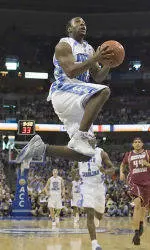
Lucas: Made Baskets Just Another Running Opportunity
March 22, 2007 | Men's Basketball
March 22, 2007
By Adam Lucas
The easy way to create the tempo Roy Williams wants is to grab the ball after a missed basket, beat the defense down the court, and get an easy hoop on the other end.
That's the easy way. But it's not what separates Carolina from some of the other uptempo teams, and it's not what led the Tar Heels to average a scorching 86.1 points per game--second-best in the country and over five points per game higher than any team left in the NCAA Tournament field.
Any team can run after a missed shot. It's the squads that run after their opponent makes a basket that really turn up the tempo.
"Coach wants us to sprint," Wayne Ellington says. "There's a difference between running and sprinting. We're not supposed to just run up the floor. We're supposed to sprint.
"When you score and the other team is right up your back, that's tough to deal with. It's hard to make the transition from offense to defense that quickly. That puts more pressure on teams."
Even tempo-conscious teams like second-round opponent Michigan State are susceptible to the Tar Heel sneak attack. On eight different occasions last Saturday, Carolina either got a shot or a free throw within a dozen seconds after a Spartan basket. MSU made just 22 field goals, meaning the Tar Heels turned it around on over a third of their opportunities. Twelve seconds might sound like a lot, but all of them came when the clock was running after made baskets, draining at least a couple of seconds before Carolina was able to initiate the offense. The eight quick-change instances led to 10 Tar Heel points; they won the game by 14.
Lately, Ty Lawson has developed a knack for stopping opponents' momentum with a well-timed dash to the basket. It happened multiple times against the Spartans. First, Drew Neitzel hit a 3-pointer to cut the Carolina lead to 41-38 early in the second half. No problem--Lawson just zipped down the court and made a layup. When MSU took a 46-45 lead later in the half, the freshman point guard made a similar play, taking the inbounds pass and going straight to the basket, eventually drawing a foul and making one of his two free throws. Five minutes later, after the Spartans had taken a 3-point lead on another Neitzel 3-pointer, it was Lawson again bee-lining for the hoop, again drawing a foul, and this time making both his free throws.
Lawson isn't just a precocious rookie with SpongeBob socks. He's a one-man momentum stopper.
"It's really demoralizing for the other team," Lawson says. "They work hard to get a 3-pointer. Then I come down and get into the lane to score or kick out for an open 3-pointer, and we've scored in four or five seconds. That's tough to handle, because we keep coming right back at them."
This is the part where misguided observers deem Carolina simply a helter-skelter team. That's oversimplifying it. Roy Williams is consistent about demanding a fast tempo from his team--but a fast tempo, as he always says, that's under control. Despite trying to coax Michigan State into a speedier game, the Tar Heels turned the ball over just 10 times.
Made baskets are supposed to provide a better defensive opportunity; the scoring squad gets the chance to set their defense. But Carolina's success in the latter part of the season and especially in the second round calls to mind a similar rate of success in 2005.
"I told our team that Michigan State is as hard to run on as anyone, because you don't get as many good rebounds," Williams says. "They're crowding you and they try to slow your outlet pass and they're sprinting back. But if you run every time, you're going to get some good ones. In the national semifinals (in 2005) we kept running every time and all of a sudden Sean May got a dunk after they scored. That's our biggest guy running right down the middle of the court and getting a pitch ahead from one of our guards. Getting guys to do that consistently is the most difficult part."
Especially big guys. Finding guards and wings who want to run isn't a challenge. Finding big men willing to sprint the full 94 feet on every possession--like Brandan Wright and Tyler Hansbrough--can be more difficult.
"You have to have big guys who can run," says Bobby Frasor. "If your wings can stretch the court, the middle is open. If you don't have the big guy running down there, you're just throwing the ball around the perimeter."
The best defense against Carolina's rapid-fire offense? Some teams have discovered that batting the ball as it comes through the net on a made hoop can be effective. Boston College, in particular, perfected the tactic. The first instance is supposed to be a warning and the second a technical foul, but if it's done subtly enough, it can usually last all game.
"Teams love to hit the ball when they score," says Wright, who often has the task of inbounding the ball. "That helps them know they don't have to get back on defense as fast as they should. The way to stop that is to get the ball out of the net quickly. You can't wait around for it."
It hasn't yet made it into Carolina's thought for the day rotation, but Abraham Lincoln summed it up perfectly: "Things may come to those who wait, but only the things left by those who hustle."
Over 100 years later, the next great dissertation on Tar Heel basketball strategy came from a man only slightly less accomplished than Lincoln--Jackie Manuel.
"A lot of teams say they want to run with us," Manuel said in the wake of the 2005 title. "But then they get out there and realize we want to run every time. And they can't handle that."
Adam Lucas's third book on Carolina basketball, The Best Game Ever, chronicles the 1957 national championship season and is available now. His previous books include Going Home Again, focusing on Roy Williams's return to Carolina, and Led By Their Dreams, a collaboration with Steve Kirschner and Matt Bowers on the 2005 championship team.