University of North Carolina Athletics
Lucas: One More Shot
July 20, 2007 | Men's Basketball
July 20, 2007
Tar Heel Monthly is the premier magazine devoted to the stories and personalities behind UNC athletics and is one of the only full-color, all-glossy college sports publications in the country. Click here for subscription details.
The following story originally ran in the June 2007 issue of the magazine.
By Adam Lucas
Nearly two months later, Wayne Ellington still can't believe it.
"It felt good when it left my hand," he says, and you know exactly what he's talking about.
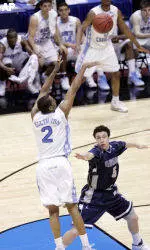
On March 25, Ellington had the Final Four on his fingertips in the Meadowlands. Carolina had frittered away an 11-point second-half lead, but they still had the ball, a tie game, and 24 seconds to score. Knock in a quick basket, and no one would remember the clunky final 10 minutes of the second half.
The play that was called in the Carolina huddle has been oversimplified as being designed to get Ellington a jumper. Anyone who knows Roy Williams knows he wouldn't hang a Final Four appearance on a jump shot, no matter how much he trusts the freshman who ended up with the ball in his hands. No, Williams would prefer to work the ball closer to the basket, which is why the Tar Heels ran "Go," a favorite late-clock set that features the point guard penetrating, looking inside, and then--and only then--if nothing is available, finding the open man.
Against Georgetown, that man was Ellington. It was a familiar position for the Philadelphia native. All his life he's been the player who wants the big shot. As a high school senior, he made a 17-foot game-winner against Neumann-Goretti in a game that was nationally televised on ESPN2.
But this time, failure. On a national stage, with his parents and all his friends and even Billy Packer watching.
It's likely to be lost in Tar Heel history that Carolina still had a five-minute overtime to win the game. What the players know, and what Ellington knows, is that it should have been closed out in regulation.
Even now, he shakes his head when he thinks about that shot. "It's as low as I've felt on a basketball court," he says.
He tried to stay out of the gym for a week after the loss, but he couldn't help himself. He had to grab a basketball, had to head down to the Smith Center, had to fire up a few jumpers. Over the month of March, he'd made just 33.3% of his 3-pointers, down from his season-long percentage of nearly 40 percent. He never made more than two trifectas in any March game, and for the second straight year a paucity of perimeter production proved to be Carolina's NCAA Tournament undoing.
He does not carry himself with the same swagger of some of Carolina's past three-point marksmen--doesn't have the growl of Rashad McCants or the burn of Shammond Williams--so it was fair to wonder: how would he handle this?
Those late March afternoons alone in the Smith Center provided the answer. He still had it. He still had that same elegance on the court, the same form that allowed him to drop through five 3-pointers in a single game back in December.
It was then that he resolved to make some changes that would prevent a similar ending in 2008.
"I have to work really hard with Jonas (Sahratian, Carolina's strength coach)," Ellington said. "I want to add some weight. One thing that surprised me about the college game is that it's such a long season. Your body really wears down so I need to be stronger."
He arrived on campus as half of a much-touted Carolina/Duke tandem with high school teammate Gerald Henderson. They were best friends at The Episcopal Academy and remained tight throughout their freshman seasons, posing for national magazine photo shoots and laughing about how they'd always be buddies despite the torn allegiances. The fox and the hound, college basketball-style.
Wait a minute. That Gerald Henderson? The one who bloodied Tyler Hansbrough's nose?
Ellington's easy grin narrows as soon as the subject is broached. In the history of the Carolina-Duke rivalry, most everything has happened at least once. But this is new. This is a best friend, someone Ellington has known for years, popping a teammate in the closing seconds.
At first, Ellington didn't realize it was Henderson that made the play. He simply saw a nondescript Blue Devil. But when he realized exactly who was being escorted off the Smith Center floor...
"Oh man," he says. "I don't think I really understood the rivalry until that happened. Some of the things people were saying about Gerald...I know that's not him. I called him that same night, just to make sure he was OK. And he called me later to get Tyler's number so he could apologize to him."
He will be asked about it frequently when the two teams meet again next season. Right now, though, he doesn't have time to worry about it. Right now his Sidekick is bleating with this message, a quote from Michael Jordan delivered courtesy of a friend:
"I've missed more than 9,000 shots in my career. I've lost almost 300 games. 26 times, I've been trusted to take the game-winning shot and missed. I've failed over and over and over again in my life. And that is why I succeed."
Ellington smiles when he recites the quote from the fellow Tar Heel. Later that afternoon, he's playing a pickup game on the floor of the Smith Center. Alum Melvin Scott is on the opposing team, first team to nine baskets wins. Ellington's squad blows an 8-4 lead and the game is tied at eight.
"You're getting tight," Scott tells the freshman.
"Naw," Ellington jaws back as he comes around a screen. He catches the ball, elevates, and releases. "That's game," he says as the ball leaves his fingertips.
And he's right, because the ball whispers through the net cleanly.
Ellington doesn't say anything else. He doesn't have to. He just smiles.
Adam Lucas most recently collaborated on a behind-the-scenes look at Carolina Basketball with Wes Miller. The Road To Blue Heaven will be released on September 1. Lucas's other books on Carolina basketball include The Best Game Ever, which chronicles the 1957 national championship season, Going Home Again, which focuses on Roy Williams's return to Carolina, and Led By Their Dreams, a collaboration with Steve Kirschner and Matt Bowers on the 2005 championship team.