University of North Carolina Athletics
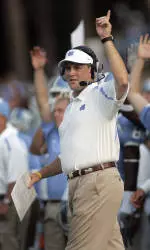
Extra Points Mailbag
September 28, 2007 | Football
Sept. 28, 2007
by Lee Pace, Extra Points
A lot has changed in college football in the seven years Butch Davis and Chuck Pagano have been coaching in the NFL. But they were reminded this week of one thing that hasn't changed: Virginia Tech is solid across the board and represents the very definition of a program.
"When your kids are truly committed, they're in the boat and drinking the Kool-Aid, they're growing up and maturing and buying into the program, that's when things start to happen," Davis said this week about his Tar Heels, who are 1-3 and face a stiff challenge Saturday in Blacksburg.
He went on to mention that the standard set by Hokie coach Frank Beamer as early as 1995 was a model for what Davis himself tried to accomplish at the University of Miami when he was head coach in Coral Gables from 1995-2000.
"They have great athletes who play two or three years, then they have another guy equally as good they plug in behind him," Davis says. "The program feeds off itself."
Pagano coached on Davis's staff at Miami and is now the Tar Heels' defensive coordinator.
"I started looking at Tech Sunday night, and it's like we never left Miami," he says.
Offensive coordinator John Shoop is in his first year in college coaching after a decade in the NFL, and he watched plenty of Virginia Tech defensive tape this week--games from this year as well as from when the Hokies played Miami in Davis's last couple of years there.
"They are not exactly identical, but the theme of the defense is still the same," Shoop says. "They have been doing the same techniques, running the same scheme for many years. They know how to recruit the right people for their program."
Davis played Tech six times during his career at Miami and lost the first five games. The Hurricanes started under Davis with severe scholarship restrictions, but by the late 1990s they were up to 85 scholarships and Tech's talent edge had evened out.
Tech won by six in Blacksburg in 1995, by two touchdowns in Miami in 1996, by two points in Blacksburg in 1997 and by one touchdown in overtime in 1998 in Miami. The Hurricanes led at halftime in Blacksburg in 1999, but Tech ripped off three scores in the blink of an eye in the third quarter take control of the game.
"That's what they could do to you then and can still do you," Pagano. "They return an interception. They block a punt. They get on a roll and the crowd gets going. It's a tough place to play. That game was a fistfight. It was a war. Then you blink and they were 20 points ahead."
The 1999 season was also Tech's 11-0 regular season, which earned the Hokies a shot at the national championship; they played Florida State in the Sugar Bowl and lost, 46-29). The next year, the Hurricanes were headed to a 10-1 regular season and a victory over Florida in the Sugar Bowl. That year they whipped the Hokies, 41-21.
Why did coach Davis not put Mike Paulus for the last few series at quarterback in the South Florida game? I thought that coach Davis said he would put Paulus in for a few series. Did he not put Paulus in because he intends to red-shirt him? I would have loved to see Paulus in for the last series to throw a few and see how he plays while watching Ryan Houston drive the ball down the field.
Will Smith, Raleigh
That question is similar to several that came into the Mailbag this week. Others wanted to know why Davis didn't substitute Cam Sexton into the game when starter T.J. Yates was struggling.
There are a couple of issues here. One, I am not aware of Davis ever saying for certain that Paulus, the true freshman from Syracuse, N.Y., would play this year. To my knowledge, no decision has been made on whether he would redshirt or play. A lot of that depends on the needs of the position. Despite a poor showing Saturday in Carolina's 37-10 loss to the Bulls, Yates has shown enormous potential, has played well for the most part and is in solid command of the position. If Yates continues to play well and remains healthy, odds are certainly that Paulus would redshirt.
Davis was asked at his weekly news conference about whether he thought of making a change during the game, and he was quick to say he had not.
"T.J. is our quarterback, and there is no reason to think about making a change at this point," Davis said. "I wanted to see him fight through adversity and see how he battles and processes what's going on around him."
Though it was difficult to tell, the Tar Heels played better on both sides of the ball during the second half, and the coaches no doubt hoped Yates and the players around him would settle down, improve in the second half and not carry as vile a taste with them into the new week.
Yates made some decisions and throws he would like to have back, but the problems were not all his. I have learned over the last decade with the advent of the Internet and email that the single least-important issue in football to the average fan is a tailback's ability to block in pass protection. It is a non-issue to 99 percent of fans. To them, a tailback is judged by how well they run the football.
But as defenses often blitz with six rushers or more and an offense never knows which combination of linebackers and safeties (or even corners in some cases) are coming after the quarterback, a tailback or fullback in pass protection is a key element of a good passing game.
On the Tar Heels' first third-down situation Saturday, receiver Brooks Foster was wide open over the middle, and a 43-yard scoring pass was there for the taking. Only problem was, a Tar Heel back missed the block on Bulls defensive end George Selvie, and Yates was sacked for a seven-yard loss. There were three more solid gains to be had in the passing game throughout the day, but a back either missing his assignment or not executing the block led to a sack or a throw-away by Yates.
The good news here is that everyone we're talking about so far is a freshman. They will get better.
Meanwhile, Yates absolutely feels the need to bounce back successfully on Saturday.
"That was one of the worst games I've ever played," Yates says. "I know I am better than that. I definitely have something to prove.
"I have to be more patient. I got a little flustered. Things were moving really fast. I need to slow it down in my mind. I've just got remember my check-downs and not think to scramble right away."
I read your column regularly, but I must take issue with your omission of mentioning problems on the defensive line. I have watched in person or listened by radio to every game so far. Sure there are problems with a young secondary and linebackers, but what about the defensive line? This was supposed to be a strength of the team. For once, I thought the Heels might have success stopping or at least slowing down the run. Nothing could be further from the truth .... I will back Butch for years to come, but let's admit the truth!
Hoke Currie, Farmville, Va.
There's no question after a 428-yard offensive output by the opposition that everyone on defense is fair game for some criticism. I suppose that I have been more lenient on the line because there is a good blend of established talent and a core of remarkable freshmen--Marvin Austin, Aleric Mullins and Darrius Massenburg. Senior end Hilee Taylor has played very well the last two games and has made two sacks and strips of the football. No one else on defense has made two plays of that magnitude.

Linebackers are so important because they have to stop the run and defend the pass. Senior Durell Mapp has been the one steady player at linebacker, a position where the Tar Heels need a major infusion of talent. True freshmen Bruce Carter and Quan Sturdivant will play more at the strongside linebacker slot as the year develops. The emergence of Deunta Williams at free safety has been noteworthy as well, but fellow newcomers Kendric Williams and Kendric Burney at cornerback are still feeling their way around.
It appears that almost all of our runs are between the tackles and rarely do we have a pitch play that is designed to go outside, potentially following some pulling guard or tackle. I watched several games this weekend where the tailback broke big plays on fairly simple toss sweeps. Do we not have the speed backs to get outside or do we feel our O-line strength is to run between the tackles or maybe the speed of our opponents to date have negated our ability to get outside? I remember the days of guys like Ron Wooten plowing the way for Famous Amos on sweeps and it appears we are wed to running almost exclusively between the tackles today.
Keitt King, UNC 1990, Atlanta
Rest assured that the Tar Heel offense under Shoop and offensive line coach Sam Pittman will make every effort to run the ball on the edges. One of the differences in the blocking scheme Pittman has instituted this year is that all five players along the offensive line pull to lead the way on running plays. In the James Madison game, for instance, center Scott Lenahan pulled to lead a sweep, hit a linebacker and knocked him airborne. On another sweep against East Carolina, Lenahan took delight in plowing under a smaller cornerback.
"We love to get on the edges and block," says Lenahan. "We're always looking for the `big hit.' Before the game we challenge ourselves on who's going to get the `big hit' and the most knockdowns."
Against Virginia, running to the outside was an important part of the offensive game plan.
"Virginia's defense is high energy, those guys are athletic and they really pursue the ball," Shoop said before the game. "They have four linebackers, so they have a lot of athletic guys. We want to get them running sideways and try to break some arm tackles. They're going to be running hard east to west and we're going to cut north to south. It's hard to tackle someone running sideways. That's exactly what Larry Johnson of the Kansas City Chiefs has done so well--running outside and then, whoosh, he cuts it up."
It will always be a factor of where Shoop perceives the soft spots in an opposing defense. If he sees them on the corners, that's where the Tar Heels will attack.
Several fans commented on my piece following the South Florida game that led with Carolina's penchant to catch former mid-major programs just as their stars are reaching an apex in the development of their programs. Louisville and Utah were average at best when the Tar Heels scheduled home-and-home series with them years ago. Both programs were outstanding during the years they faced Carolina; each have now lost the architects of those teams (Bobby Petrino of Louisville and Urban Meyer of Utah) and their records have slumped. The last two years, Carolina has caught Rutgers and South Florida just as they have climbed into the national rankings.
John Chiulli reminded me that Carolina faced Miami of Ohio and QB Ben Roehlisberger in a home loss in 2002, and Reggie Harrison points out that Carolina caught Notre Dame with senior QB Brady Quinn in 2006--instead of the 0-4 team the Irish are fielding this year. Good points both.
These are not meant to be excuses. Carolina's decade long run of football mediocrity goes far beyond scheduling. But there is no question that over-aggressive scheduling (a direct response to under-aggressive scheduling from the early 1990s) has come back to bite the Tar Heels in the rear end as they have tried to establish some consistency. And there's been a fair amount of this bad luck as well. It's nothing more, nothing less--just another interesting element to the mix.
Chapel Hill writer Lee Pace is in his 18th season writing "Extra Points," a colorful and in-depth look at Tar Heel football. He'll answer your questions about the Tar Heels regularly during the season in his "Extra Points Mailbag" column and on the Tar Heel Sports Network's pregame show. Email him your questions (please, no recruiting questions) about the Tar Heels at leepace@nc.rr.com and he'll answer the most interesting ones.