University of North Carolina Athletics

Lucas: UNC Baseball Mailbag
May 30, 2008 | Baseball, Featured Writers, Adam Lucas
May 30, 2008
By Adam Lucas
Thanks for all the great questions this week for the year's first (and hopefully not last) edition of the Baseball Mailbag. There's not enough space in this column to answer all of this week's questions, but hopefully we'll have cause for another edition next week. If that's the case, go ahead and get your questions in now. Of course, that same address will also enable you to send an email to the radio booth tonight, where Jones Angell and I will eagerly await them. We'll be on the air at 6 p.m. and look forward to hearing from you, whether you're listening online here at TarHeelBlue.com or over the radio via 850 in Raleigh, 1360 in Chapel Hill, or 1150 in Burlington. Now, on to the questions...
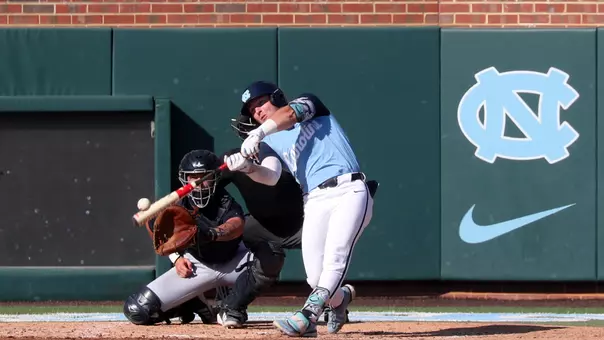
I'm 11 years old and am a huge Tar Heel fan. Earlier this year, I noticed Dustin Ackley and Seth Williams hitting with the new Nike composite bat and I told my Mom that I had to have one. I have since noticed that they aren't using it any more and have gone back to the aluminum bat. Any reason why?
Rick Tant
Wendell, NC
Because baseball players are weird, Rick. It's by far the most superstitious sport around. How else can you explain the fact that one Tar Heel carries a rib in his pocket (Colin Bates) and another carries dirt from Yankee Stadium in his pocket (Tim Fedroff)? My theory is that the fact that baseball is a game of failure--the best hitters fail well over half the time--breeds superstition among the players.
We posed your question to two-time defending ACC Equipment Manager of the Year Nate Yarbrough, who responded, "The only time they really want to switch bats is when they are in a slump and need something new or another color to help them get out of it." Yes, that's right, if you're 0-for-4 you can get out of it by simply using a different color bat.
Right now, the Tar Heels do seem to favor the aluminum bats. That's partly because that's what they grew up using and partly because the offense is going well right now, so there's no reason to change. Does that mean we've seen the last of the white composite bats? Absolutely not. In addition to being very superstitious, baseball players also tend to be fickle. So keep your eyes open for more bat shenanigans.
By the way, we should mention that Fedroff actually uses a very rare bat that's been signed by Yarbrough. Don't look for it on eBay anytime soon. Nate, as you probably remember, is the man in charge of Carolina's endless uniform choices. For more on that topic, check out this story from last postseason. The biggest uniform change for this year is the addition of white spikes to the Tar Heel uniform palette. Expect the whites to make an appearance at some point this weekend, as most of the players are very fond of them.
While watching the ACC Championships in Jacksonville last week, I noticed that during the two games they lost the Tar Heels did not appear to be as good at fundamentals as their opponents. Will Coach Fox and the Tar Heels make improving on fundamentals a priority this week as they prepare for NCAA play?
Tim Wright
Jacksonville, FL
This reminds me of the questions we get during basketball season about free throw shooting. The Tar Heels can make 500 consecutive free throws in games, but let a player miss one in the closing moments of a close game and suddenly the Mailbag fills with, "Doesn't Roy ever tell his team to practice free throws?" questions.
Can we agree that the basic baseball fundamentals are fielding, throwing strikes, baserunning, and putting the ball in play on offense (I understand that offense is more nuanced than that, but I don't have any stats handy to measure things like moving runners over by hitting the ball to the right side)? Good, then let's take them one by one.
I'm guessing that this question was spawned by the fact that Carolina committed five errors in three games in Jacksonville, and four of those five led directly to runs by the opposition. The Tar Heels are now 9-8 when committing two or more errors and 21-1 when playing errorless baseball. Carolina ranks fourth in the ACC in fielding percentage at .970, ahead of fellow league teams in the NCAA Tournament Virginia, NC State, and Florida State. Miami (.975) is the best of the ACC teams still left in the field.
As you probably know by now, Tar Heel pitchers set a new school record every time they strike out another hitter in 2008. Carolina hurlers have punched out a nation's best 599 batters so far this year. The flip side is that UNC pitchers have also issued 249 walks this season--only Wake Forest at 284 has given more free passes. Bases on balls have been a problem in Carolina's last three losses. What's more maddening is that it's often been walks to hitters at the bottom of the opposing order that have been most costly. Virginia's 11th-inning scoring in the ACC Tournament was started by a walk to eighth-place batter John Barr, and Florida State's six-run explosion in the ninth began with a one-out walk to .240-hitting ninth-place batter Parker Brunelle. Especially in Cary, where home runs will be at a premium and teams will be scrapping to score, walks will be important.
There's not a great way to quantify baserunning, because stolen bases aren't necessarily the best metric. For the record, though, the Tar Heels have 63 steals in 58 games. Carolina starters have been picked off a respectable ten times this year (just to compare, UNC pitchers--who as a staff are generally above-average at holding runners--have picked off 13 runners).
Offensively is where Carolina's fundamentally solid play has escaped some notice. The Tar Heels have struck out just 316 times this season, fewer than anyone in the conference during the regular season (Duke has 299 strikeouts but didn't play in the ACC Tournament). Carolina also ranks third in the league in on-base percentage. As noted earlier this week, this isn't much of a bunting team, but there are hitters throughout the order who are capable of getting the ball on the ground when needed--and it's a safe bet it'll be needed at some point this weekend.
During the ACC tournament Carolina lost to UVA but if UVA would've lost to Wake Forest Saturday night then UNC and UVA would both have been 2-1(If of course Carolina could've beat FSU but let's say they did) but UNC would not have been in the championship even though UNC would've had the head-to-head on Wake. Why is that and how does the round robin work exactly?
Jordan Falls
The ACC Tournament round-robin is complicated. In Jordan's scenario, Carolina would've been 2-1, Virginia would have been 2-1, Wake Forest would have been 1-2, and Florida State would have been 1-2. In that situation, Virginia would have advanced to Sunday's championship game by virtue of their head-to-head win over the Tar Heels.
There's no guarantee that the format will continue for next year's event, which will be held at Boston's Fenway Park. Coaches seem to have mixed feelings about the current situation. There are two big decisions to be made about the ACC Tournament: which format to use and where to hold it. No tournament sites beyond Boston in 2009 have been announced yet. The format question is trickier. The problem is that there's no great way to have a tournament with 12 teams without going full double-elimination, which was ditched because it forced teams to burn out their pitching before the NCAA Tournament. Another idea sure to be suggested by the coaches is the elimination of the ACC Tournament to allow for an extra weekend in the regular season. That would prevent teams from being forced to play five games every week, a compact schedule that existed this year because of the NCAA's new mandatory start date.
My question has to do with all sports, but baseball brought it to mind. Question: How many scholarship players does the NCAA allow for our baseball, basketball, and football teams?
Jeff Lewis
Fairmont, NC
Football gets 85 scholarships, men's basketball gets 13 (women's basketball gets 15), and baseball gets 11.7. As with anything related to scholarships, Title IX plays a big role in determining which sports receive how many scholarships. Many fans don't realize that no one on the Tar Heel baseball roster is on a full scholarship. Instead, head coach Mike Fox and the coaching staff must go through a complex mathematical balancing act to figure out how to divide their scholarship dollars.
There are big changes on the way this summer for college baseball. In its infinite wisdom, the NCAA has capped rosters at 35, with no more than 30 on financial aid. Each player on aid must receive at least 25 percent of a scholarship. Coaches nationwide despise the new rules, which could result in dramatic changes to the college baseball landscape. A pitcher like Robert Woodard, who came to Carolina for very little scholarship money, would now probably go elsewhere to receive at least 25 percent.
Adam Lucas is the publisher of Tar Heel Monthly. He is also the author or co-author of four books on Carolina basketball.