University of North Carolina Athletics
Extra Points: Something New Around The Tar Heels
August 17, 2008 | Football, Featured Writers, Lee Pace
Aug. 17, 2008
By Lee Pace, Extra Points
When we last saw the Tar Heels, Greg Little was at the bottom of a scrum in the east end zone of Kenan Stadium, the field was covered in firewords-induced haze and the clang of the Victory Bell was resonating through the chilly November night. Duke was off to fire one coach and hire another in the wake of its 20-14 overtime loss to Carolina, while the Heels were related to celebrate for one night and then turn their attentions squarely toward Aug. 30, 2008--the first game of the next season.
"The mood will be a thousand percent better in the building on Monday," Butch Davis said in the glow of the win. "It was pandemonium in the locker room. It's the springboard that helps you get into recruiting and get into the off-season."
So much has happened over the last eight months. From that springboard has evolved a multitude of changes and improvements around Tar Heel football that hopefully will result in a stark improvement over last season's four-win total and the loss of six games by seven points or less.
The Tar Heels have better brains and better bodies. Many have been moved to new spots on the chess board. The infrastructure around them has been honed in accordance with Davis's master plan and his attention to the most minute detail of the program. And the Heels are getting a little love from the college football world around them, evoking a modicum of confidence that can never be underestimated.
You walk into the Kenan Football Center through the field-side tunnel and one of the first things you notice is a replica road sign in highway department green reading, "The Road To Tampa Bay / Only 680 Miles To Go."
Here's some of what's new around the Tar Heels to help in their quest to win the ACC Coastal Division title and land in the league title game Dec. 6 in Raymond James Stadium:
New Brains
On any given day a Tar Heel offensive player might watch a cut-up reel of a particular pass route or throw or run that is being installed or identified for special emphasis by the coaches.
Here's Hakeem Nicks running a drive route;
Brandon Tate running a drive route;
Brooks Foster running a drive route;
And here's Jerry Rice running that very same drive route.
Here's Greg Little running the power play;
Ryan Houston running the power play;
Jamal Womble running the power play;
And here's LaDainian Tomlinson running the power play.
"We have an incredible library of film," says offensive coordinator John Shoop. "Coach Davis has spent a lot of time in the NFL. I've got stuff from Jon Gruden and Norv Turner. We've got Peyton Manning and Tom Brady. That's how we teach. The other day we were installing a route and put together a series of Jerry Rice, Sterling Sharpe, Tim Brown and Antonio Freeman running the very same route.
"We say, `Hey guys, these are the guys that invented these routes. This is how you do it.' I think we do a good job stimulating our players. A picture's worth a thousand words. They like that."
As the Tar Heels have matured from that 2007 team that played 28 true or red-shirt freshmen, they have learned to take advantage of the technical resources in Kenan Football Center and how to use tape study to improve their awareness and decision-making skills on the field. At times the Tar Heels displayed "a blind dog in the meat-house mentality," as Davis says, particularly on special teams. Frequently they were thinking too much, particularly first-year players on defense, which led to missed assignments altogether or slow reaction times. In some instances quarterback T.J. Yates knew enough to get the offense out of a bad play at the line of scrimmage and avoid a blow-up snap; but he wasn't savvy enough to counter into a home-run play. There's a major difference.
"One of our top goals during the off-season was to become a smarter football team," Davis says. "I have no doubt we've done that."
Yates on offense and safety Deunta Williams on defense are among the chief film wonks on the team. Williams is in the building every morning at 6 a.m. watching tape, and Davis notes that Yates has become "an absolute film junkie." But it's something that a significant percentage of players have learned to add to their arsenal of improving their skills.
"Watching film makes me a better player--period," says Williams. "I love doing it. I watch film so much and I study the quarterback so much I understand where he's going. I had pre-game nerves a lot at the beginning of last year. But the more I played and the more I studied film, the more confident I became in what I was doing."
Yates could bait Williams into false steps a year ago by looking away from his intended receiver. But no more.
"He's gotten a lot smarter," Yates says. "We help each other from each side of the ball. We're trying to disguise the play and they're trying to disguise the coverage. I can help him with some of the little things we're doing to catch them off guard."
Both players were red-shirt freshmen a year ago and spent a considerable part of the year learning their respective playbooks and sides of the ball. In 2008, they can devote more attention to the opponent and understand better what they are seeing.
"It's exciting how much smarter football players we can be this year," Yates says.
New Bodies
Say fried chicken to Cam Thomas, and he rolls his eyes back in his head.

"Aw, man," he says.
Torture him a little more: Ribs, cornbread.
"Aw, mannnnnnnnnnnnn," he moans.
"I'm from the South," the affable defensive tackle says. "I love country cooking--fat back and fried food. When I'd go home, all my mom would do is cook and fill the table. She's a great cook, and she works at the Perdue plant. So she's strong with chicken."
Over the last year, however, Thomas has developed his knowledge base of how to eat to become a better player and, more importantly, has become committed toward using that knowledge. He has lost 15 pounds from his 2007 playing weight and more than 30 from his 2005 arrival weight. He's significantly more nimble and durable at 315 pounds and is slated as the starter at noseguard.
"I took it seriously this year," he says. "I didn't take it as seriously as I should have the last couple of years. I'd go crazy at McDonalds--give me three double cheeseburgers, something like that. I knew what I was putting in my body, but it tasted good. But if I want to be a good football player, I've got to make better choices. The weight loss has made a difference--especially in the pass rush. I'm quicker and I can go longer and harder, too."
A host of Tar Heels have made noticeable body improvements over eight months--some have gained muscle and size, others have trimmed down. Working with strength and conditioning coach Jeff Connors and nutrition director Jen Ketterly, each player has had a program specific to his needs.
"Some places take 85 football players and say, `Do this,' and everyone goes and runs five miles," tight end Zack Pianalto says. "Here they do a great job of tweaking the program to each player's needs. I didn't run as much because they didn't want me burning as many calories. I lifted twice a day sometimes to gain weight. Other guys were running a lot because they needed to lose."
Following Thomas's lead in the weight loss category, fullback Bobby Rome has lost 20 pounds and gone from a 42-inch waist to 38. Tailback Ryan Houston has dropped 33 pounds from 273 to 240 and has shed six inches off his waist. Offensive guard Kevin Bryant has dropped some 60 pounds--from around 400 to 345.
Pianalto is among the players needing an opposite tack--he need to put on more weight. He's now at 250 pounds after arriving in Chapel Hill 18 months ago at 215 and playing last fall at 225. Vince Jacobs has gained 20 pounds. A number of young offensive linemen who needed size and strength have made considerable gains.
"I laugh thinking about last year," Pianalto says. "I was 225 pounds trying to block a 265-pound defensive end. It was tough. I got overpowered a lot. Now I know the defense better and I've learned how to use my feet and hands. I know what to do and can take the right step. And once I get there, I'm not getting blown back. I have some weight to stay in position, and I finish with leg strength."
New Squares
Davis stressed on the first day of practice in August that a major priority was to find a place for every player to contribute.
"Every single kid can find a role if he gives great effort, knows what to do and can be trusted," Davis says. "Not every kid can be a starter. But there is a niche for kids to feel they are significant contributors on game day."
Much of that process continues less than two weeks before kickoff against McNeese State--particularly in determining if freshmen defensive ends like Michael McAdoo, Quentin Coples and Robert Quinn have a place on the two-deep and if linebackers like Zach Brown, Dion Guy and Ebele Okakpu figure on special teams.
More than a half-dozen position changes were contemplated or actually executed back in the spring, and those movements around the game board are cementing through training camp.
Aaron Stahl is now the center after moving from left guard. Cooter Arnold is a back-up receiver after one year at tailback and two at safety. Ryan Taylor has moved from tight end to linebacker and is a key special-teams contributor. Johnny White jumped from tailback to cornerback in the spring, following the mid-season move of Richie Rich. Vince Jacobs is a defensive end after two years at tight end. Quarterback B.J. Phillips is a tight end. Junior college transfer Melvin Williams played both cornerback and safety in the spring and has settled at safety.
And most recently, safety Shaun Draughn has bounded to offense and is getting a tryout at backup tailback behind receiver-turned-runner Greg Little.
"You can get a lot of measurements--height, weight, 40 times--but one thing you cannot measure that separates all running backs is vision," Davis says. "Some kids have it, some don't. A kid can have 4.3 speed and the hole is supposed to be blocked here, but it actually develops one gap wider. The Emmitt Smiths and Barry Sanders just see that, hit the new hole and have eight yards. Other guys don't get back to the line of scrimmage. Shawn has that."
Taylor was a backup tight end on offense and a mainstay on special teams a year ago, and Davis said in the spring that his best shot of making an NFL roster would be as a core special teams player. That end would be easier achieved--and the Tar Heels helped in the process--if Taylor moved to linebacker and honed his tackling and coverage skills.
"A lot of the things we ask him to do on special teams have a defensive nature," Davis says. "All of the drills that he does--the open-field tackling, all the change of direction in space--those are things that relate to playing linebacker."
Taylor is a second-team strongside linebacker and says his primary goal is to earn a starting job before he leaves.
"But I think playing defense and learning to play linebacker can help me from the special teams aspect," he says. "I'm learning to play in space and break on the ball, to stay under control and make a tackle. Those things will help tremendously on punt and kick-off coverage."
Arnold started his first career game at tailback at Georgia Tech in 2005 but could never develop any momentum at the position and subsequently moved to safety. He asked after last fall to move back to offense, originally hoping to get another try at tailback. During spring practice he was posted at receiver on the offensive scout team and drew some notice with his speed and catching skills.
"Every day I feel more and more comfortable," he says. "It's fun to be out there making plays, and I always liked the offensive side of the ball. I feel like I've found a home. I just want to do anything I can to help us win the ACC championship."
That the Tar Heels have their sights set on the league title is yet another twist on the coming year. That is a requisite goal each year, but often over the last decade it's seemed like a pipe dream with Carolina having too many issues to overcome to usurp the traditional league hierarchy. The Heels are far from a finished product in Davis's second season, but the fact Davis has recruited well for two years and done an excellent job meticulously framing the infrastructure bodes well for the future.
Given that the two Virginia schools in the ACC Coastal Division are facing significant personnel issues; that Miami is attempting to rebound from a nasty 2007; and that Georgia Tech is an unknown under first-year coach Paul Johnson, it's not surprising Carolina has been tapped preseason No. 2 in its division.
"Every year I've been here except this year, people have picked us second-to-last or dead last in the ACC," senior linebacker Mark Paschal says. "This year it's nice to see people excited about what we're doing here and what we're starting to put together. Over time, it's great what the media think about us and write about us, but it all boils down to what we put on the field, what we put on tape."
So when you settle into your seat in Kenan Stadium next Saturday, consider all the work put into the finished product since Greg Little bounded in from 20 yards out to close the 2007 season.
"The long, grueling hours of timeless effort and sweat that that goes in before the start of the season is what people don't get to see," Davis says. "It's easy to show up on Saturdays with 65,000 people in the stands and the blimp in the air and the TV cameras. It's the guys that pay the price during April, May, June, July that run in 95-degree heat and the only person driving them is themselves and their teammates."
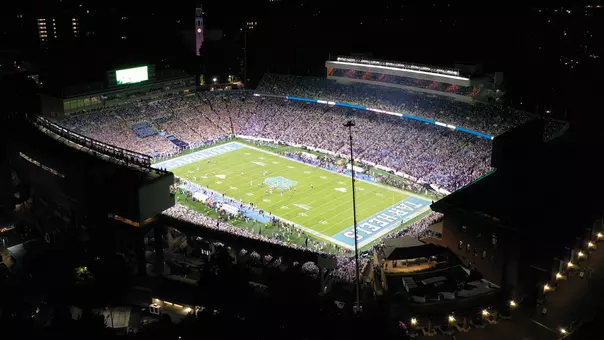
And as you take your seat in this 1927 campus heirloom, look around and realize after this season the structure will never look quite the same again. In December a multi-phase, multi-year expansion and enhancement project begins. But that's another chapter in the always evolving story of Tar Heel football.
Chapel Hill writer Lee Pace has written Extra Points, a lively and informative view of Tar Heel football, since 1990. Email him your questions about the Tar Heels at leepace@nc.rr.com and he'll answer the most interesting ones in his Tar Heel Mailbag column and on the pre-game show of the Tar Heel Sports Network.
Players Mentioned