University of North Carolina Athletics
Lucas: Ill Intentions
February 12, 2011 | Men's Basketball, Featured Writers, Adam Lucas
Feb. 12, 2011
By Adam Lucas
CLEMSON, S.C.--There was a time when we didn't know Harrison Barnes well enough to know what was going to happen next. With 3:20 left at Clemson, Roy Williams had called a (very timely) timeout with the game tied at 51.
He substituted Leslie McDonald for offense and diagrammed a play that had multiple options. One was the ball going inside to John Henson. Another was Tyler Zeller setting a screen for Barnes.
The latter happened, and Barnes received the ball at the top of the key. This is the point where we knew what would happen. The freshman creates some space with a dribble and perhaps a crossover, elevates, and fires a jumper. Already in his Carolina career he has taken that exact shot dozens of times. By now, we know him. It's his move, like Zeller lifting a jump-hook or Kendall Marshall finding an open man 35 feet ahead. Barnes even held the ball for just a second, which made you even more sure a jumper was coming.
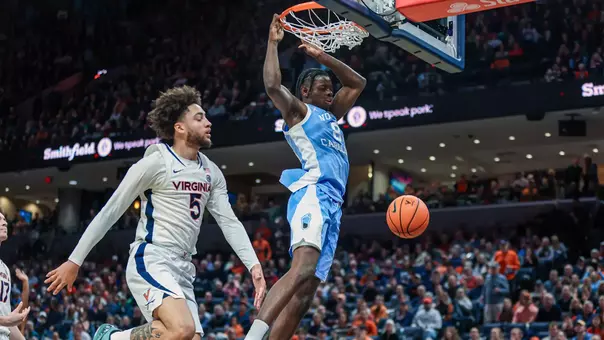
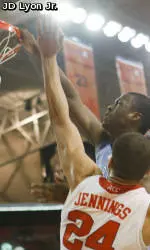
Only...something else happened. Barnes took a step to the rim, and then another step, and then a spin, and then all of a sudden he was at the basket and leaping. He went up, and he moved the ball to his right hand, and he kept going up, and suddenly he was violently slamming the ball over a helpless Milton Jennings. There have been times he has been content to be on the perimeter. This was not one of those times. This one had ill intentions.
Most plays in a basketball game get a reaction--maybe a cheer or a boo or a gasp. This play was so startling, so out of character, that the entire building went silent. Ten thousand people, most wearing orange, immediately fell mute.
"That was the changing point," said Marshall. "When that happened, I thought, `OK, we're going to win this game.' They didn't see it coming, and we didn't even see it coming."
No one saw it coming--even the Iowa native who had just crammed the ball into the basket.
"I didn't know that was going to happen," Barnes said. "I was reacting on instinct. Coach has been stressing that to me, that if I'll attack the rim on my first step the lane will be more open. There was a small window to create that opportunity."
This space is usually for agreeing with the head coach, not disputing him. This time, however, there is an issue.
"To me, it was just two points," Williams said.
Uh, no. It was much, much more than two points. Without that play, Carolina doesn't leave the Palmetto State with Clemson's brownies. In the context of the game, it was--as Marshall said--the Carolina catalyst. In the context of the season, it was the play that keeps Carolina at the top of the ACC rather than in the middle of the pack, scratching to distinguish themselves from the other teams clumped there. This was a gutty, hard-fought, character-building win. That was the play that made it happen.
And in Barnes's career, too, it will be one that earns an asterisk. Three years from now, a Tar Heel will dunk the ball with authority and someone will say, "That looked like Harrison at Clemson," and everyone will know exactly what you're talking about. After the game, Steve Kirschner compared it to Marvin Williams's dunk at Florida State in 2005. It had that kind of brutality about it, and it had the same kind of demoralizing effect on the home crowd.
After the Black Falcon had swooped to the rim, it seemed reasonable to wonder what he might have been thinking. For those of us who don't spend a lot of time above--or near--the rim, we have to wonder what it's like not just to do something like that, but to realize you just did something like that.
"The first thing I thought was about Marvin Williams," Barnes said. "He always encourages me to dunk a lot, because he says that opens up the lane for you later. So when I came down, I thought about Marvin."
Remember Wednesday, when the Tar Heels had to play a teeth-gritting, white-knuckle second half against Duke? It felt like the lessons learned from that game would somehow pay dividends later. As it turns out, later was Saturday. Because at 51-51 with four minutes left, Carolina instantly found itself in the exact same situation.
Two weeks ago, everyone talked about the daunting four-game stretch on the horizon. Road games at Boston College, Duke and Clemson, plus a home tilt with Florida State. By the end of this, we thought, we'll know something about Carolina.
After Boston College, it was too soon to judge. Maybe the Eagles just didn't shoot well. After Florida State, it was too soon to judge. Maybe the Seminoles were just road-weary. After Duke, it was too soon to judge. Let's see what they learn from a defeat.
Then, after a halting first half at Littlejohn, it felt like we'd know something after the second half. And then, after 156 minutes of the 160-minute stretch, the verdict on Carolina's success in the quartet of key games would come down only to their performance in the final four minutes. Lose this game, and the Tar Heels would go 2-2 and be right back in the middle of the league. Win it, and they're legitimized as contenders.
Freshmen scored 12 of UNC's 13 points over those next four minutes, and Reggie Bullock had a key tip-out of a missed free throw that preserved a possession.
"These types of games define your team," Marshall said. "You want to be able to tough it out and get it done. To come in here to Clemson when they are playing their best basketball, it felt good."
"You have to be calm in those situations," Barnes said. "You can't get too caught up in your emotions. You have to execute your plays and relax. That's what allowed us to be successful."
After the 64-62 win, the Tar Heels went through the long Littlejohn tunnel. Here, the visiting locker room is two stories above the playing court. There are 55 steps to climb. You know how it is. You're young and steps are nothing. There have been times the players and coaches have bounced up every one of them after a big win, powered by adrenaline.
In the context of this season and this particular point in the program, this was as big a win as any of those. Suddenly, this team doesn't seem so young anymore. They've been there in some big games, and now they've been there in some big games and won. They're older and maybe just a little bit wiser.
Steps or elevator? "Elevator," Marshall said. "I'm definitely taking the elevator."
Hear that? The boys are growing up.
Adam Lucas is the publisher of Tar Heel Monthly. He is also the author or co-author of six books on Carolina basketball, including the official chronicle of the first 100 years of Tar Heel hoops, A Century of Excellence, which is available now. Get real-time UNC sports updates from the THM staff on Twitter.