University of North Carolina Athletics
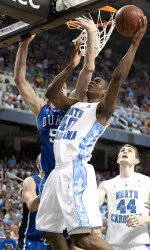
Lucas: A Forward Thinker
September 7, 2011 | Men's Basketball
Sept. 7, 2011
By Adam Lucas
Amid all the baying about the fantastic existence afforded to an NBA player, it's startling to find the most clear-eyed assessment delivered by a 19-year-old college sophomore from Iowa.
This particular sophomore, Harrison Barnes, could have stepped directly into that lifestyle this summer. But he chose to return to North Carolina, so it seems reasonable to inquire as to why--when so many of his peers are in a hurry to minimize the college experience--he's back in Chapel Hill, wearing a shirt depicting Michael Jordan leaning against the Brooklyn Bridge and the slogan, "The best thing to come out of Brooklyn since the Dodgers."
Barnes, typically, is thoughtful. This is nothing unusual, unless you're unfamiliar with him, in which case it can be disarming. All his interviews are thoughtful. You get out of them exactly what you put into them. Ask him a question he's been asked dozens of times before, and you'll get the answer he's delivered--politely--dozens of times before. Ask him something unique, and he's likely to pause before speaking, as if he's rehearsing. Remember that kid in school who always turned in a rough draft and, not coincidentally, always got the best grades? That's Harrison Barnes.
He grew up in Iowa without cable television, so he wasn't a nightly SportsCenter viewer like so many of his peers. It's only since last summer that he says he's truly studied the media relations talents (or lack thereof) of some of his basketball heroes. He admits to occasionally making mental notes on interview skills just like he does for hardwood skills.
He processes everything. You can see him playing back an answer after he gives it. Once, he misspeaks and says summer instruction from Shammond Williams "kept me on my heels." Everyone knows exactly what he means. But before the conversation continues more than two extra sentences, he corrects himself. "Sorry to interrupt," he says, "I meant to say it kept me on my toes." It is very important to get things right.
What of this decision he has made to put off becoming an adult for at least one more year?
"Being around Carolina, you can see the excitement, the joy and the pride the former players have in coming back here and knowing they won a championship here," Barnes says. "That's something I want to do. The money and the NBA, that stuff is very provocative because it's right here, right now. But to be able to come back to a program like this years from now and look at what you've done, that is very important."
In a society where we have instant downloads and instant messaging to help achieve our ultimate goal of instant gratification, Barnes seems like a throwback. Here, sitting in the Smith Center, he's already weighing the value of being able to walk back into this building in five years with a sturdy Tar Heel resume. When Williams-era alumni are in town, current players are well aware that credibility is measured by rings.
To help achieve that goal, he spent his summer refining the parts of his game he considered lacking as a freshman. That was the same freshman campaign in which he tied for the team lead in scoring and became the first Tar Heel in 40 years--and only the third Tar Heel ever--to score 40 points in a single game in the ACC Tournament. Certainly you remember that game, a 92-87 win over Clemson. After a long summer, paging through the details--he scored 14 of Carolina's 19 points in overtime and cemented his late-season reputation as the deadliest of the late-game big shot artists--is like rediscovering a favorite movie.
But it wasn't a perfect freshman season. Barnes shot just 42.3% from the field, a figure he thinks could improve, and he committed 72 turnovers.
"Coach Williams asked me to get more well-rounded as a player," Barnes says of his pre-summer conversation with the Tar Heel head coach. "He wants me to be more selective with the shots I take and improve my ball-handling."
This is the paradox of Barnes: he will enter his sophomore season generally acknowledged as one of the best players in the nation, one of the marquee players in all of college basketball. But he will probably have less pressure than he had as a freshman, when he was expected to not just be transcendent, but also single-handedly lead one of the nation's best programs out of the depths of the NIT.
He does seem slightly more at ease, and his summer workouts led him to a kindred spirit in Chapel Hill in Shammond Williams, a 1998 graduate who is a regular at the Smith Center pickup games. Williams is unfailingly honest with the current Tar Heels, always willing to point out where a screen could be stiffer or a pass could be delivered more accurately.
"I learned a lot from him," Barnes says. "It could be something in the weight room or it could be a pointer in pickup. It's easy to become complacent in the summer because you don't have those routine checkups that you have during the season, when you're always playing games. During the season, you go out and play a game and see what you need to improve. In the summer, you have to stay motivated. And I feel like I learned a lot this summer and became a better player."
Adam Lucas is the publisher of Tar Heel Monthly. He is also the author or co-author of six books on Carolina basketball, including the official chronicle of the first 100 years of Tar Heel hoops, A Century of Excellence, which is available now. Get real-time UNC sports updates from the THM staff on Twitter or on Facebook.