University of North Carolina Athletics
Turner's Take: Built To Last
October 13, 2014 | Men's Basketball, Featured Writers, Turner Walston
by Turner Walston
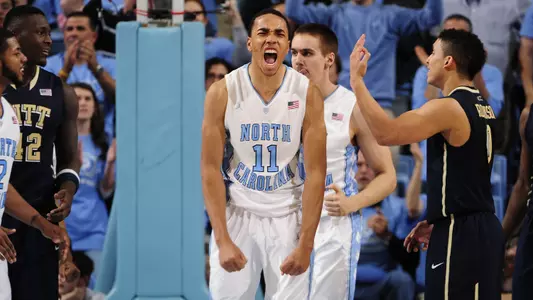
Brice Johnson was a string bean when he arrived at Carolina in the summer of 2012. He stood 6'9 and weight 187 pounds. He played in all 36 games that season and averaged about 11 minutes per game. Last season, he played at 210 pounds, nearly doubled his minutes per game average and was among the Atlantic Coast Conference's best 'sixth men.' Now, with the departure of James Michael McAdoo, Johnson is Carolina's second-leading returning scorer (behind Marcus Paige) and his tied with Kennedy Meeks for the team's leading returning rebounder. Despite only starting two games a season ago, Johnson led the team in blocks, and his impact was felt every time he was on the floor.
Johnson was at his best down the stretch last year. Beginning with the NC State game in mid-January, he scored 10 or more points in 10 of the final 14 games (he scored just two against Iowa State when he sprained his ankle midway through the first half). The ankle injury lingered into the summer, but Johnson has recovered and continued to add weight.
Brice checked in at 217 pounds at his summer press conference. “I can tell a big difference,” he said then, in the midst of a series of hard-fought, physical pickup games with former Tar Heels now in the professional ranks. “I just have to be able to hold my ground.”
Last week at Media Day, Johnson said he weighed 230 pounds, a full 43 pounds heavier than when he first got to Chapel Hill as an 18 year-old. “It's been a very difficult process,” he said of learning to play with his new body. “For one, I'm not used to playing with a lot of weight on my body, and two, it's a very hard thing to keep running with it.
Tar Heel fans will look at Brice Johnson this season and see a different player, physically. The change is not as dramatic as that of Kennedy Meeks (who went the other way with his weight), but Johnson appears stronger and more muscular. It's evident that he is better built to handle the rigors of ACC play in 2014-15.
The key for Johnson, now that he presumably will step into a starting role with McAdoo gone, is to maintain the explosiveness even as he carries the equivalent of a kindergartener on his back, to provide the same spark he brought off the bench to the game's tip-off. “I'm going to have to,” he said of bringing that energy. “If that's what it entails, then yes, I'm going to do it. If I have to come off the bench, then I'm going to still have to bring the energy that I brought last year, but if I have to start, then just have to go out there and be able to do it.”
Sophomore Isaiah Hicks, who is now playing power forward after a crowded post forced him to the wing a year ago, should help Johnson balance that energy. “He's not playing the three man like he was last year, and that wasn't his natural position,” Johnson said. “He's a lot more comfortable.” Hicks and Johnson are practically the same size, and if Hicks' confidence holds, the Tar Heels can benefit from some steadiness in the paint.
The ankle injury that ended Johnson's season a year ago may have been a harbinger for the end of the Tar Heels' season. Carolina fell to Iowa State by two points without Johnson on the floor. Now healthy, Johnson hopes he can stay on the floor longer and carry the team further. “I want to be able to keep going,” he said. We made it to the second round (of the NCAA Tournament) both years. I want to be able to make it to that second weekend,” he said. “It's good to finish that first weekend, but I want to make it to that second weekend. I don't want to just be mediocre and have the first weekend and not be able to keep going, because the team before me made it to the Elite Eight. I want to have this team be able to do that, too.”
Brice Johnson and the Tar Heels have high hopes and high expectations entering 2014-15. Now, at 230 pounds, Johnson is built to carry the weight of those expectations.