University of North Carolina Athletics
Lucas: Next Steps
December 13, 2014 | Men's Basketball, Featured Writers, Adam Lucas
By Adam Lucas
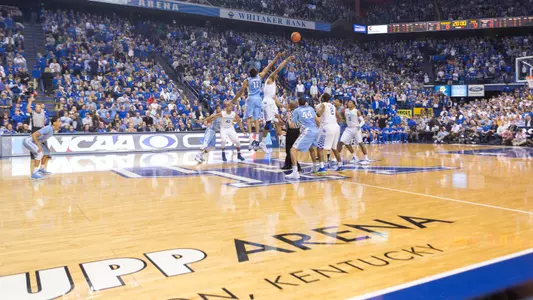
LEXINGTON—The postgame mood following Carolina's 84-70 loss at Kentucky on Saturday was very different than the one that accompanied defeats to Butler and Iowa.
Those losses felt ominous and frustrating. This one felt more instructive.
The Wildcats are very likely the best team in the country. Even without an injured Alex Poythress, they go two deep at almost every position. They have size, they have athleticism, and on Saturday, for one of the first times all year, they had shooting, as they hit 7-of-15 from three-point range. In other words, they were a very good team playing very well.
"They're athletic and they're deep,” Nate Britt said. “Everyone is long, everyone is big, and everyone is athletic. Everyone on that team has a lot of ability and there is no drop off when someone comes off the bench.”
They are, simply, a very good team. They're not superhuman, because they are still very young, and that will likely cause a hiccup or two at some point. But they are playing at a higher level than Carolina right now—it's still December—and they were useful on Saturday primarily as a measuring stick.
The Tar Heels became the first team this season to shoot better than 40 percent against the Wildcats, hitting 45.0% from the field, including 46.2 percent from the three-point line and even 83.3 percent on free throws. The visitors were also the first team to outrebound Kentucky, winning the boards 31-24 and getting more offensive rebounds (18 to 11) and more second chance points (18 to 14) than the 'Cats, a team that had dominated the glass so far this season.
Marcus Paige reemerged, draining four second-half three-pointers. Brice Johnson played well early and finished with a team-high 15 points.
Reading through the last two paragraphs, it sounds an awful lot like what you might have expected to read if Carolina had pulled the upset.
“When we did what we talked about in pregame—taking care of the ball, executing, running out on defense—we got exactly what we wanted,” Paige said. “Defensively, when we were locked in and not making silly mistakes, they didn't score. That's one thing we should take from this, is that when we do what Coach is talking about, it works.”
Instead, the Tar Heels never led, and other than a couple brief second-half pushes—what felt like a big Britt three-pointer went all the way down before spinning out—the outcome never felt very much in doubt.
On this day, at this stage of the season, Kentucky is simply better than Carolina. Look at Willie Cauley-Stein, who changed the game in multiple ways, scoring 15 points to go with his six rebounds and four steals. But his most impressive play might have come in the second half, when he refused to let Kennedy Meeks post him up, fought around Meeks, knocked away Carolina's entry pass, and then dove on the floor to recover the loose ball and called timeout to secure the possession.
It was a gritty play by a player who is supposed to be one of Kentucky's stars, and when you get even the stars making the gritty plays, that's when a team excels. Expect Roy Williams to continue to emphasize that message in an important upcoming seven days. Carolina visits Wes Miller and UNC-Greensboro on Tuesday night, but then faces a very important game against Ohio State in Chicago next Saturday.
That contest against the Buckeyes looms as the pivotal contest of the nonconference part of the season. Win that game, and Carolina heads toward ACC play with wins over UCLA, Florida and Ohio State, and can reasonably expect to be competitive at the top of the loaded league standings. But lose to the Buckeyes, and the Tar Heels will have at least four non-league losses (against an admittedly stacked schedule) and will need some impressive wins in ACC games.
In theory, those 18 games against league competition are when the Tar Heels should see the true benefits of Saturday's game. Carolina won't play a better team than Kentucky over the next four months. They won't play in a bigger or more hostile environment than Rupp Arena, which hosted the ninth-largest crowd in Kentucky history on Saturday.
Those experiences are exactly why you schedule games like this, exactly why you don't want a team's first exposure to a sold-out arena full of roaring opposing fans to be in a conference game in January.
Saturday's outcome has almost nothing to do with where Carolina will be in March. What they get out of that outcome, however, will be vital.