University of North Carolina Athletics
Lucas: Next Phase For Stackhouse
August 26, 2014 | Men's Basketball
Like many parents, Jerry Stackhouse sat in the stands watching his middle school-aged son play basketball and had a nagging feeling he could be a more effective coach than the individual charged with coaching the team.
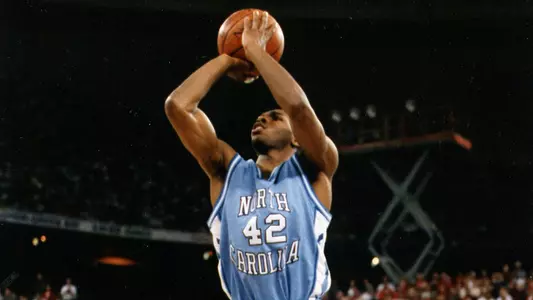
Unlike many parents, Stackhouse had the credentials of an NBA career that would eventually stretch to almost two decades, plus a decorated two years at Carolina that included the 1995 Final Four and the National Player of the Year award from Sports Illustrated.
Thus was born Stackhouse Elite, as Stackhouse did indeed form his own AAU basketball program. It might have started as a way to give his son, Jaye Stackhouse, better instruction. But it turned into a passion project for the elder Stackhouse, who has coached the five-player core of his team for the past five years, and has seen all five earn college offers. Taking his commitment one step further, the NBA veteran even brought five players into his home to rescue them from a public school system in which they were unlikely to experience success.
The irony is that Jaye Stackhouse is no longer a basketball prospect, and is instead likely to attend college--where his combination of academics and athletics has interest from schools such as Stanford and Yale--to play football. But even though his son has moved onto the gridiron, Jerry Stackhouse has found a possible second stage of his basketball career on the sideline.
"When I started coaching, I loved it," says the Kinston native, who now lives near Atlanta. "I was transitioning towards the end of my career in the NBA, and I had more of a mental role and an assistant coach-type role the last few years I played. I never thought early in my career I would want to coach. No way would I be as foolish to get into something like coaching. But sometimes things choose you, and coaching and helping guys get better is one of those things."
It's not just talk. Stackhouse spent part of this summer in Italy coaching a USA Select team at Eurocamp, and he has had discussions with both the Atlanta Hawks and the Phil Jackson-led New York Knicks about a possible assistant coaching role.
When that transition to full-time coaching happens, Stackhouse plans to impart the wisdom he first learned from Dean Smith in Chapel Hill.
"Coach Smith taught me how to play the game," Stackhouse says. "As a player, he taught me how to play with other great players. We learned how to share the floor. That was the biggest thing with his message was sharing. When I was here at Carolina, that was the only thing I wanted to do was get his praise. I felt like if I pleased Coach Smith and did what he asked me to do, everything else would fall into place."
In most cases, Stackhouse did please his head coach. There were a few instances, though--especially during an occasionally rocky freshman season when Stackhouse was part of the loaded 1994 club--when youthful individualism overwhelmed Smith's team-oriented approach.
"One time on the break my freshman year, I was going to put a little hot sauce on it and try a reverse jam," Stackhouse says. "I think I actually jumped too high and threw it off the back of the rim. Before the ball even came down, somebody else was to the (scorer's) table to get me."
That's what some impatient fans might remember, or might have noticed at the time. But Stackhouse, who eventually recovered from those struggles to win the Most Valuable Player award as Carolina captured the 1994 ACC Tournament title, remembers something else about the sequence.
"A couple plays later, I was back in there," he says. "As young players, teaching that discipline and hierarchy of how it works is important. And I do the same thing now. That's the same message I use with the players I coach and work with."