University of North Carolina Athletics
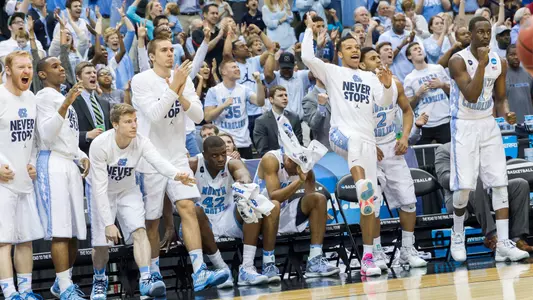
Lucas: Film Work And Feeling
March 20, 2015 | Men's Basketball, Featured Writers, Adam Lucas
By Adam Lucas
JACKSONVILLE—Before he became known as the author of one of this year's biggest upsets by guiding UAB over Iowa State on Thursday, current Blazers head coach Jerod Haase was a long-time assistant coach under Roy Williams.
Haase used to describe the hours of study he'd put into each opposing scouting report this way: “You study film all week so that when Coach Williams turns to you with one minute left in a tie game and says, 'What are they going to run?' you have a pretty good guess.”
So it was that Carolina huddled with 1:04 remaining in the NCAA Tournament opener against Harvard. The game was tied at 65, the Crimson had eliminated a 16-point second half deficit, and what had been a slumbering Jacksonville Veterans Memorial Arena crowd had come to life as they sensed yet another first-day upset.
Tommy Amaker's team had the ball, and he'd called timeout to set up the potential game-winning play. As the Tar Heels broke the huddle to go back on defense, UNC assistant coach Steve Robinson—who had scouting responsibilities against Harvard—grabbed J.P. Tokoto.
“Watch the back door,” he told Tokoto, who would have the defensive assignment on Harvard's high-scoring Wesley Saunders, who had been the focal point of the offense throughout the evening.
The next minute would determine everything about how the 2014-15 season was remembered. Give up a basket, lose to Harvard, and Carolina would be a punch line. Find a way to get a stop and some points, and the Tar Heels would at least have the opportunity to play on, something only 31 other teams will have after Friday evening.
On the previous Harvard possession, Tokoto had blanketed Saunders, chasing him all over the court for the better part of 20 seconds and preventing point guard Siyani Chambers from getting Saunders the ball. Tokoto's exceptional defense forced Chambers to heave a desperation three-pointer…it swished through, Marcus Paige fouled Chambers, and he completed the four-point play. Maybe it would just be that kind of night.
Having watched Tokoto harass Saunders the previous time down the court, Amaker set up exactly what Robinson expected—a backdoor play for Saunders that would, in theory, take advantage of Tokoto's overplaying defense to create an easy basket.
So, a minute left in a tie game. Unfamiliar opponent, one you wouldn't even just randomly stumble across during the season on television. What are they going to run?
“We knew out of a timeout they like to run backdoor plays,” Tokoto said. “They had a few of them early on. They caught me with one, and there was one where they didn't throw it. But I knew in my mind he was going backdoor.”
Saunders cut hard to the wing as if to receive a pass for a three-pointer. Then he planted and jabbed hard back towards the basket, the move intended to free him for a layup. But Tokoto was there with him, denied the pass, and forced Harvard into some secondary options.
With the first choice denied, Chambers missed a late-clock three-pointer. Tokoto searched out the rebound, and before he fully secured the ball, had already glanced ahead and spotted two white jerseys and just one black Harvard jersey.
This is that moment with Tokoto that you've grown to love and fear. A split-second decision is required, and there's a very small window required to make a play. Is that window big enough to squeeze the ball through? It's not immediately clear, which means a snap decision is required, which means you've got your hands over your eyes and your fingers spread just wide enough to see what happens.
“As soon as I caught the ball, I looked upcourt and saw two teammates,” Tokoto said. “The defensive guy had his head turned. I looked at him first. If he had been looking at me, I wasn't going to throw it.”
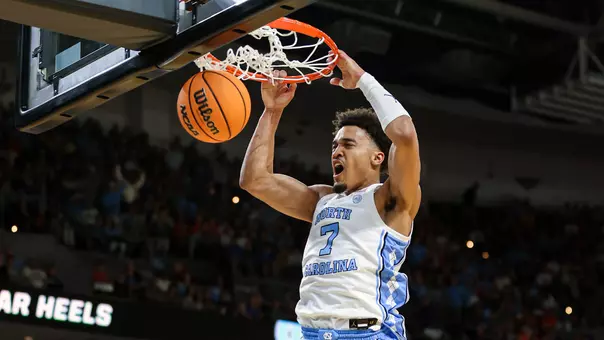
But he did throw it, finding Marcus Paige, who then dropped it to Justin Jackson for a dunk that provided the final 67-65 margin.
An entire season came down to those two moments, one solely created by instinct and one fostered by something else.
Robinson stood in a corner of the Carolina locker room after the win, looking as tired as downtown Jacksonville real estate. He had just watched the Tar Heels turn the ball over too much, give up too many second chance points, and fail to put away a less talented opponent.
And yet somehow they had won the game, thanks largely to the UNC defense having an accurate forecast of what Harvard wanted to run at a key moment. What was it, Robinson was asked, that enabled him to know what the Crimson would want to run?
“Film work,” he said with a sigh. “Film work.”