University of North Carolina Athletics
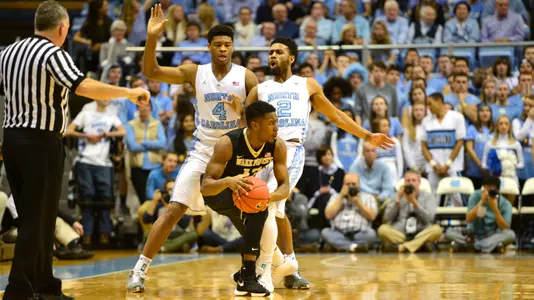
Lucas: In The Zone
January 28, 2016 | Men's Basketball, Featured Writers, Adam Lucas
By Adam Lucas
Roy Williams does not like zone.
Roy Williams does not believe he is a good zone coach.
But Roy Williams likes to win more than he dislikes zone, and on multiple occasions this year, he's used a couple different zone defenses to help the Tar Heels get a victory. The most recent occasion was Sunday night in Blacksburg, when Carolina utilized a 3-2 zone to try and limit the Hokies' dribble penetration.
“We needed to try and contain the basketball better,” Williams told Jones Angell on this week's radio show. “You can contain the basketball better against the zone, because you have someone closer to the dribbler. Regardless of where you spread the offense, there will be someone closer to them.”
The 3-2 zone helped force a couple key Hokie turnovers in the final five minutes of the game, including a held ball against Zach LeDay with 1:35 remaining that gave the Tar Heels some breathing room.
Williams has shown as much defensive flexibility this season as at any point in his Carolina tenure. In any given game, while the Tar Heels will be in straight man-to-man for most of the game, you're likely to see them employ at least a couple possessions of trapping, a couple possessions of zone, and maybe even a 1-3-1 zone thrown in just for effect.
“It helps a great deal to give the other team a different look,” says Brice Johnson. “It throws them off balance. Say we're playing a zone, and they call a timeout to go over their zone plays. Coming out of the timeout, we may go back to man. It messes with their head a little bit.”
That's probably not exactly the way Dean Smith would have phrased it, but it was exactly his philosophy behind multiple defenses. When he accepted the inaugural Dean Smith Award earlier this season, former Georgetown coach John Thompson talked about a key moment in the 1982 championship game. In a one-point game, Thompson chose not to call timeout to set up a play.
“If you call timeout, you give the other team a chance to set up a defense,” Thompson said. “I didn't know what defense Dean would go into, so what good would a timeout be to me?”
Williams isn't quite that unpredictable just yet—he still believes man-to-man is, as he calls it, the bread and butter of his defense—but this year's personnel has given him more options. Forcing opponents to prepare for multiple defenses is a valuable tool, as are those couple of seconds of indecisiveness when an opposing point guard dribbles down the court and has to diagnose what defense the Tar Heels are playing.
When he used a zone early in his UNC coaching career, Williams most often utilized the Smith-taught point zone. This year, however, the makeup of his roster and a college game increasingly dependent on containing dribble penetration has caused him to rely more heavily on the 3-2.
“We have two bigs who are usually active,” says Marcus Paige. “Especially when it's Brice and Isaiah (Hicks), they can cover a lot of ground. Our guards have good length and athleticism. The zone makes it tougher for the offense to find driving angles. The 3-2 takes away driving.”
Of course, there are also situations where the 3-2 zone won't be as effective—teams that shoot very well from the perimeter can beat it, as can teams that toss the ball into the middle of the zone. But the Tar Heels felt comfortable letting Virginia Tech fire away from the outside, and throwing the ball into the middle would have taken the ball away from the Hokies' playmakers—also a defensive win.
Don't look for Williams to teach any zone clinics anytime soon. But even a coach firmly set in his ways knows the value of uncertainty. He still doesn't like it. He still doesn't want to coach it. But “sometimes,” he says, “change is good for change's sake.”