University of North Carolina Athletics
Turner's Take: A Switch On The Pick-And-Roll
March 18, 2016 | Men's Basketball, Featured Writers, Turner Walston
By Turner Walston
Roy Williams yelled at his team at halftime. That much was clear both from what his players said after Thursday night's first-round NCAA Tournament win against Florida Gulf Coast, and how those players had responded to begin the second half. Ahead by a single point at intermission, the Tar Heels outscored the Eagles 25-6 in the next eight minutes and 28 seconds and never looked back en route to an 83-67 win.
“He definitely was upset,” Brice Johnson said of his head coach. “He was probably turning pink more than any time I had seen him.” Johnson went on to say that assistant coach and former Tar Heel Hubert Davis hadn't said anything at all, he was so upset.
They had reason to be upset: the Tar Heels, who'd played so well in dispatching three NCAA Tournament teams by an average margin of better than 17 points last weekend in the ACC Tournament, had led the Eagles by as many as 11 midway through the opening stanza, then allowed Florida Gulf Coast to stick around, to hope, to believe that they could be the first 16 seed to knock off a #1. So yes, Roy Williams yelled. But that's not all he did.
In the game's first 20 minutes, Florida Gulf Coast had scored 22 of their 40 points in the paint. The Eagles starting front line is 6'8 and 6'9, while Johnson and Kennedy Meeks are both listed at 6'10, yet Florida Gulf Coast was getting high-percentage shots and converting them. How? The Eagles ran a pick and roll up top, with the Tar Heel big men hedging out to try and take the ball-handler farther from the basket. The problem was, the Tar Heel big away from the ball was helping guard against the driver, leaving his man underneath the basket for an easy score. Too often this happened in the first half, keeping the Eagles in the game and keeping their hope alive. “We needed to be more alert on the defensive end,” Nate Britt said. “Our rotations weren't as quick as they needed to be. We were rotating late and that was giving up a lot of lay-ups for the bigs.” The Tar Heels know all too well the dangers of letting an opponent hang around, of not finishing the game.
In the second half, the Tar Heels changed not only their effort, but their pick-and-roll defense. Instead of hedging on the screen, the post players would hang back. The Eagles weren't hurting the Tar Heels from three-point range (they'd shot just 1-3 from deep in the first half); they weren't using the screeners to buy space to fire from long range. So the Tar Heel guards would fight through their screens, staying with the ball-handler, while the bigs made sure the basket was well-defended.
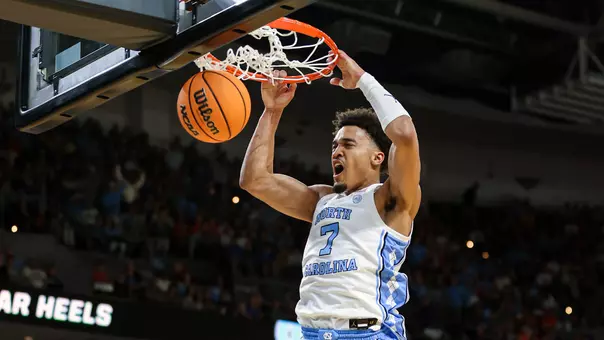
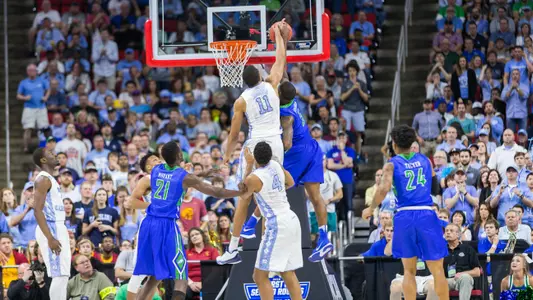
It was well-defended. Brice Johnson had eight blocks in the game, with six of them coming in the second half. Florida Gulf Coast had done well to stay away from Johnson in the first half, but they wouldn't be able to both get high-percentage shots and avoid the All-American in the second. “It's just coming over from the help side,” Johnson said. There were a lot of times where the guy that helps out was probably the person that was hurting us the most in the first half (by leaving his man open), so if somebody's not paying attention, I just try to come from top side, from the weak side, to be able to just block it, because I can jump very high and just go get it.”
With Johnson blocking shots and altering game plans, Florida Gulf Coast scored just 10 points in the paint in the second half. “Just his presence kind of affected their ability to finish at the rim, and then that also helped us get out on the break a little bit,” Paige said.
Basketball historians often talk about Bill Russell's ability to not only block shots, but direct them to teammates, effectively creating a blocked shot and a fast-break opportunity all in one. Carolina got defensive rebounds on six of Johnson's eight blocked shots, and turned them into seven points on the other end (like this). “A couple of them went out of bounds, but a lot of them we were able to get the ball and start our break, so he did a great job of providing energy plays like blocked shots,” Paige said. “He gets going, starts flexing and stuff, so that helps us out and gives us energy.”
It gives the Carolina perimeter defenders confidence when they know they have a shot-blocker like Johnson behind them. “Just like when Kentucky had Anthony Davis back there,” Theo Pinson said. “If they got beat off the dribble, they knew they've got a guy back there who's going to clean all that up. And once we get those blocks and they get into our hands, you're in trouble then, because once we get into run-outs, we're just scoring and that's where we get our runs.”
The Tar Heels will do well to play that way for two halves on Saturday if they hope to advance to the Sweet Sixteen. But a win is a win, and the Tar Heels live to try to out-do themselves in the second round. “I think you do build your momentum once you get in a tournament,” Williams said. “Coach Smith always believed that. I understood what he was talking about and still believe it to this day. Hopefully we'll have better momentum than we had today.”
Turner Walston is the editor of CAROLINA digital magazine. Follow Turner on Twitter.