University of North Carolina Athletics
Lucas: Philadelphia Story
March 22, 2016 | Men's Basketball, Featured Writers, Adam Lucas
By Adam Lucas
Barring something unforeseen, there will be one very big difference between Friday's regional semifinal matching Carolina and Indiana in Philadelphia and the national championship game 35 years earlier in the same city: in the hours leading up to the game, both sides will be certain the game is going to be played.
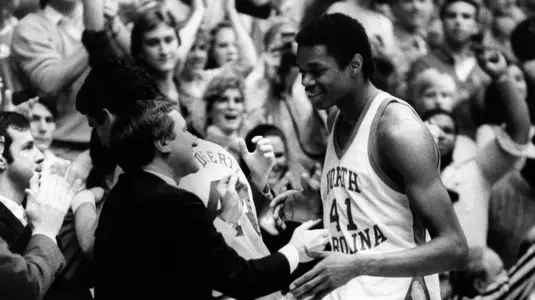
That wasn't the case in 1981, when the Tar Heels and Hoosiers were slated to meet for the national title on March 30. It was supposed to be a marquee matchup. Carolina was ranked second in the country and led by sophomore standout James Worthy and senior star Al Wood, who was coming off a 39-point, 10-rebound performance against top-ranked Virginia in the national semifinals. Indiana, meanwhile, featured sophomore All-America point guard Isiah Thomas. The game also included a star-studded head coaching matchup between Dean Smith and Bob Knight.
But in the hours before the game, no one was actually sure if it would be played. At 2:25 p.m., a would-be assassin named John Hinckley fired six shots at President Ronald Reagan. A police officer and Secret Service agent were wounded. Press secretary Jim Brady was paralyzed. Reagan was hit in the chest and rushed to the hospital.
It was less than 20 years after John F. Kennedy had been assassinated in Dallas. The NFL had made a controversial decision to play the weekend after Kennedy's death; the NCAA was now faced with a similar dilemma, but with a very uncertain situation surrounding Reagan's health. The Academy Awards were scheduled to be presented that night, but that organization made the decision to delay its event by one night.
So if the Oscars were going to wait, could you play a college basketball game? Ultimately, the decision-makers agreed (fifteen years ago, the Los Angeles Times had a good look at the decision-making process) that as long as Reagan's health was not in grave danger, the game would proceed as planned. It wasn't just the championship game they had to consider; 1981 was also the last year of the consolation game matching the losers of the national semifinals. Virginia played LSU as scheduled at 5 p.m. A few hours later, NBC carried its final NCAA title game, with tipoff shortly after 8 p.m. as planned.
There was significant uncertainty in the hours before the game. The Washington Post reported that Knight asked Smith less than an hour before tip if it would actually be played; both coaches met with NCAA administrators in a Spectrum utility closet to be briefed on contingency plans.
The game went forward with a somewhat unusual atmosphere. Just before tipoff, the Spectrum PA announcer told the crowd, “The NCAA wants you to know the condition of President Reagan is good.”
Once the game began, Thomas was terrific on his way to most valuable player honors. The most damaging play to the Tar Heels—as Roy Williams, an assistant on that team, recalled last night on his radio show—came when official Booker Turner whistled Worthy for a dubious third foul in the first half. The Hoosiers led, 27-26, at halftime, but used a quick spurt at the start of the second half on the way to a 63-50 victory and Knight's second national championship.
As you would expect, Smith had a much longer perspective on the events of the day beyond just the impact on his basketball team, even as national observers began to chirp that the Tar Heel coach couldn't win the big game. “This was just a game,” he told his team, reminding them that the President of the United States had been shot the same day.
When the team arrived back in Chapel Hill, they held an impromptu players-only meeting at Granville Towers. The program had just suffered its sixth defeat at the Final Four in the past 15 years. Returning players were adamant it wouldn't happen again.
One year later, they were right. With the addition of a skinny freshman named Michael Jordan, Worthy and Sam Perkins helped lead the Tar Heels to Smith's first national title.