University of North Carolina Athletics
Extra Points: Made Man
August 11, 2016 | Football, Featured Writers, Lee Pace
By Lee Pace
Nazair Jones remembers his middle school years with crystal clarity. He lived, he says, in “the projects” in Roanoke Rapids where fights, drugs and domestic abuse were constant parts of the landscape. He remembers his mother suggesting the company he was keeping fell into the “lie down with dogs ...” category. He just shakes his head today at the thought of distancing himself from two of those good pals and hearing several months later both were in jail for armed robbery and drug possession.
“Middle school was a horrible time for me,” he says. “We're all immature, we're basically terrible people at that time. I was in with the wrong crowd. I was with guys 24-7 who were eventually locked up. Luckily, I went in a different direction.”
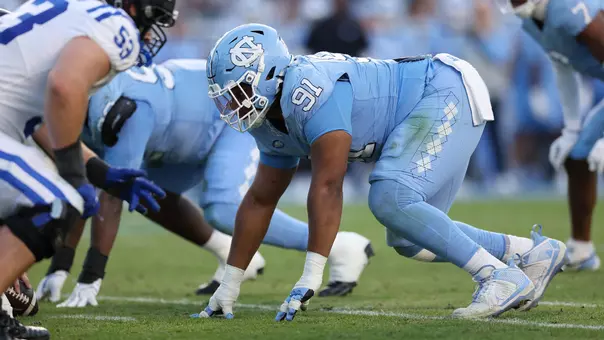
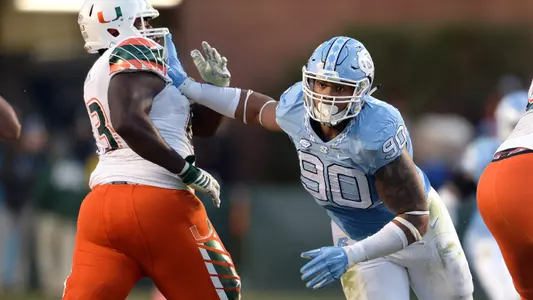
Indeed, Jones today is a junior defensive tackle on the Tar Heel football team with immense size, strength and athleticism. But most remarkable is his poise, maturity and wherewithal for 21 years old. Jones has not yet earned a college diploma or cashed in as he might do one day to the riches of the NFL. But he already understands the concept of giving back.
“I want to change the lives of kids, especially those in impoverished cities where there is absolutely nothing to do but get in trouble,” Jones says. “I want to be a mentor, help kids like I was helped. It's partly about school. It's also about being a good man and good human being in our society. I just want to see kids make the right decisions, do the right things. It's so easy to go down wrong path.”
Jones is working to establish a non-profit entity called MADE Men Mentoring and is raising money for start-up costs (legal, filing fees, domain name, etc.), and his efforts have all been vetted by UNC's compliance and legal officials. The name comes from the acronym of MADE for “making a difference every day” and that the definition of a “made man” is “one whose success is assured.”
The idea is something Jones has toyed with for several years, and he was triggered into action in March following the death of 66-year-old McGrue Booker, a Roanoke Rapids man who had been a coach, teacher and mentor to Jones since those turbulent middle school years and who, along with his mother Tammy, helped anchor him and keep him on the straight and narrow.
“After McGrue died, I knew I needed to do something to honor his memory and make an impact on someone else's life the way he did in mine,” Jones says.
Naz was born in New Jersey but moved south as a boy when his mother decided that Halifax County and the kinfolk there would provide a better environment for Naz and his younger sister.
Jones was 11 years old when his maternal great-grandfather died, taking from him the one consistent male role model. Howard Jones' right arm was paralyzed from a car accident years earlier, and young Naz drew strength from the idea that “his arm never bothered him, it never stopped him from doing whatever he wanted to do. That perseverance showed me a lot.” Naz now has the tattoo of a dove and his great-grandfather's date of death inked onto his right arm.
“I look at the dove on my arm and know he's looking down on me,” Jones says.
Soon after, Booker entered the picture.
Jones knew Booker's two granddaughters from middle school and was approached after a basketball game by Booker, a high school state track champion from Jacksonville, N.C., in the late-1960s who was now a coach and teacher at a college preparatory high school in nearby Gaston called KIPP Pride High (Knowledge Is Power Program). Booker and his son, McGrue II, also a coach at KIPP, suggested Jones transfer to KIPP and promised his mother they'd watch over him and give him some ballast and guidance as needed.
“Our bond grew and grew,” Jones says. “McGrue was my position coach in football, he coached basketball, track, taught me how to swing a golf club. He taught me all the things a man should know how to do. He was always there for me, made sure I was never hungry.”
The younger Booker, known around Roanoke Rapids as “Mac Junior,” says his father got in trouble himself as a young man and resolved as an adult to help as many young males as he could make the right decisions.
“Naz got the caring and nurturing from his mother, but there are things a boy needs to get from a man,” Booker says. “If your father's not around, they look for someone for mentorship and sometimes they look to the wrong people.
“Pops took kids in off the street, kept them off the street and gave them something to do to burn all that energy. He taught them the only thing they have is their good name. He loved Naz but he was tough. He said, 'Son, I'll hurt you before I let you go the wrong way. You're not going bad, not on my watch.'”
After two years, Jones sensed that his opportunity for a college scholarship would be stronger if he moved to Roanoke Rapids High, and Booker Sr. moved there as well, becoming an assistant on head coach Russell Weinstein's staff. Weinstein embraced Jones' athleticism and personality over the two years he coached him.
“Nazair's a very personable young man, he's easy to talk to,” Weinstein says. “He's a forward thinker, a progressive thinker. He's got a lot of ambition. Naz is a bright young man, he 'gets it,' as they say. He sees things in a much more mature light than others his age.”
Jones's sense of maturity has evolved as well from a frightening medical experience he faced beginning in November 2011, just after his team had been eliminated from the high school playoffs his junior year. Jones woke up the next morning, tried to stand up and his upper body locked. He was rushed to the hospital, admitted and began a months-long process of examinations at different facilities and lengthy rehab. After several diagnostic attempts and finally one at UNC Hospitals, the malady was identified as “complex regional pain syndrome,” which results in constant pain to an area of the body following injury or trauma. He was in a wheelchair for a period and dropped from 250 pounds to under 200.
“That offseason was touch-and-go,” Weinstein says. “Fortunately, we got him to UNC in time before any of the damage was permanent. His senior year, he was not near 100 percent.”
Jones had been on Carolina's recruiting radar his junior season but was not offered a scholarship until he came to Chapel Hill for camp in July 2012. Weinstein was there and said he was “holding his breath” that Jones could perform well enough in front of Coach Larry Fedora and his defensive assistants. Weinstein didn't think Jones could rev himself up to more than 75 percent of what he'd been when healthy.
“Coach Fedora offered him on faith—good faith that he could get back to 100 percent,” Weinstein says.
“One day I was perfectly fine, the next day I could not walk,” Jones says. “Things can happen in an instant. You never know how, you never know why. It just happens. That's why you can't take anything for granted. Life is short.”
Jones has seen and done much in his short 21 years on earth. He could be seriously good for the Tar Heels this season if he can stay healthy, and he has an interesting and challenging sideline in the mentoring arena.
“I've never acted my age,” he says. “I've always had friends older than me. I've enjoyed being around older people, you learn a lot from them. Now it's time to help those coming behind me.”
Chapel Hill writer Lee Pace has been writing “Extra Points” since 1990 and has been the sideline reporter for the Tar Heel Sports Network since 2004. Follow him on Twitter at @LeePaceTweet.