


University of North Carolina Athletics
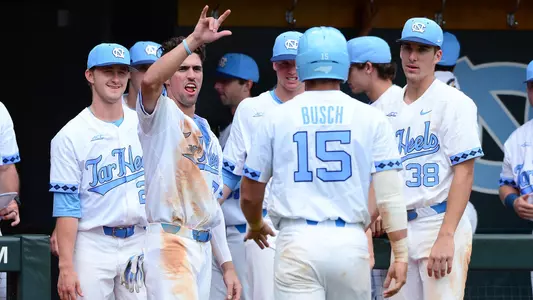
Dallas Tessar (7) and the Tar Heels open NCAA play on Friday.
Photo by: Jeffrey A. Camarati
JUCOs Help Key 2018 Tar Heels
June 1, 2018 | Baseball, Featured Writers
By Pat James, GoHeels.com
Mike Fox initially felt a little nervous about the idea.
At this time last year, the North Carolina baseball team featured nine juniors and seniors who were eligible for selection in the MLB Draft. But UNC also rostered five sophomores, including starters Kyle Datres and Cody Roberts, who were eligible at 21 years old.
The coaches couldn't guarantee then that all five sophomores would return. So in their efforts to build a roster for this season and beyond, the Tar Heels turned to the junior college ranks.
That hasn't been unusual in Fox's 20 seasons coaching at Carolina. Only twice in that span has UNC not rostered at least one junior college transfer. Among them, Ralph Roberts, Cody Stubbs and current assistant coach Jesse Wierzbicki are a few who made significant contributions.
Yet no Carolina team has boasted as many junior college transfers as the five – Kip Brandenburg, Cooper Criswell, Dylan Enwiller, Jackson Hesterlee and Dallas Tessar – on this year's squad. And although their playing time has varied, they've all been key in helping UNC earn the No. 6 national seed in the NCAA Tournament, which begins Friday.
"It's not really been our philosophy in general over the years," said Fox of relying on so many junior college transfers. "But I have to give these five a lot of credit. They're five really, really good kids with great attitudes. Not all of them have played, and that's always a dynamic you have to deal with when you bring in transfers because their expectations are, 'Well, you're bringing me in for a reason, and that's to play every day.' Sometimes that doesn't happen.
"I think that's been a big key to our success because they've not been any problem whatsoever when they haven't played. And yet when they have played, they've been able to help us win. That's because of their attitudes."
Ones that were helped shaped by their junior college experiences.
A learning opportunity
Growing up in Greensboro, Brandenburg watched as both of his older brothers, Kyle and Corey, went on to play college baseball. And like them, he quickly realized he wanted to do the same.
But Brandenburg said he didn't receive many scholarship offers in high school. Of those he collected, a majority were from smaller schools. So after seeing Kyle and Corey attend Guilford Technical Community College out of high school, Brandenburg also decided to play at a junior college.
Specifically, Brandenburg chose to play at Spartanburg Methodist. And once there, he found success, batting .337 and slugging .651 across 56 games.
A majority of players attend junior college for two years before transferring to a bigger school or entering professional baseball, if they're selected in the MLB Draft. Brandenburg only stayed at Spartanburg Methodist for one year.
"I thought I was going to be there for two years," he said. "But after my first year into the tournament of my freshman year, Carolina saw me play there and I talked to them in the summer."
Last summer, Brandenburg played for the High Point-Thomasville HiToms of the Coastal Plain League. He'd always admired the Tar Heels growing up. And if that wasn't enough, his relationship with Ike Freeman, one of his teammates with the HiToms, convinced him to commit to UNC.
Brandenburg easily could have committed and left Spartanburg Methodist without saying any formal goodbyes. Instead, he drove from his home in Greensboro to Spartanburg, S.C., to tell his coach, Tim Wallace, he was leaving for Carolina.
"I didn't want to have him get the news over the phone or a text message," Brandenburg said. "I felt like it would be better to do it face-to-face, man-to-man. I thought he'd have more respect for that."
In 18 games with the Tar Heels this season, Brandenburg is batting .296 (8-for-27). He has nine RBIs, three of which came on a double against High Point, where Kyle played for two seasons. He also tallied three RBIs in the three-game sweep of Pittsburgh.
Brandenburg said his junior college experience helped him learn how to balance school and baseball. It also prepared him for the team-first environment he's now in at UNC.
"In junior college, there are guys out there who might be there for a semester or one year, two years," he said. "So everybody is just going their own ways. I learned how to be a leader there and how try to have the strongest team possible."
Being selfless
Coming out of Chaminade College Preparatory School in West Hills, Calif., Tessar said he was somewhat immature. But it took two stops between there and UNC to reach that realization.
As a high school sophomore, Tessar committed to Washington over Stanford. He played in four games for the Huskies as a freshman in 2016. But a back injury ultimately ended his season prematurely, and in the aftermath, he opted to transfer.
Tessar could have chosen then to transfer to another Division I program. Yet because NCAA transfer rules would have forced him to sit out a year and he could have been drafted after one season at a junior college, he chose to attend Yavapai College in Prescott, Ariz.
"I went from going to a pretty good Pac-12 program to a junior college that won the national championship the year before I got there," Tessar said. "I didn't know anybody, I was living on my own. But I wouldn't change it for anything."
Tessar said he grew as a baseball player and a person in one season at Yavapai. And as the starting shortstop, he built a strong relationship with Enwiller, Yavapai's second baseman.
At Hamilton High School in Chandler, Arizona, Enwiller said he didn't play consistently on the varsity baseball team until his senior season. So he chose to attend Yavapai. In his freshman season there, he helped lead the team to the 2016 JUCO World Series championship. He then batted .338 with nine home runs and 39 RBIs as a sophomore.
"If I went to a bigger school out of high school, I probably wouldn't have played my first two seasons," Enwiller said. "So just getting the at-bats and getting playing time and reps and stuff really helped me grow."
In the fall of 2016, Tessar said his coach at Yavapai asked him for a list of Division I schools he'd like to attend. Tessar listed about 15, including UNC. Scott Forbes contacted him shortly after that. And after Robert Woodard watched Tessar in person, Carolina offered Tessar a scholarship that he accepted a few weeks later.
The Tar Heels subsequently started recruiting Enwiller.
"I was able to ask (Tessar) questions about it," said Enwiller, who rooms with Tessar at UNC. "It was a really good experience to have someone I knew coming into this because moving across the country, I really didn't know anyone."
Both Enwiller and Tessar said they didn't know exactly what their roles would be when they enrolled at Carolina. But they've been willing to do whatever has been asked of them.
Enwiller began the season as the Tar Heels' starting center fielder. Since then, he's primarily served as a key sub off the bench; he's often used as a pinch runner. His ability to play both center field and second base makes him versatile.
"Something coach Fox always preaches is selflessness," Enwiller said. "And I think that's one of the most important things to have in a successful team is having a bunch of players who are selfless and willing to do whatever it takes to help out the team."
Tessar embodies that mindset.
When he arrived at UNC, Tessar thought he'd play second base, third base or shortstop. Those positions, after all, are the ones he'd always played. But he kept an open mind. And when the coaching staff asked him to play in the outfield, he said yes, even though he had no experience.
Tessar has been steady defensively as he's manned both left and right field this season. He's also been effective at the plate, hitting .319 in ACC play. He's made 30 starts on the season, and the Tar Heels are 22-8 in those games.
"I think coming out of high school I was probably more about me," Tessar said. "That's why I'm so grateful for the experience I gained from Washington and junior college because I gained maturity and perspective.
"I'm grateful for every opportunity Coach Fox has given me, and I wouldn't change anything. I love it here. It's everything I hoped for, everything I expected."
'Really a blessing'
In their hometown of Carrollton, Ga., where their homes are separated by about a mile, Criswell and Hesterlee always talked about how amazing it would be if they played together in college.
But they couldn't fathom doing so at two different schools, as they've done the last three years.
Best friends since second grade, Criswell and Hesterlee were introduced to baseball by their fathers, who both played in college. They steadily progressed. But neither player said they were ready to compete at the Division I level out of high school.
Criswell said his fastball sat at about 84-86 mph, a few notches below what Division I coaches are looking for. He also underwent Tommy John surgery before his senior season. Although bigger than most kids his age, Hesterlee, currently listed at 6-foot-4 and 210 pounds, said he needed more time to develop and grow into his body.
Carrolton High baseball coach Ryan Zaideman helped Criswell and Hesterlee organize visits with a few different junior colleges in Georgia and Alabama. They ultimately picked Southern Union State Community College in Wadley, Ala.
"Out of high school, he didn't have any Division I offers and I didn't either," Criswell said. "So we were like, 'Why not just go to the same JUCO? It's not like we're turning down some big-time school or anything.' We kind of sat down and were like, 'Alright, let's do it.'"
After their freshman seasons at Southern Union State, Criswell said the coaches had him and Hesterlee compose a list of 10 Division I schools they each wished to attend. UNC was on both lists. But neither Criswell nor Hesterlee thought any Division I program outside Alabama would ever visit Wadley, a town without a stoplight.
For the most part, Criswell said that was true. But Forbes eventually visited.
"When they came down, I was really surprised they liked me because we did intersquad and stuff like that and it was actually one of my worst days at the plate," Hesterlee said. "But Coach Forbes said he liked what he saw and liked the way I carried myself."
"As soon as Coach Forbes saw us, he fell in love with us and he trusted us," Criswell said. "I think that just says a lot about the coaching staff, how he saw us once and he knew we could play here at this level."
Criswell and Hesterlee visited UNC the following weekend. They committed on the spot. And both have played influential roles in Carolina's success this season.
Hesterlee has started only 11 games. But he's been crucial in 25 games off the bench, going 11-for-19 at the plate. His pinch-hit, game-tying grand slam against Georgia Tech on April 21 is one of the most memorable moments of the season so far.
"Before all the games," Hesterlee said, "Coach Fox tells us the lineup and he always reminds us, all the names on the back of the card, 'Stay ready and stay in the game, ready for your moment.' I kind of take that heart because I know the way he subs."
Criswell started the season in the bullpen. But with the Tar Heels looking for more stability in the starting rotation as Gianluca Dalatri recovered from injury, Criswell provided that. He ultimately finished ACC play with a 3.19 ERA across 42 1/3 innings. On Friday, he'll start UNC's NCAA regional opener against North Carolina A&T.
In many ways, both Criswell and Hesterlee said, their first season at Carolina has exceeded expectations.
"Coming from a junior college, it made me really appreciate the support and all the stuff we get here," Hesterlee said. "It's probably easy to take it for granted if you don't know the other side of it. But coming from getting nothing and no support staff, no trainers, nothing like that, and coming to this, it's really a blessing."
Mike Fox initially felt a little nervous about the idea.
At this time last year, the North Carolina baseball team featured nine juniors and seniors who were eligible for selection in the MLB Draft. But UNC also rostered five sophomores, including starters Kyle Datres and Cody Roberts, who were eligible at 21 years old.
The coaches couldn't guarantee then that all five sophomores would return. So in their efforts to build a roster for this season and beyond, the Tar Heels turned to the junior college ranks.
That hasn't been unusual in Fox's 20 seasons coaching at Carolina. Only twice in that span has UNC not rostered at least one junior college transfer. Among them, Ralph Roberts, Cody Stubbs and current assistant coach Jesse Wierzbicki are a few who made significant contributions.
Yet no Carolina team has boasted as many junior college transfers as the five – Kip Brandenburg, Cooper Criswell, Dylan Enwiller, Jackson Hesterlee and Dallas Tessar – on this year's squad. And although their playing time has varied, they've all been key in helping UNC earn the No. 6 national seed in the NCAA Tournament, which begins Friday.
"It's not really been our philosophy in general over the years," said Fox of relying on so many junior college transfers. "But I have to give these five a lot of credit. They're five really, really good kids with great attitudes. Not all of them have played, and that's always a dynamic you have to deal with when you bring in transfers because their expectations are, 'Well, you're bringing me in for a reason, and that's to play every day.' Sometimes that doesn't happen.
"I think that's been a big key to our success because they've not been any problem whatsoever when they haven't played. And yet when they have played, they've been able to help us win. That's because of their attitudes."
Ones that were helped shaped by their junior college experiences.
A learning opportunity
Growing up in Greensboro, Brandenburg watched as both of his older brothers, Kyle and Corey, went on to play college baseball. And like them, he quickly realized he wanted to do the same.
But Brandenburg said he didn't receive many scholarship offers in high school. Of those he collected, a majority were from smaller schools. So after seeing Kyle and Corey attend Guilford Technical Community College out of high school, Brandenburg also decided to play at a junior college.
Specifically, Brandenburg chose to play at Spartanburg Methodist. And once there, he found success, batting .337 and slugging .651 across 56 games.
A majority of players attend junior college for two years before transferring to a bigger school or entering professional baseball, if they're selected in the MLB Draft. Brandenburg only stayed at Spartanburg Methodist for one year.
"I thought I was going to be there for two years," he said. "But after my first year into the tournament of my freshman year, Carolina saw me play there and I talked to them in the summer."
Last summer, Brandenburg played for the High Point-Thomasville HiToms of the Coastal Plain League. He'd always admired the Tar Heels growing up. And if that wasn't enough, his relationship with Ike Freeman, one of his teammates with the HiToms, convinced him to commit to UNC.
Brandenburg easily could have committed and left Spartanburg Methodist without saying any formal goodbyes. Instead, he drove from his home in Greensboro to Spartanburg, S.C., to tell his coach, Tim Wallace, he was leaving for Carolina.
"I didn't want to have him get the news over the phone or a text message," Brandenburg said. "I felt like it would be better to do it face-to-face, man-to-man. I thought he'd have more respect for that."
In 18 games with the Tar Heels this season, Brandenburg is batting .296 (8-for-27). He has nine RBIs, three of which came on a double against High Point, where Kyle played for two seasons. He also tallied three RBIs in the three-game sweep of Pittsburgh.
Brandenburg said his junior college experience helped him learn how to balance school and baseball. It also prepared him for the team-first environment he's now in at UNC.
"In junior college, there are guys out there who might be there for a semester or one year, two years," he said. "So everybody is just going their own ways. I learned how to be a leader there and how try to have the strongest team possible."
Being selfless
Coming out of Chaminade College Preparatory School in West Hills, Calif., Tessar said he was somewhat immature. But it took two stops between there and UNC to reach that realization.
As a high school sophomore, Tessar committed to Washington over Stanford. He played in four games for the Huskies as a freshman in 2016. But a back injury ultimately ended his season prematurely, and in the aftermath, he opted to transfer.
Tessar could have chosen then to transfer to another Division I program. Yet because NCAA transfer rules would have forced him to sit out a year and he could have been drafted after one season at a junior college, he chose to attend Yavapai College in Prescott, Ariz.
"I went from going to a pretty good Pac-12 program to a junior college that won the national championship the year before I got there," Tessar said. "I didn't know anybody, I was living on my own. But I wouldn't change it for anything."
Tessar said he grew as a baseball player and a person in one season at Yavapai. And as the starting shortstop, he built a strong relationship with Enwiller, Yavapai's second baseman.
At Hamilton High School in Chandler, Arizona, Enwiller said he didn't play consistently on the varsity baseball team until his senior season. So he chose to attend Yavapai. In his freshman season there, he helped lead the team to the 2016 JUCO World Series championship. He then batted .338 with nine home runs and 39 RBIs as a sophomore.
"If I went to a bigger school out of high school, I probably wouldn't have played my first two seasons," Enwiller said. "So just getting the at-bats and getting playing time and reps and stuff really helped me grow."
In the fall of 2016, Tessar said his coach at Yavapai asked him for a list of Division I schools he'd like to attend. Tessar listed about 15, including UNC. Scott Forbes contacted him shortly after that. And after Robert Woodard watched Tessar in person, Carolina offered Tessar a scholarship that he accepted a few weeks later.
The Tar Heels subsequently started recruiting Enwiller.
"I was able to ask (Tessar) questions about it," said Enwiller, who rooms with Tessar at UNC. "It was a really good experience to have someone I knew coming into this because moving across the country, I really didn't know anyone."
Both Enwiller and Tessar said they didn't know exactly what their roles would be when they enrolled at Carolina. But they've been willing to do whatever has been asked of them.
Enwiller began the season as the Tar Heels' starting center fielder. Since then, he's primarily served as a key sub off the bench; he's often used as a pinch runner. His ability to play both center field and second base makes him versatile.
"Something coach Fox always preaches is selflessness," Enwiller said. "And I think that's one of the most important things to have in a successful team is having a bunch of players who are selfless and willing to do whatever it takes to help out the team."
Tessar embodies that mindset.
When he arrived at UNC, Tessar thought he'd play second base, third base or shortstop. Those positions, after all, are the ones he'd always played. But he kept an open mind. And when the coaching staff asked him to play in the outfield, he said yes, even though he had no experience.
Tessar has been steady defensively as he's manned both left and right field this season. He's also been effective at the plate, hitting .319 in ACC play. He's made 30 starts on the season, and the Tar Heels are 22-8 in those games.
"I think coming out of high school I was probably more about me," Tessar said. "That's why I'm so grateful for the experience I gained from Washington and junior college because I gained maturity and perspective.
"I'm grateful for every opportunity Coach Fox has given me, and I wouldn't change anything. I love it here. It's everything I hoped for, everything I expected."
'Really a blessing'
In their hometown of Carrollton, Ga., where their homes are separated by about a mile, Criswell and Hesterlee always talked about how amazing it would be if they played together in college.
But they couldn't fathom doing so at two different schools, as they've done the last three years.
Best friends since second grade, Criswell and Hesterlee were introduced to baseball by their fathers, who both played in college. They steadily progressed. But neither player said they were ready to compete at the Division I level out of high school.
Criswell said his fastball sat at about 84-86 mph, a few notches below what Division I coaches are looking for. He also underwent Tommy John surgery before his senior season. Although bigger than most kids his age, Hesterlee, currently listed at 6-foot-4 and 210 pounds, said he needed more time to develop and grow into his body.
Carrolton High baseball coach Ryan Zaideman helped Criswell and Hesterlee organize visits with a few different junior colleges in Georgia and Alabama. They ultimately picked Southern Union State Community College in Wadley, Ala.
"Out of high school, he didn't have any Division I offers and I didn't either," Criswell said. "So we were like, 'Why not just go to the same JUCO? It's not like we're turning down some big-time school or anything.' We kind of sat down and were like, 'Alright, let's do it.'"
After their freshman seasons at Southern Union State, Criswell said the coaches had him and Hesterlee compose a list of 10 Division I schools they each wished to attend. UNC was on both lists. But neither Criswell nor Hesterlee thought any Division I program outside Alabama would ever visit Wadley, a town without a stoplight.
For the most part, Criswell said that was true. But Forbes eventually visited.
"When they came down, I was really surprised they liked me because we did intersquad and stuff like that and it was actually one of my worst days at the plate," Hesterlee said. "But Coach Forbes said he liked what he saw and liked the way I carried myself."
"As soon as Coach Forbes saw us, he fell in love with us and he trusted us," Criswell said. "I think that just says a lot about the coaching staff, how he saw us once and he knew we could play here at this level."
Criswell and Hesterlee visited UNC the following weekend. They committed on the spot. And both have played influential roles in Carolina's success this season.
Hesterlee has started only 11 games. But he's been crucial in 25 games off the bench, going 11-for-19 at the plate. His pinch-hit, game-tying grand slam against Georgia Tech on April 21 is one of the most memorable moments of the season so far.
"Before all the games," Hesterlee said, "Coach Fox tells us the lineup and he always reminds us, all the names on the back of the card, 'Stay ready and stay in the game, ready for your moment.' I kind of take that heart because I know the way he subs."
Criswell started the season in the bullpen. But with the Tar Heels looking for more stability in the starting rotation as Gianluca Dalatri recovered from injury, Criswell provided that. He ultimately finished ACC play with a 3.19 ERA across 42 1/3 innings. On Friday, he'll start UNC's NCAA regional opener against North Carolina A&T.
In many ways, both Criswell and Hesterlee said, their first season at Carolina has exceeded expectations.
"Coming from a junior college, it made me really appreciate the support and all the stuff we get here," Hesterlee said. "It's probably easy to take it for granted if you don't know the other side of it. But coming from getting nothing and no support staff, no trainers, nothing like that, and coming to this, it's really a blessing."

Players Mentioned
OF/1B
/ Baseball
RHP
/ Baseball
RHP/DH
/ Baseball
3B
/ Baseball
OF/2B
/ Baseball
SS/2B
/ Baseball
OF
/ Baseball
C
/ Baseball
SS/OF
/ BaseballMonday, June 22
Sunday, June 21
Sunday, June 21
Sunday, June 21