


University of North Carolina Athletics
Lucas: A Carmichael Primer
December 12, 2019 | Men's Basketball, Featured Writers, Adam Lucas
Some names and terms you need to know in order to be familiar with Carolina basketball in Carmichael.
By Adam Lucas
Whether you're going to your first Carolina men's basketball game in Carmichael on Sunday or your 100th, there are a few basic people and storylines you need to know in order to appreciate the history of the building as it relates to the Tar Heels.
Auditorium: Sure, now it's an arena, after an impressive facelift modernized it and made it a suitable home for the women's basketball program. But for men's basketball purposes, it was always Carmichael Auditorium.
Carolina Victory: Always played by the pep band when--but never until--the game was clearly in hand. The opening notes of the song usually received a loud roar as soon as they were played, as the Tar Heel fans in attendance realized another win was assured.
Comebacks: Carolina players and coaches knew they were never out of a game at Carmichael. More importantly, the opponents knew it, too. Several of the best Carmichael comebacks were featured in Tuesday's story.
The flip scoreboard: This is probably the most-beloved Carmichael artifact, but was also a sign of just how far Dean Smith was ahead of his time. The scoreboard was originally created because Carolina's game film didn't have a way to indicate score and time without uncomfortably panning to one of the arena boards. So Smith decided he could put a scoreboard in the corner of the court, enabling it to constantly show up on game film. He was at least a quarter-century ahead of the television industry, which didn't make constant on-screen score and time a regular feature of broadcasts for nearly three more decades.
The heat: Tar Heel opponents actually believed Dean Smith always turned up the heat in Carmichael to make it especially uncomfortable for foes. This theory began with NC State's Norm Sloan, but Maryland's Lefty Driesell was perhaps the most famous believer (even on a Carolina Insider podcast appearance 30 years after he last coached a game in the building, he still believed it). Smith found the conspiracy theory slightly humorous and insisted he had no idea how the Carmichael heat was controlled.
Heckling: Under Smith, it wasn't allowed. The Carolina head coach was known to admonish fans who waved their arms during an opponent's free throw, and booing in Carmichael was unthinkable. Carmichael crowds were loud, intense...and constantly respectful. In most cases, they followed Smith's lead and applauded the opponent during team introductions.
The last game: There were actually two "last games at Carmichael." The first was a win against Clemson at the end of the 1985 regular season. The Smith Center was scheduled to open at the outset of the 1985-86 campaign, and there was significant fanfare about the game against the Tigers. The program even produced a state-of-the-art VHS cassette that spring wrapping up the Carmichael era. But construction was delayed, the Tar Heels played in Carmichael at the beginning of the next season, and eventually closed the building with a win over Jim Valvano and NC State in January of 1986. The men's team returned to Carmichael for one game during the 2010 NIT, beating William & Mary.
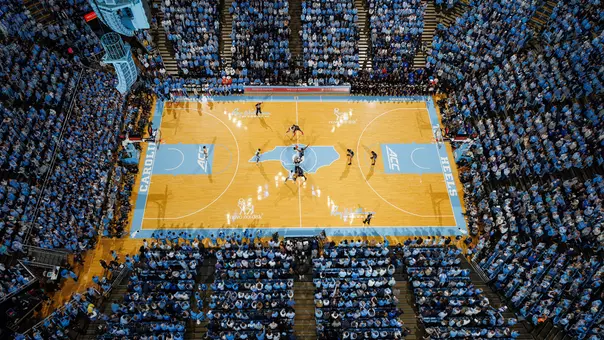
Tickets: They were impossible to get. Before the days of online ticket exchanges, tickets to games in the approximately 10,000-seat Carmichael Auditorium (it now seats 6,822 for the Hickory Tavern Throwback Game presented by Coca-Cola) were some of the most highly prized items in the Triangle. Student tickets went through a variety of distribution methods, and by the end of the Carmichael era, there were even occasional crackdowns on students--unable to resist the thriving secondary market--selling their seats. The student section had a prime position behind the benches and was known as one of the rowdiest in the league.
Whether you're going to your first Carolina men's basketball game in Carmichael on Sunday or your 100th, there are a few basic people and storylines you need to know in order to appreciate the history of the building as it relates to the Tar Heels.
Auditorium: Sure, now it's an arena, after an impressive facelift modernized it and made it a suitable home for the women's basketball program. But for men's basketball purposes, it was always Carmichael Auditorium.
Carolina Victory: Always played by the pep band when--but never until--the game was clearly in hand. The opening notes of the song usually received a loud roar as soon as they were played, as the Tar Heel fans in attendance realized another win was assured.
Comebacks: Carolina players and coaches knew they were never out of a game at Carmichael. More importantly, the opponents knew it, too. Several of the best Carmichael comebacks were featured in Tuesday's story.
The flip scoreboard: This is probably the most-beloved Carmichael artifact, but was also a sign of just how far Dean Smith was ahead of his time. The scoreboard was originally created because Carolina's game film didn't have a way to indicate score and time without uncomfortably panning to one of the arena boards. So Smith decided he could put a scoreboard in the corner of the court, enabling it to constantly show up on game film. He was at least a quarter-century ahead of the television industry, which didn't make constant on-screen score and time a regular feature of broadcasts for nearly three more decades.
The heat: Tar Heel opponents actually believed Dean Smith always turned up the heat in Carmichael to make it especially uncomfortable for foes. This theory began with NC State's Norm Sloan, but Maryland's Lefty Driesell was perhaps the most famous believer (even on a Carolina Insider podcast appearance 30 years after he last coached a game in the building, he still believed it). Smith found the conspiracy theory slightly humorous and insisted he had no idea how the Carmichael heat was controlled.
Heckling: Under Smith, it wasn't allowed. The Carolina head coach was known to admonish fans who waved their arms during an opponent's free throw, and booing in Carmichael was unthinkable. Carmichael crowds were loud, intense...and constantly respectful. In most cases, they followed Smith's lead and applauded the opponent during team introductions.
The last game: There were actually two "last games at Carmichael." The first was a win against Clemson at the end of the 1985 regular season. The Smith Center was scheduled to open at the outset of the 1985-86 campaign, and there was significant fanfare about the game against the Tigers. The program even produced a state-of-the-art VHS cassette that spring wrapping up the Carmichael era. But construction was delayed, the Tar Heels played in Carmichael at the beginning of the next season, and eventually closed the building with a win over Jim Valvano and NC State in January of 1986. The men's team returned to Carmichael for one game during the 2010 NIT, beating William & Mary.
Tickets: They were impossible to get. Before the days of online ticket exchanges, tickets to games in the approximately 10,000-seat Carmichael Auditorium (it now seats 6,822 for the Hickory Tavern Throwback Game presented by Coca-Cola) were some of the most highly prized items in the Triangle. Student tickets went through a variety of distribution methods, and by the end of the Carmichael era, there were even occasional crackdowns on students--unable to resist the thriving secondary market--selling their seats. The student section had a prime position behind the benches and was known as one of the rowdiest in the league.
Friday, September 04
Friday, September 04
Thursday, September 03
Thursday, September 03