


University of North Carolina Athletics
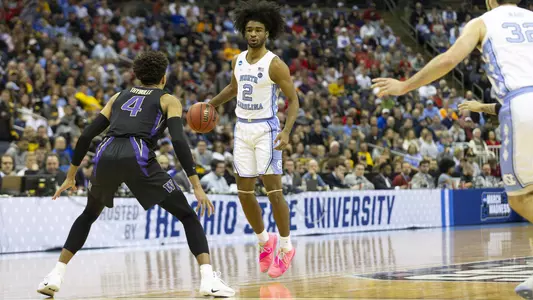
Photo by: J.D. Lyon Jr.
Lucas: Beat The Clock
March 28, 2019 | Men's Basketball, Featured Writers, Adam Lucas
Carolina continues to work on late clock offensive execution.
By Adam Lucas
KANSAS CITY—There won't be very many late-clock situations on Friday night when Carolina meets Auburn in the regional semifinals.
But they might be the most important possessions of the game, and that's why Roy Williams has been so worried about Carolina's execution in those scenarios. The Tar Heel head coach mentioned late clock offense as one of the two areas (defense was the other) where his team needed to improve going into the postseason.
Williams says he's practiced late clock offense more this season than any other year of his coaching career, and he still isn't satisfied with the Tar Heels' proficiency. The two primary Carolina point guards agreed on Thursday about the source of the issues.
"We have to set up our offense earlier in those situations rather than letting the clock run down," Coby White said. "Under ten seconds (on the shot clock) is too late. I need to start it more around 12 or 13 seconds."
"We end up rushed when we start the offense too late," said Seventh Woods. "Coach wants Coby and I to get the ball around 15 seconds (on the shot clock), because that gives you a little more time. When you go get it at 10, you're really beginning the offense at eight seconds, and you usually end up settling for an outside shot or a contested shot."
That's an ongoing adjustment for White, who has been the primary late-clock offense on every team on which he's ever played. Clock running out? Just get the ball to Coby and let him do his thing.
Williams would like his late clock offense to be slightly more sophisticated, or at least more aggressive. He wasn't pleased, for example, when the Tar Heels didn't get a great shot at the end of the Duke game in the ACC Tournament semifinal.
That's part of the issue with Carolina's late clock offense—they simply don't get very many game situations to practice it. And when they do, it's often some of the most important possessions of the game.
You probably already know the Tar Heels are playing at the fastest tempo of Roy Williams' career in Chapel Hill. You might not realize how that manifests itself in the course of a game. Carolina has played two NCAA Tournament games so far, and they have a combined 67 field goals in those games. Only five of those baskets have come with fewer than ten seconds on the shot clock.
A startling eleven of the 67 hoops have come with 25 seconds or more remaining on the shot clock—and that's not counting baskets scored on offensive rebound putbacks. That means there have been 11 occasions in the first two games of the postseason when the Tar Heels have taken control of the ball and then scored within five seconds. That's an amazing statistic.
But it also doesn't leave much room for game speed repetitions on late clock situations. Of those five baskets with under ten seconds on the shot or game clock remaining, only one was a traditional late clock type of basket, with White splitting a double team and scoring through contact near the rim.
"The first key is not to panic," says Brandon Robinson, who had a nice assist to Cameron Johnson on one of Carolina's late baskets. "And I think we do a good job of that. We don't get in a frenzy when the clock gets low."
Of course, as both White and Woods said, part of the issue might be that the Tar Heels are a little too lackadaisical when the clock gets low. And with both Carolina and Auburn expected to push the pace at the Sprint Center, late clock execution may not matter…until it very much matters.
"At this time of year, everything is important," Woods said. "The next game we play could come down to one late clock situation, and I think we're ready for it."
KANSAS CITY—There won't be very many late-clock situations on Friday night when Carolina meets Auburn in the regional semifinals.
But they might be the most important possessions of the game, and that's why Roy Williams has been so worried about Carolina's execution in those scenarios. The Tar Heel head coach mentioned late clock offense as one of the two areas (defense was the other) where his team needed to improve going into the postseason.
Williams says he's practiced late clock offense more this season than any other year of his coaching career, and he still isn't satisfied with the Tar Heels' proficiency. The two primary Carolina point guards agreed on Thursday about the source of the issues.
"We have to set up our offense earlier in those situations rather than letting the clock run down," Coby White said. "Under ten seconds (on the shot clock) is too late. I need to start it more around 12 or 13 seconds."
"We end up rushed when we start the offense too late," said Seventh Woods. "Coach wants Coby and I to get the ball around 15 seconds (on the shot clock), because that gives you a little more time. When you go get it at 10, you're really beginning the offense at eight seconds, and you usually end up settling for an outside shot or a contested shot."
That's an ongoing adjustment for White, who has been the primary late-clock offense on every team on which he's ever played. Clock running out? Just get the ball to Coby and let him do his thing.
Williams would like his late clock offense to be slightly more sophisticated, or at least more aggressive. He wasn't pleased, for example, when the Tar Heels didn't get a great shot at the end of the Duke game in the ACC Tournament semifinal.
That's part of the issue with Carolina's late clock offense—they simply don't get very many game situations to practice it. And when they do, it's often some of the most important possessions of the game.
You probably already know the Tar Heels are playing at the fastest tempo of Roy Williams' career in Chapel Hill. You might not realize how that manifests itself in the course of a game. Carolina has played two NCAA Tournament games so far, and they have a combined 67 field goals in those games. Only five of those baskets have come with fewer than ten seconds on the shot clock.
A startling eleven of the 67 hoops have come with 25 seconds or more remaining on the shot clock—and that's not counting baskets scored on offensive rebound putbacks. That means there have been 11 occasions in the first two games of the postseason when the Tar Heels have taken control of the ball and then scored within five seconds. That's an amazing statistic.
But it also doesn't leave much room for game speed repetitions on late clock situations. Of those five baskets with under ten seconds on the shot or game clock remaining, only one was a traditional late clock type of basket, with White splitting a double team and scoring through contact near the rim.
"The first key is not to panic," says Brandon Robinson, who had a nice assist to Cameron Johnson on one of Carolina's late baskets. "And I think we do a good job of that. We don't get in a frenzy when the clock gets low."
Of course, as both White and Woods said, part of the issue might be that the Tar Heels are a little too lackadaisical when the clock gets low. And with both Carolina and Auburn expected to push the pace at the Sprint Center, late clock execution may not matter…until it very much matters.
"At this time of year, everything is important," Woods said. "The next game we play could come down to one late clock situation, and I think we're ready for it."

Players Mentioned

G
/ Men's Basketball
G
/ Men's Basketball
G
/ Men's Basketball
G
/ Men's BasketballMonday, September 21
Monday, September 21
Sunday, September 20
Friday, September 18