


University of North Carolina Athletics
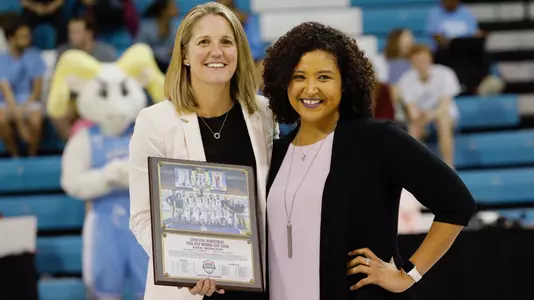
Nicole Alexander (right, with head coach Courtney Banghart) was honored before a women's basketball game in 2020 for her work with USA Basketball.
Photo by: UNC Athletic Communications
Q and A with Staff Athletic Trainer Nicole Alexander
June 10, 2020 | Women's Basketball
Throughout the year, the UNC women's basketball program relies heavily on the "team behind the team," professionals who support the Tar Heels' success. Those roles are just as crucial during the offseason, when student-athletes work hard to make gains for the coming campaign.
The 2019-20 season was Nicole Alexander's seventh as the staff athletic trainer. She is responsible for the wellness of the team, coordinating all injury rehabilitation and making sure the Tar Heels are as healthy as possible.
Alexander earned her undergraduate degree at University of Florida then went on to Syracuse for a master's degree in exercise. She worked at Notre Dame for five years before coming to Chapel Hill in 2013.
In addition to her responsibilities at UNC, Alexander has worked and traveled with USA Basketball teams, most recently supporting the U.S. team at the 2018 FIBA U17 World Cup in Belarus.
Alexander spoke recently with GoHeels.com:
GoHeels: What's your usual off-season focus with the team?
Nicole Alexander: Off-season focus is dependent on the person. My focus in late spring (immediately after season) is to rehab any injuries that may be lingering from the previous season. Typically this is the time for end-of-season physicals with our team physician, Dr. Harry Stafford, and developing specific plans for the summer. With COVID-19 this was a bit more challenging. We were able to schedule follow up tests (x-ray, MRI, etc.) for our athletes closer to home. I have since been able to send rehab programs based on what is needed. This is difficult with not being able to see the athletes in person, but we are finding a way!
GH: As a professional who has worked in this field for more than a decade, are you seeing some recent trends? Have rehab practices and/or common injuries changed since you came to UNC in 2013?
NA: I think the biggest change I have seen in the past 12 years is the technology we have available. There used to be somewhat limited resources (ice bag, heat pack, electrical stim, ultrasound, etc.). Now, in 2020, we have access to recourses such as blood flow restriction therapy (BFR), which assists in muscle growth, and dry needling techniques, which helps with anything from swelling to scar tissue formation. The progressions in technology allow us to add to our typical treatment and rehab programs and tailor them specifically to the athlete, with the ultimate goal of a faster return to activity.
There is also an increase in recovery methods. In addition to more familiar methods such as stretching and ice baths, we now have other resources like recovery boots, vibrating foam rollers, and the Game Ready ice and compression machine that we use regularly. These things are also portable, which allows us to travel with these resources to make sure that our athletes don't miss out on recovery while on the road.
GH: What kind of contact do you have with the incoming freshmen, in terms of making sure they're ready to hit the ground running (literally, perhaps) when they get to Chapel Hill?
NA: My contact with the incoming freshmen is typically somewhat limited until they arrive on campus. However, one positive to COVID-19 is that I have been able to develop a relationship with them before their arrival, as I have been doing regular check-ins with them via telephone. This has allowed me to gain a little bit of understanding of their bodies, especially from their perspective. This will help our relationship when they arrive on campus and will help them learn that visiting the Athletic Trainer is not just for times that they're hurt.
GH: How has not being on campus as a team this spring changed your preparation for the summer and fall?
NA: Not being on campus has changed everything for summer and fall. This is the longest the athletes have gone without structured workouts or treatment. Therefore, our return to activity will be look very different than it has in the past. I know, however, that the team has really taken ownership of their individual preparation for return to activity. They have really bought in to flexibility in order to prevent injury.
On a positive note, being away has allowed for a lot of good communication between myself and the team. It can be very easy for them to come into see me, have me evaluate them and decide on a treatment plan. Being limited to virtual check-ins has increased their ability to communicate what body part and what motions may be causing an issue. It has also increased their ability to take ownership of doing stretches and exercises and in turn feeling better.
The virtual check-ins have also allowed me to improve as a clinician. I am so used to using my hands to evaluate and treat. Without that I have had to increase my skills as a listener, so I am excited to be able to use this as a learning opportunity to grow along with my athletes.
The 2019-20 season was Nicole Alexander's seventh as the staff athletic trainer. She is responsible for the wellness of the team, coordinating all injury rehabilitation and making sure the Tar Heels are as healthy as possible.
Alexander earned her undergraduate degree at University of Florida then went on to Syracuse for a master's degree in exercise. She worked at Notre Dame for five years before coming to Chapel Hill in 2013.
In addition to her responsibilities at UNC, Alexander has worked and traveled with USA Basketball teams, most recently supporting the U.S. team at the 2018 FIBA U17 World Cup in Belarus.
Alexander spoke recently with GoHeels.com:
GoHeels: What's your usual off-season focus with the team?
Nicole Alexander: Off-season focus is dependent on the person. My focus in late spring (immediately after season) is to rehab any injuries that may be lingering from the previous season. Typically this is the time for end-of-season physicals with our team physician, Dr. Harry Stafford, and developing specific plans for the summer. With COVID-19 this was a bit more challenging. We were able to schedule follow up tests (x-ray, MRI, etc.) for our athletes closer to home. I have since been able to send rehab programs based on what is needed. This is difficult with not being able to see the athletes in person, but we are finding a way!
GH: As a professional who has worked in this field for more than a decade, are you seeing some recent trends? Have rehab practices and/or common injuries changed since you came to UNC in 2013?
NA: I think the biggest change I have seen in the past 12 years is the technology we have available. There used to be somewhat limited resources (ice bag, heat pack, electrical stim, ultrasound, etc.). Now, in 2020, we have access to recourses such as blood flow restriction therapy (BFR), which assists in muscle growth, and dry needling techniques, which helps with anything from swelling to scar tissue formation. The progressions in technology allow us to add to our typical treatment and rehab programs and tailor them specifically to the athlete, with the ultimate goal of a faster return to activity.
There is also an increase in recovery methods. In addition to more familiar methods such as stretching and ice baths, we now have other resources like recovery boots, vibrating foam rollers, and the Game Ready ice and compression machine that we use regularly. These things are also portable, which allows us to travel with these resources to make sure that our athletes don't miss out on recovery while on the road.
GH: What kind of contact do you have with the incoming freshmen, in terms of making sure they're ready to hit the ground running (literally, perhaps) when they get to Chapel Hill?
NA: My contact with the incoming freshmen is typically somewhat limited until they arrive on campus. However, one positive to COVID-19 is that I have been able to develop a relationship with them before their arrival, as I have been doing regular check-ins with them via telephone. This has allowed me to gain a little bit of understanding of their bodies, especially from their perspective. This will help our relationship when they arrive on campus and will help them learn that visiting the Athletic Trainer is not just for times that they're hurt.
GH: How has not being on campus as a team this spring changed your preparation for the summer and fall?
NA: Not being on campus has changed everything for summer and fall. This is the longest the athletes have gone without structured workouts or treatment. Therefore, our return to activity will be look very different than it has in the past. I know, however, that the team has really taken ownership of their individual preparation for return to activity. They have really bought in to flexibility in order to prevent injury.
On a positive note, being away has allowed for a lot of good communication between myself and the team. It can be very easy for them to come into see me, have me evaluate them and decide on a treatment plan. Being limited to virtual check-ins has increased their ability to communicate what body part and what motions may be causing an issue. It has also increased their ability to take ownership of doing stretches and exercises and in turn feeling better.
The virtual check-ins have also allowed me to improve as a clinician. I am so used to using my hands to evaluate and treat. Without that I have had to increase my skills as a listener, so I am excited to be able to use this as a learning opportunity to grow along with my athletes.
MBB: Luka Bogavac Interview In Serbian
Sunday, March 08
UNC Baseball: Howe Walks-Off Virginia in 12th Inning, 8-7
Sunday, March 08
UNC Softball: LeGette Rallies Heels Past Hoos in Extras, 11-9
Sunday, March 08
UNC Men's Lacrosse: Tar Heels Defeat Brown for Breschi's 175th Win at UNC
Saturday, March 07