University of North Carolina Athletics
Car-O-Lines: Fans Stick With Vastly Improved Tar Heels
January 2, 2002 | Men's Basketball
Jan. 2, 2002
By Rick Brewer, SID Emeritus
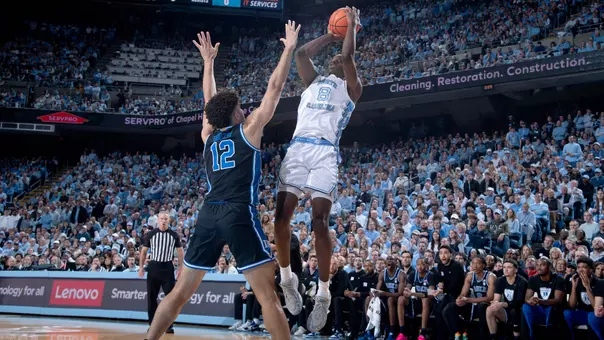
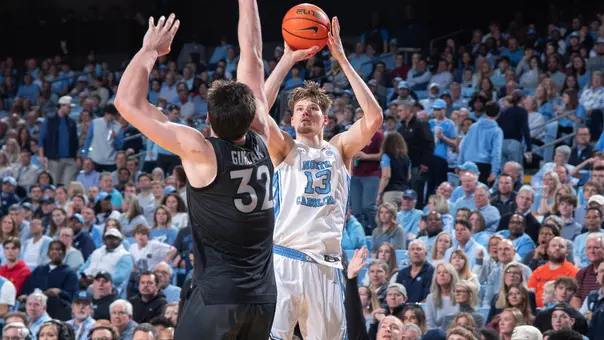
CHAPEL HILL-- One of the most surprising aspects of the recent holiday season was the attendance at two North Carolina basketball games.
Over 15,000 fans saw the Tar Heels score one-sided victories over North Carolina A&T and Texas A&M.
What makes this so unusual was the uncharacteristically slow start by Carolina this year.
Plus, over 23,000 Tar Heel fans were in Atlanta for Carolina's appearance in the Peach Bowl.
Students were also away from campus on the holiday break between semesters.
Most season ticket holders at the Smith Center were travelling with the football team. It's a credit to them that they apparently gave their tickets to friends who would not normally be able to see a basketball game in Chapel Hill.
"I was stunned when I went to the A&T game," said local fan the next day. "I even left a little late, figuring I'd have no trouble getting to the Smith Center or securing a ticket. I was able to buy a ticket when I got to the arena.
"But, getting there was the problem. The parking lots were just as crowded as usual."
The traffic may have even been heavier than normal because many of the fans were unfamiliar with the parking situation. Cars were lined up on Manning Drive as fans searched for available parking lots.
Such is the interest in Carolina basketball, even though the team entered the last two games of the year with a 3-5 record.
What these people saw was a Tar Heel team that has vastly improved since opening the season with three straight losses. That isn't to say Carolina is once again one of the top four or five teams in the country, but Coach Matt Doherty has certainly been happy with the progress his young squad has made.
"We've gotten a lot better in every area of play," said Doherty after Carolina won both of its final games in 2001 to even its record at 5-5. "But, we've still got a long way to go to be the type of team we want to be."
Doherty knows the Tar Heels have now begun the toughest part of their schedule-games against Atlantic Coast Conference competition. Five of those ACC opponents have already been nationally ranked at one time or another this year.
It is in these games that the Tar Heels will get a better picture of what their greatest strengths and weaknesses are.
One thing Carolina certainly gained in the latter stages of 2001 was much needed confidence. But, former Tar Heel Coach Dean Smith always warned his teams about getting a "false sense of confidence" because of wins against non-conference opponents. He feared that would make them vulnerable to the rugged play they would face in the ACC.
Still, with its inexperience and the way the season started, this team needed any kind of a boost to its confidence before tackling league opposition.
There were several noticeable differences between Carolina in late December from the team that began play in late November.
Foremost was better decision-making. Shot selection improved drastically. Players still took some bad shots-long jumpers with no offensive rebounders around the basket and driving layup attempts into heavy traffic. Players still occasionally fired up shots with two or three defenders on them, while a teammate stood wide open much closer to the basket.
But, overall, these were cut down a great deal.
The same was true for turnovers. Those numbers decreased considerably, especially the unforced errors that plagued Carolina earlier in the year. However, improvement must continue in that area as the Tar Heels begin facing the pressure defenses used by so many of its ACC opponents.
Shooting percentages in games increased a great deal. Shot selection had a lot to do with that, as did better execution of the fast break.
Defensive rebounding and excellent outlet passes helped set up a lot of fast break opportunities in the latter part of December.
The Tar Heels also made greater use of the three-point shot in this stretch. Earlier in the season three-pointers were seemingly being tossed up anytime someone could get himself open.
But, as the younger players began to get more experience and Jason Capel was able to shake an unusual shooting slump, three-point shots began to fall more regularly.
Players stopped trying to create their own three-point opportunities off the dribble and were instead setting up behind the arc, waiting for passes out of the halfcourt offense.
Spotting up for three-pointers make the shot so much easier than trying to take them after dribbling. By spotting up, players can get their feet set under them which makes them much more accurate with their shooting. Getting their feet set in such a manner is what made players like Hubert Davis, Ranzino Smith and Jeff Lebo such deadly shooters from long range.
The entire halfcourt offense also began to operate more efficiently. A lot of credit for that must go to point guards Melvin Scott and Adam Boone. The experience they gained in the first month of the year made them much better at directing the attack.
The Tar Heels were much more active defensively late in December. A number of fast break baskets came as a result of turnovers forced by Carolina's pressure defense.
Improved play by Capel was another big factor in the late December wins. He may have been pressing early, trying to compensate for the inexperience of younger teammates. But, he seemed to get much more at ease as the season progressed. His shooting returned to form and he continued to be outstanding on the backboards.
Carolina needed his rebounding as Kris Lang was slowed the last half of December with a knee injury.
Lang and Capel have played out of their normal positions all year because of personnel problems. Lang, a natural power forward, was moved to center and Capel, the prototype small forward, was shifted to Lang's old spot.
Center and power forward are almost interchangeable in Carolina's offense so the change wasn't been as much of a problem for Lang as it was for Capel. Even though his offense seemed out of sync earlier in the year, Capel was still effective defensively and on the boards. When his shooting returned to normal, he was again the effective player he had been for his first three years on campus.
If 6-9 freshman Jawad Williams continues the rapid improvement he showed the first month of the year, Capel could even move back to his familiar small forward slot on a more regular basis.
Even with improvement in these areas, Doherty knows his team has a long way to go. But, like the Smith Center crowds over the holidays, he had to be encouraged by what he saw late in the year. Now the real tests begin.
To keep up with everything going on in Carolina athletics - including last-minute ticket availability, special ticket offers, merchandise specials, and late breaking news - subscribe to the Tar Heel News Flash email newsletter. To subscribe all you have to do is send a blank email to uncathletics-join@listserv.unc.edu.