University of North Carolina Athletics
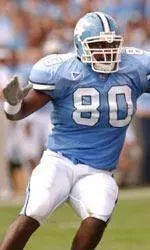
Countdown to Kickoff: Training Camp Wrap
September 2, 2005 | Football
Sept. 2, 2005
By Adam Lucas
The training camp phase of preseason practice ended Wednesday night with a general feeling of optimism--despite dire forecasts from outside observers--radiating from the program. It's the most positive training camp since John Bunting's first year at Carolina. Last year the early positive returns were smoked by the season-ending injury to Chase Page. Depth, especially on the defensive side, was so scarce in 2003 that Madison Hedgecock had been moved to defensive end. And even in 2002, coming off a stirring run to a Peach Bowl victory, coaches knew it might take some rebuilding before the Tar Heels could put the same type of talent on the field they'd utilized in 2001.
But optimism never won a game. And while the past three weeks of preseason practice have answered some of the questions that lingered over the summer, others can't--or won't--be answered until the Tar Heels take the field in Atlanta on September 10.
What follows are the five key queries that fall into each of those two categories.
Questions Answered
This was the rallying cry of the woe-is-Carolina crowd throughout the summer. But while observers gnashed their teeth over his unproven record as a college quarterback--he'll likely throw more passes in the first month of the season than he's thrown in his previous three years of college eligibility--Baker was busy organizing voluntary workout sessions for his teammates and sitting in film rooms studying tape of Georgia Tech.
Baker has a stronger arm than Darian Durant and is more athletic than many people realize. Remember, he was an outstanding prep lacrosse player, so he knows how to move.
It turns out there are several. Cooter Arnold has gotten the most publicity of Carolina's backups, and the freshman from Davie County will play early and often for the Tar Heels. But don't forget about Richie Rich, who has shown flashes of toughness throughout training camp and will eventually be a contributor, and Justin Warren, a walk-on who may earn some playing time. Warren will likely start the season as the third-stringer.
This may be the most unexpected surprise of training camp. In the spring, there wasn't much optimism about the health of Scott Lenahan, Calvin Darity, and Bryon Bishop. Combine that with the absence of Skip Seagraves and the Tar Heels had to shuffle players between the first-team and the second-team during the same drill in spring ball. Steven Bell might work at first-team center on one snap, second-team guard on the next.
Darity has made the most progress, as he's been able to participate in scrimmages and is almost two months ahead of schedule. Scott Lenahan has also made rapid strides from a serious knee injury.
Seagraves is also back, which means the Tar Heels can almost fill out the two-deep without having to utilize any true freshmen. Offensive line coach Hal Hunter will have the luxury of playing Andre Barbour, Garrett Reynolds, or Kyle Jolly if he feels they're ready rather than having to initiate them out of necessity.
Landing Tommy Thigpen was a master stroke, as the former Tar Heel standout has quickly connected with his linebackers. Thigpen has been a valuable recruiter at all of his coaching stops and should do the same for Carolina.
Receivers coach Dave Brock isn't as boisterous as his predecessor, Gunter Brewer, but the receivers seem to have taken to him. He oversees the deepest position group on the field for the Tar Heels, depth that's been bolstered by Brooks Foster's quality training camp.
Part of the addition of the new coaches was a restructuring of the staff--the return of Kenny Browning to defensive tackles should pay significant dividends. Marvin Sanders has the sole control of the defense this year and has noticed an attitude overhaul.
"The players really got some confidence last year late in the season," he said. "They started understanding our system better and they saw that it can work. That's carried over now. There's a good spirit with them. You see them coming off the field and there's something you like about them. You can't put your finger on it, it's just this feeling."
After a star-studded 2004 haul, the 2005 group that signed in February was less widely praised by those who make it their business to do such things. The Carolina coaching staff didn't seem concerned. They'd evaluated most of the class in person and felt a combination of factors--including the fact that early commitments, like those of Camaron Thomas, tend to be grossly undervalued because there's none of the Signing Day press conference drama that follow players who string out their decisions--meant this class would be better than expected.
Early returns suggest they were right. The class will eventually divide into two groups: those who play this year and those who redshirt. Those who play will do so because they've earned the snaps. That group includes Cooter Arnold, Nick Starcevic, Richard Quinn and Garrett White. But don't overlook the players who are likely to redshirt. Little-known Andre Coleman has been a surprisingly big hitter considering his size, Jordan Hemby is a future cover cornerback, and Thomas will get a chance to plug the middle of the defensive line once Chase Page graduates.
 |
Countdown to Kickoff: 8 Days
|
The Tar Heels are gradually building young depth. As evidence, consider the situation of redshirt freshman receiver Brooks Foster. Bunting brought him up at least once per week as having one of the best camps of any player, but despite his high level of play, he wasn't able to crack the two-deep. Every player wants to play immediately, but that type of dues-paying is a good sign for the program.
Unanswered Questions
This is the one question on his resume still remaining. It's easy to quantify things like running speed and arm strength. But until Sept. 10 at 3:30, there's no way to know how he'll react to a horde of angry Georgia Tech blitzers chasing him around Grant Field. He has impressed teammates so far with his confidence. But he's spent all of training camp wearing a red no-contact jersey. That won't be the case in the opener.
Roger Heinz's season-ending surgery was important because it subtracted the quarterback with the best knowledge of Carolina's offensive system. The Tar Heels don't want to put a QB under center who doesn't understand the playbook and allow defenses to tee off on simple plays. That's why Joey Bozich's biggest task during camp wasn't learning how to throw the out route or hit a skinny post. It was getting comfortable with Gary Tranquill's precise scheme.
Bozich enters the season as the backup quarterback and the Tar Heels aren't counting on Cameron Sexton--unless they hear differently from a doctor--unseating Bozich. Sexton remains on injury rehab from a broken ankle suffered in spring practice.
The LSU transfer entered camp as the anointed starter at tailback following Ronnie McGill's chest injury. Edwards is still holding onto that role, but he'll be critical in pass blocking and must improve in that area.
"Barrington had a pretty good camp," Bunting said. "I'd like to see him progress more in terms of knowledge of our scheme. He has a ways to go...He has to come to grips with continuing to make good decisions. There are a lot of things that don't transfer from the meeting room to the field. That has to happen soon.
"In the first three games, we're going to get blitzed coming off the bus. (Picking that up) isn't a problem with his physicality. It's alertness and awareness. We have to get into a game and see what he can do with that type of pressure on him."
Line play is always difficult to evaluate during training camp. One side has to play better, but it could be because the other side is weak.
That being said, the line did look better against the run during camp. But ends Brian Rackley and Tommy Davis have to generate some pass rush in order to prevent teams from marching down the field. Defensive coordinator Marvin Sanders shelved numerous blitzes in the final scrimmage in an effort to evaluate his front four.
"I think they can create some rush," he said. "When I watch film of them, we've got some young guys who can get after the quarterback."
Both Bunting and Sanders said they plan to blitz more in 2005. That's exciting from a fan standpoint and can create big losses, but the more blitzes, the more opportunity for offensive big plays. The 2001 team rarely blitzed--they didn't have to, because the front four was always in the backfield.
This is a major point of emphasis on defense.
"Getting off the field on third downs is key for us," Chase Page said. "The big thing is we have to win on first down in order to push them to a third and long. That's why stopping the run will always be the biggest deal."
There's a general feeling the Tar Heels will be better against the run, turning some of those first-down rushes that have gone for 5-7 yards the past three years into short-gainers and ultimately creating longer passing situations on third down. But Georgia Tech's P.J. Daniels will provide a true test--he gouged the Heels for 240 yards in 2003.
Adam Lucas is the publisher of Tar Heel Monthly and can be reached at alucas@tarheelmonthly.com. He is the coauthor of the official book of the 2005 championship season, Led By Their Dreams, and his book on Roy Williams's first season at Carolina, Going Home Again, is now available in bookstores. To subscribe to Tar Heel Monthly or learn more about Going Home Again, click here.
Players Mentioned