University of North Carolina Athletics
Overcome
December 26, 2015 | Football, Featured Writers, Turner Walston
This story originally appeared in the December 22 issue of CAROLINA.
By Turner Walston
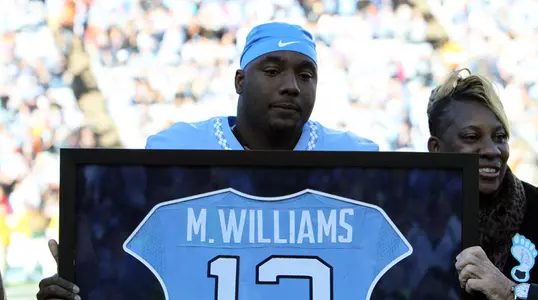
Marquise Williams is overcome. He examines a picture of himself on Senior Day. In it, he stands with his mother, holding a framed jersey minutes before kickoff against Miami. It's hard to describe the look on his face –not smiling, not frowning, but a bit bleary-eyed. Overcome. “Just finished crying,” he says of the face in the picture. “Like, 'Wow, I did it,' and this would be my last time playing at Kenan Football Stadium.”
It still hasn't hit Williams that he's just days away from playing his final game at quarterback for the North Carolina Tar Heels. It still hasn't hit him that not long ago he wore a cap and gown and received his degree in communication studies, with a minor in sociology. “I feel like I still have a semester to come back and finish school,” he says, “but it's been a long five years. It's been ups and downs, there's been fun, there's been adversity. It still hasn't hit me yet.” Marquise Williams is overcome.
Things came easy for eight year-old Marquise. Growing up in Shelby, he starred on the football and baseball fields at the city park. He made A's and B's in the classroom. He was just in elementary school, but he was 'The Man.' Or so he thought.
“I thought I knew everything at eight, nine, ten years old,” he says now, at 23. “I thought I was on top of the world. I was just one of the best football players in my little town.”
Sports and school came easy to Williams. “I was making A's and B's, but I didn't like to read,” Williams says. “I didn't want to do any of the homework assignments. I would just ace the test and I'd be good.” Williams' father warned him that adversity would come. If not now, then someday.
For even the brightest students, there comes a time that simply being smart alone no longer works; that studying and dedication become necessary. Williams was doing well in his favorite subject, math, but his disinterest in reading was going to catch up with him.
A school administrator set Williams up with a tutor, Robin Smith. “Mrs. Smith comes in and she says, 'Hey, I'm Robin Smith,'” Williams remembers. “I said, 'Hey, I'm Marquise,' and she's like 'Today we're going to be reading.' I'm seven or eight. 'I'm not reading. I can pass my test. I do not need help reading.'”
That attitude would come back to bite Williams, who later failed the reading portion of an end-of-grade test. “Mrs. Smith was like, 'See, if you had just listened to me and your dad, you'd have been successful. The second time, I studied and I passed it. I looked at it like, man, I need to get something together, because I think I'm too mannish.' I could have been held back, and then everybody would have been laughing at me.”
Williams learned his lesson, and Smith earned the young man's trust. He played baseball with her son Baxter, got to know her husband Kip, and rode horses with daughter Wesley, now a Carolina student. “This family didn't come out of the woodwork when I was doing well in football,” he says. “They came out and helped me read.”
He began to accept that he didn't know everything, that there were worthwhile mentors in life. “I wasn't going to let myself down again; that was the thing,” he says. “Any advice somebody was giving me, I was going to take it and run with it.”
Williams also took the football and ran with it, taking new Mallard Creek High School from a one-win season to a pair of playoff appearances. His success on the football field garnered the attention of programs nationwide. The recruiting battle came down to Virginia Tech and North Carolina. In Chapel Hill, he sat in on quarterback meetings and sensed the familial atmosphere in the room. “I knew right then that that was a close group that I wanted to be around,” he says. “I saw how Bryn (Renner) was learning from T.J. (Yates). Bryn wasn't the starter, but when his time came, he was ready to go.”
The relationships, with Butch Davis and John Shoop, and with his fellow quarterbacks, won him over. He decided he wanted to blaze his own trail at Carolina.
“When you think of North Carolina, you're thinking of the basketball program,” he says now. “I wanted to go somewhere and change it. I didn't want to go to Virginia Tech, where there's always been a tradition, a legacy of guys winning ACC championships. I could have gone anywhere in the country, but I wanted to come here because that's what I did in high school at Mallard Creek. I went to a brand new school. I wanted to build my own legacy. I wanted to make history where I was. That was my goal. I didn't want to go on something that was already there; I wanted to start something new.”
Williams arrived on campus in January 2011. Yates, who had just led the Tar Heels to a Music City Bowl victory in his final game, told Williams that the journey ahead wasn't going to be easy, that he shouldn't expect to start right away. “He said, 'If I were you, I'd learn a lot from Bryn, because Bryn has learned a lot from me. He's going to be a successful guy, and when his time is up, you're going to be there,'” Williams remembers.
He threw himself into his playbook and got a jump on his academics. But that summer, the head coach who had recruited him was fired. Williams redshirted in the fall, and Larry Fedora was hired in December. The coaching staff that had recruited him was gone. The pro-style offense that he'd spent a year learning no longer fit the offensive philosophy. All of a sudden, there was doubt.
“I was a big Butch Davis fan,” Williams says. “I committed to him, and it's like, 'What do I do now?' In the back of my mind, I knew I'd committed to Butch Davis, but I committed to the university. I committed to a lot of fans, and my goal is to come and start my legacy and make history here. I said, I'm going to stay here. I'm not going to transfer anywhere. Whoever the coach is next, I'm going to give him my all. I'm going to try my best to get on the football field.”
He tried his best, subbing for Renner in nine games as a redshirt freshman. He threw for 127 yards and a score and rushed for 186 and three.
But that spring, he was off the field and out of school due to an academic suspension. Williams had turned back into the mannish boy that had gotten into trouble in Shelby. “As a freshman, you're not really thinking,” he says. He took the easy way out in the classroom and was caught.
“I got suspended out of school,” he says. “And then it's like everybody forgot who I was.” Mitch Trubisky, Fedora's first quarterback recruit, had enrolled in January. “Everybody was talking about Mitch Trubisky, Mr. (Football) Ohio. I was like, 'If I get the opportunity to come back, I'm going to make people remember who I was.' These people used to love me, and now they just let me go.”
On to the next one. Yates and Renner had warned him. Yates had even been booed when he was shown on the screen at a basketball game. By his own school's fans. It's tricky, being the quarterback. When you're the backup, they're clamoring for you to play. When you're the starter, they're looking ahead to the next man. And now, Williams had taken himself out of the running.
“I said, 'Man, I've got some work to do.' [Trubisky was] a special kid coming out of high school, and he's still the real deal now. Either you want it or you let it get taken away from you. I said, 'This is my opportunity to be successful. This is my opportunity that a lot of kids will not be able to get.'
He went about the work of making it right. He wasn't in school and couldn't practice, but he could hit his playbook hard. Teammate Mack Hollins volunteered to throw with him. “That's when nobody knew who Mack Hollins was,” Williams says now. “We would come out and throw in the mornings. After he finished Blue Dawn (spring conditioning), he would come around with me. That's one guy that I can always trust and believe in, because that guy was there with me when nobody else was.”
After serving his suspension, Williams returned to the team and school. Renner was the starter, but with Trubisky redshirting, Williams appeared in relief and for an occasional change of pace. Then, he made his first career start at Virginia Tech, where he threw for 277 yards and two touchdowns. The Tar Heels hadn't won the game, but they'd competed behind a first-time starter.
“It was fun,” he says. “After that day, Bryn told me, 'You're going to be very special because of some of the plays I saw you make out there today.'” Four weeks later, Renner was lost for the season after injuring his shoulder late in the third quarter at NC State. By that point, Williams was appearing in every third or fourth series. He then took the reins of the offense and helped the Tar Heels finish a 27-19 win.
Renner signed with an agent following his injury and could no longer be on the sideline. Still, he watched and advised Williams, who went 4-1 in his final five starts. Three days after Christmas, Carolina won the Belk Bowl behind big plays from Williams and a Ryan Switzer punt return touchdown.
As a junior, Williams was the starter, with Trubisky alternating occasional series, as Williams had done with Renner. Still, Williams set 18 single-season or career records, including tallying 3,856 yards of total offense, 362 better than Renner's 2012 mark. The full-time starter in 2015, Williams led the Tar Heels to 11 straight wins after stumbling in the opener to South Carolina. And the Tar Heels were an onside kick recovery away from a potential game-tying drive in the ACC Championship game against Clemson.
In the process, Williams has helped put Carolina football in the national conversation and helped change perceptions in Chapel Hill. At a recent basketball game, an usher recognized him and asked if he would be OK with fans seeking pictures and autographs. Of course he was. “He said, 'I'm going to have to stop some of them from coming,' and I said, 'No, you're not. These people made me, man. These people put me in this situation of who I am today. These people have been there for me when a lot of people turned their backs on me, and if they want to come take a picture, I can move my seat.'” The fans in the same building that once booed its quarterback now are eager to stand next to him. And Williams is happy to oblige. “I want to thank them for the opportunity to come play football and to also receive a degree from the best university,” he said. “I have one more game to enjoy this ride, but man, it's been a great one. It's been a great one.”
On December 13, Williams was back in the Smith Center, graduating from Carolina with a degree in communications and a minor in sociology. The 'mannish' boy had become a man. The journey was nearly complete. “It meant a lot,” he said of wearing the Carolina blue cap and gown. “I went through a little bit of adversity, but I still achieved my goal. I was telling myself, I'm not coming here five years and not get my degree. When you see North Carolina, that's a very special degree. It still hasn't hit me, but that was a dream come true and I wanted to cry. It was an emotional day for me, to see Landon, Jeff Schoettmer, Shak and Romar, Sam Smiley, Alex Bales, Ian Dibble, Jarrod James, all those guys . . . it was like, man these are the guys I came in with, and now we're finally leaving with a degree.”
On December 29, Williams and his fellow seniors will play their final game in Carolina blue in the Russell Athletic Bowl against Baylor. The Tar Heels have the opportunity to win a twelfth game, something no team before them has done. For Williams, it's a chance to break more records and further cement his legacy.
“I'm going to give it my all,” he said. “My main thing is getting that twelfth win. That's all I'm really thinking about, getting that twelfth win for this university.”
When he was younger, Marquise Williams played the NCAA Football video game, putting himself at quarterback of the Tar Heels, setting records and taking his team to the ACC championship. He's done those things in real life. His name will be among the greats at Carolina: Renner, Yates, Darian Durant, Ronald Curry. “Knowing I'm in the record book, and my name will always be there, it's special,” he said. “I'm going to always remember that I set a lot of records here and I've done a lot of great things. I'm speechless, because this is what you dream about. You want to always be remembered for something good.”
Indeed. And because of adversity, because of triumph, because of wins, losses, records and championships, because of all that Marquise Williams has overcome, Marquise Williams is overcome.
Turner Walston is the editor of CAROLINA digital magazine. Follow Turner on Twitter.