University of North Carolina Athletics
Know Your Final Fours: Part One
March 31, 2016 | Men's Basketball
Carolina opens play in its 19th Final Four Saturday night in Houston. Take a look back at the 18 prior trips that have defined the program's history over the last eight decades. Part one takes you from the first UNC run to the final in 1946 to the program-defining championship season of 1982.
1946
Finish: Runner-up (Lost to Oklahoma A&M, 43-40)
Location: Madison Square Garden, New York, N.Y.
Final Record: 30-5, 13-1 SoCon
The NCAA tournament of the early days bore little resemblance to the event we will see Saturday night in Houston. Starting in 1939, an eight-team field made up of two four-team regionals - East and West - played for the title. After going 0-2 in its first NCAA tournament in 1941, Carolina advanced to the national championship game in 1946 with wins over NYU and Ohio State in the East Regional. Those victories at Madison Square Garden gave the Tar Heels a shot at defending champion Oklahoma A&M in the final, which was also held at MSG.
A&M (present-day Oklahoma State) was coached by Hall of Famer Henry Iba and led by 7-footer Bob Kurland. Kurland, a Hall of Famer himself whose shot-blocking prowess led to goal tending being banned from the game, scored a game-high 23 points and earned Most Outstanding Player honors for the second straight year. John "Hook" Dillon, one of two All-Americans on the team along with Jim Jordan, led Carolina with 16 points.
UNC was coached by Ben Carnevale, perhaps the least-known Tar Heel in the Naismith Memorial Basketball Hall of Fame. Carnevale, who received a Purple Heart during World War II and played under Hall of Fame coach Howard Cann at NYU, spent just two seasons at Carolina before a 20-year career at Navy that featured five NCAA tournament appearances. In 1959, his Midshipmen beat UNC in an NCAA first round game at MSG. He would later spend six years as the Director of Athletics at his alma mater before spending a decade in the same role at William & Mary.
1957
Finish: Champion (Beat Michigan State, 74-70 (3OT), beat Kansas, 54-53 (3OT)
Location: Municipal Auditorium, Kansas City, Mo.
Final Record: 32-0, 14-0 ACC
Fittingly, the path to Carolina's first NCAA title started in the same place the 1946 run ended. After beating Yale at Madison Square Garden to open the 1957 tournament, Carolina beat Canisius and Syracuse on back-to-back nights at the Palestra in Philadelphia. That earned the Tar Heels a trip to Kansas City for what would prove to be the most incredible Final Four in college basketball history.
Lennie Rosenbluth (far right, below) led the '57 Tar Heels, and his 28.0 points per game average that season still stands as the Carolina record nearly 60 years later. He was named National Player of the Year and became UNC's first NBA draft pick when the Philadelphia Warriors took him sixth overall later that spring.

And while Rosenbluth was outstanding in both Final Four games, scoring a total of 51 points, a pair of his teammates played key roles in the triple-overtime wins. With four seconds remaining in the second overtime against Michigan State in the semifinal, Pete Brennan forced a third OT during which the Tar Heels eventually won 74-70. In the title game - perhaps The Best Game Ever - against Wilt Chamberlain and Kansas, Rosenbluth fouled out at the end of regulation. But Joe Quigg's two foul shots with six seconds left in the third overtime lifted Carolina to a 54-53 win and the program's first NCAA title.
1967
Finish: Fourth Place (Lost to Dayton, 76-62, lost to Houston, 84-62)
Location: Freedom Hall, Louisville, Ky.
Final Record: 26-6, 12-2 ACC
Dean Smith's first Final Four was largely one to forget as the Tar Heels were soundly beaten by Dayton in the national semifinal before losing to Houston in the third-place game. Carolina posted two of its five worst shooting halves in tournament history at Louisville's Freedom Hall, including a 9 of 32 first half performance against the Flyers, who were led by Don May's 34 points and 15 rebounds.
The disappointment of the 1967 finish would help lay the foundation for two more Final Four appearances, however, as junior star Larry Miller and a core of talented underclassmen were set to return to Chapel Hill. Senior Bob Lewis was named regional MVP that year after scoring 31 points in a win over Bob Cousy-coached Boston College at Cole Field House in College Park, Maryland.
1968
Finish: Runner-up (Beat Ohio State, 80-66, lost to UCLA, 78-55)
Location: Sports Arena, Los Angeles, Calif.
Final Record: 28-4, 12-2 ACC
Coach Smith worried that in 1967 his team had spent so much energy winning the ACC title (and the corresponding NCAA bid) that they didn't have enough left for the rigors of the national tournament. He had no such concerns in 1968, when the Tar Heels beat Bob Lanier-led St. Bonaventure and Davidson at Reynolds Coliseum in Raleigh to advance to a second straight Final Four.
Carolina made relatively quick work of Ohio State in the national semifinal behind a double-double from Bill Bunting and 20 points from Miller, but reigning champion UCLA stood in the way of a title. If playing the Bruins in Los Angeles weren't daunting enough, John Wooden's team was led by perhaps the greatest college player of all time in Lew Alcindor. Alcindor finished with 34 points and 16 boards in the final for a squad that Smith called "the best college team I had ever seen to that date."
1969
Finish: Fourth Place (Lost to Purdue, 92-65, lost to Drake, 104-84)
Location: Freedom Hall, Louisville, Ky.
Final Record: 27-5, 12-2 ACC
Carolina's run to the 1969 Final Four mirrored the 1967 trip in several ways, some good and some bad. Led by Charles Scott's 32 points, the Tar Heels once again beat Lefty Driesell's Davidson at Cole Field House to take the East Region title. The first-team All-American averaged better than 22 and 7 for the season, which also featured a win over Duke in the ACC Tournament final.
Unfortunately, as it had in 1967, UNC found itself on the wrong side of a pair of blowouts at the Final Four in Louisville. Indiana schoolboy legend Rick Mount scored 36 to lead high-scoring Purdue to a 92-65 win over the Tar Heels in the national semifinal before a 104-84 loss to Drake in the third-place game. Drake's 104 points still stand as the most ever scored against Carolina in the NCAA tournament.

1972
Finish: Third Place (Lost to Florida State, 79-75, beat Louisville, 105-91)
Location: Sports Arena, Los Angeles, Calif.
Final Record: 26-5, 9-3 ACC
The ACC of the early 1970s was as competitive as it has ever been, and the stakes at the conference tournament were as high as possible with only the champion earning a spot in the NCAA field. The Tar Heels, who had dropped a one-point decision to South Carolina in the 1971 ACC final, avenged an earlier loss to Maryland in beating the Terps 73-64 to grab the league's NCAA bid for 1972.
Carolina paid the Gamecocks back with a 92-69 win to start NCAA play and advanced to its sixth Final Four by beating Penn 73-59. While the Tar Heels were able to dispatch a former ACC member, it was a future league foe that did them in in the national semifinals.
Back at the Los Angeles Sports Arena for a second time, Carolina fell to Florida State 79-75, missing out on a chance for a No. 1 vs. No. 2 showdown with UCLA. Robert McAdoo led the charge against the Seminoles with 24 points and 15 rebounds, but the future Hall of Famer fouled out with 13 minutes to play and the Tar Heels could not overcome a 13-point halftime hole. Carolina did score its first (and only) win in the third place game two nights later with a 105-91 rout of Louisville.
1977
Finish: Runner-up (Beat UNLV, 84-83, lost to Marquette, 67-59)
Location: The Omni, Atlanta, Ga.
Final Record: 28-5, 9-3 ACC
The end of every Carolina basketball season - even the ones that end in titles - hurts a little. Talk to anyone who lived through it, and they'll tell you this one hurt the most.
Carolina ran a gauntlet just to get to the Final Four in Atlanta, topping Purdue, Notre Dame and Kentucky by a combined 12 points before meeting UNLV in the national semifinal. The Tar Heels, who had lost star center Tom LaGarde in February, played without an injured Walter Davis (far left, below) in the second round, and he scored 21 with a broken finger in the regional final.

The biggest toll of the regional round, however, was an injury to Phil Ford. Ford, who controlled Smith's vaunted Four Corners offense, suffered a hyper-extended elbow against Notre Dame and was limited to just two points against Kentucky. With Ford not at 100 percent, Carolina got 31 points and eight rebounds from freshman Mike O'Koren to rally past Jerry Tarkanian's UNLV in the national semifinal, 84-83.
The final pitted UNC against another coaching legend in Al McGuire, whose Marquette team edged UNC Charlotte 51-49 in the other semifinal. Despite rallying from a 12-point halftime deficit to take the lead, Carolina fell to the Warriors 67-59 in McGuire's final game as a coach. Davis had 20 to lead the Tar Heels in the final, with MOP Butch Lee scoring 19 for Marquette.
1981
Finish: Runner-up (Beat Virginia, 78-65, lost to Indiana, 63-50)
Location: Spectrum, Philadelphia, Pa.
Final Record: 29-8, 10-4 ACC
Prior to Carolina's regional semifinal win over Indiana, Adam Lucas looked back at the oddity that was the 1981 title game. The Tar Heels routed Kansas State (a No. 8 seed that knocked off top-seeded Oregon State in the second round) in the regional final behind 16 and 11 from Big Smooth himself. That came two days after outlasting Utah (in Salt Lake City!) by five.
While the Final Four ultimately ended in disappointment, it did feature on of the greatest matchups of ACC teams in postseason history. Before falling to IU in the final, Carolina had to get past No. 1 Virginia and the great Ralph Sampson. The Wahoos had won the ACC regular season title by three games over the Tar Heels, but UNC held Sampson to just 11 points in the national semifinal. Senior Al Wood, one of the few impact players who wouldn't be around a year later, led the Tar Heels with 39 points and 10 rebounds.
1982
Finish: Champion (Beat Houston, 68-63, beat Georgetown, 63-62)
Location: Superdome, New Orleans, La.
Final Record: 32-2, 12-2 ACC
Dean Smith's seventh Final Four team ended once and for all any question of whether or not the Carolina patriarch was a big-game coach. Fittingly, his 1982 squad had to defeat two incredibly talented opponents to do it.

The Tar Heels had two win three games in North Carolina to advance to New Orleans, but the championship run was almost over before it started. UNC survived an opening-round scare from James Madison in Charlotte, winning 52-50 before handling Alabama and Villanova in Raleigh.
The national semifinal matched Carolina with an upstart Houston team that won the Midwest Regional as a No. 6 seed. The Cougars were anything but short on talent, however, as Hall of Fame head coach Guy Lewis' first Phi Slama Jama team featured Clyde Drexler, Rob Williams, Michael Young and a raw freshman center from Nigeria named (at the time) Akeem Olajuwon.
The Tar Heels shot a blistering 59 percent from the floor against Houston, with Sam Perkins' 25 points and 10 rebounds leading the way. Michael Jordan added 18 to cancel out Drexler's 17 and 9, and Carolina pushed its way into the NCAA final for the fourth time under Smith.
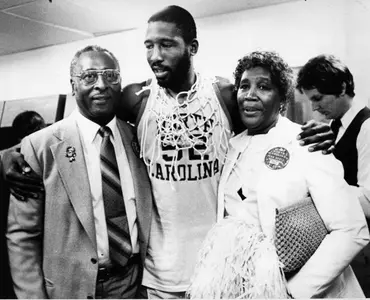
The final two nights later needs no retelling here, but spare an extra moment of appreciation for Final Four MVP James Worthy. Thirty-four years later, Jordan's game-winning shot is the indelible memory of 1982 and, for many, Carolina basketball as a whole. But it wouldn't have been possible without a virtuoso performance from Worthy, who scored 28 points on 13-of-17 shooting to give Coach Smith his long-awaited first NCAA title.