University of North Carolina Athletics
Extra Points: Tar Heels Hope Puzzle Fits After Lean Years
August 19, 2004 | Football
Aug. 19, 2004
Complete Extra Points in PDF Format
 Download Free Acrobat Reader
By Lee Pace
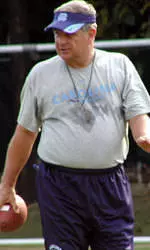
John Bunting's life every August revolves around the details. Opening kick-off is just weeks away, and there's never enough time to thread every needle. A linebacker is too heavy. A senior wears a bandana to a meeting -- strictly against team rules. A nose guard loses his leverage -- "Too HIGH, Jonas!!!" Bunting yells. A wide receiver's error of impertinence is rewarded with a tongue-lashing. A rainy preseason has forced the Tar Heels to the artificial turf for too long and it's taken a toll on the players' legs, so Bunting pushes to get back on grass as soon as possible -- mucky spots or no. He cautions his offensive assistants that blockers have to be more wary of potential holding penalties. "I don't care if it's not a holding penalty -- if it looks like one, you're going to get flagged," he says. Signing day is still six months away, but there's always a back to slap, a call to make, a note to write.
Bunting's even micro-managing his personal diet and fluid intake this August: Water and apple juice only, no caffeine.
"I've got to be sharp," Bunting says. "I'm feeling the best I've felt in a long time in terms of waking up and being energized. I've got to be upbeat. I've got to be on top of everything -- the players and the staff. It's my job to worry about the little things."
Bunting has certainly had plenty to worry about for two years now, but fortunately the big kinks in the Carolina armor are beginning to work themselves out. This 2004 edition that Bunting is cultivating toward a Sept. 4 opener against William & Mary should be an interesting study. The offense could be among the best ever fielded in Kenan Stadium. The kicking game is underscored by youth -- talented neophytes who'll dazzle with firecracking legs one snap and frustrate with inconsistency the next. And the defense, as quarterback Darian Durant noted earlier this summer, "can't be any worse." Indeed, there's nowhere to go but up (2003 NCAA total defense ranking: 116th of 117 teams). With an influx of quality players like Kyndraus Guy, Khalif Mitchell and Gerald Sensabaugh, combined with the fresh air of a new coaching mindset, the improvement should be noticeable.
How this will translate in terms of wins and losses against an exceedingly difficult schedule remains to be seen. I see numerous similarities in this season and Mack Brown's 1990 challenge -- turn two years of bottoming-out and stench into discernable progress. But Brown had the luxury in rebounding to 6-4-1 in 1990 with a schedule that included a solid South Carolina team, an average Kentucky squad and a mediocre Connecticut offering. There was a Miami on that schedule as well -- Ohio, not Florida. Look at the 2004 schedule and the name "Utah" hardly revs the pulse; but pick up Sports Illustrated's college football preview and you see the Utes are ranked No. 19 in the country -- and the Tar Heels are going there.
"We're very close to getting back to where we want to be," Bunting says. "I think in large part the pieces to this enormous puzzle are now in place. The schedule is very, very challenging. But that's the way it should be. To get to the top of this game, you've got to play the best."
During a quiet moment as two-a-days unfolded this week, Bunting reflected on his three-plus-year journey since his return to Chapel Hill following an NFL playing career and subsequent coaching legs in Division III and the NFL. His 2001 team rode holdover defensive talent to an 8-5 season and Peach Bowl win over Auburn. His 2002 and '03 teams were beset with all manner of issues on defense -- specifically lack of speed, athleticism, numbers and age -- and the result was a 5-19 watershed. Staff has been a riddle on defense as well; since the end of the 2002 season, three coaches have departed and now the defense is under the watch of John Gutekunst (linebackers and co-coordinator), Brad Lawing (line) and Marvin Sanders (secondary and co-coordinator).
"That first camp being back was very exciting," Bunting says. "We had some defensive guys we knew would be very good. Julius Peppers never ran out of gas. He was always running. To see a guy like David Thornton develop in camp--and you could see it happen, day after day--was fun. But on offense, we were struggling. We didn't know who Darian Durant was. We were worried about Ronald Curry throwing it a hundred yards downfield and 80 feet over someone's head. Our O-line was average. Adam Metts was a battler, but everyone else was new. It was scary, but at the same very exciting.
"The last two years, you'd go out there every day with a list of concerns. The offense was getting better. But the defense worried you to death. I used the word `dreadful' with a reporter talking about our linebacker play.
"I'm not saying I'm less concerned now, but this camp has been a lot of fun.
The kids are so upbeat, every single day. Every drill is competitive. The kids are responding to the new staff. It's coming. I see it. The staff and the kids see it. There's never been a doubt about that. Now we just need to show it on Saturdays."

Of course, no one said the process would be easy. Just as Bunting and staff were beginning to feel good about quality and quantity at a key position such as defensive line, a veteran like Chase Page suffers a hand injury 10 days into training camp and is lost for the year.
"Now we have to close ranks," Bunting said Wednesday morning, hours after Page had undergone surgery to repair a flexor tendon in his left pinky finger. "We just became a younger team. Chase is a senior, and I can't turn a freshman into a senior."
Bunting and staff quickly move Mitchell from end to tackle. Hilee Taylor, a true freshman, takes on third-down pass-rushing responsibilities. The details never go away.
Here's what to expect from the Tar Heels, circa 2004:
A potent offense.
Coordinator Gary Tranquil is not one to dispense good tidings flippantly. But even he acknowledges, "We could be pretty good. We've got a lot of big-play guys at receiver, and we've got three tailbacks and each one brings a little something different to the table."
Carolina has three seniors on the offensive line and is developing some quality depth. Madison Hedgecock is back at his natural fullback position after a year and a half helping shore up the defensive line, and backup Rikki Cook is vastly improved.
And there is Durant, the veteran quarterback who owns 47 Tar Heel passing, scoring and total yards records -- including the most important, career total offense of 7,204 yards. Well back in the dust in that category are Ronald Curry (6,236), Jason Stanicek (5,497) and one Charles Justice (4,883).
The weapons and offensive arsenal are extensive. Tranquill was limited in the passing game in 2003 because receivers Mike Mason, Jesse Holley and Adarius Bowman were freshmen. This year they'll get lined up properly and read the defense while running routes. Ronnie McGill brings power to the ground game and is the first tailback in many years with the ability to wear down the defense. Jacque Lewis is dangerous in the passing game. A reservoir of fullbacks and tight ends gives the Heels personnel options they lacked a year ago. Durant is seasoned enough to take three plays to the line of scrimmage on many downs and check into the proper call.
"We think we can put a lot of points on the board, no matter what the defense does," says Durant.
An explosive kicking game.
Sophomore David Wooldridge averaged 45 yards a punt in part-time duty last fall and moves into the starting position. He has the leg strength to deliver on special-team coach James Webster's goal of 10 yards of distance for every one second of hang time. Webster wants a 40-yard punt with four seconds in the air -- not a 50-yarder with 3.5 seconds. True freshman Connor Barth has kicked 50-yard-plus field goals in training camp and has competition from another true freshman, walk-on Lane Clemmons.
Sophomore Mike Mason has the potential to be the Tar Heels' most electric kick-return specialist in many years. He has speed, nerve and confidence. "I want three touchdowns on kick returns this year," he says. "That's a realistic goal."
In short, the Tar Heels should get an edge in field position from the kicking game and be a threat to put three points on the board anytime the offense nudges the opposition's 40 yard-line.
And an improved defense.
How much improvement is the question, of course.
The Tar Heel defense in 2003 intercepted two passes and forced 10 total turnovers; combined with 25 giveaways by the offense, the minus-15 turnover margin ranked 111th in the nation. Carolina had 16 quarterback sacks; Florida State and Maryland led the ACC with 34 and 33, respectively. Missed tackles are not an official statistic; suffice it to say, the Tar Heels would have run the table in that category as well, particularly in the secondary.
 Co-defensive coordinator Marvin Sanders  |
|
"Turnover-margin and tackling in the open field are the two biggest concerns on this football team," Bunting says. "It is crucial that we get better in both areas."
That process begins upfront. At left end, the Tar Heels have a potential all-star in Guy, a red-shirt freshman. He was splitting time with Mitchell, a true freshman, until Mitchell moved into Page's tackle slot. Both have the physical skills, motors and mindsets to be exceptional. Nose guards Isiah Thomas and Jonas Seawright have each lost upwards of 40 pounds in the off-season. It's particularly noticeable on Seawright, a fifth-year senior who's never fulfilled his potential.
"Jonas is like night and day," says Bunting. "He has made this head coach very, very happy. To have another guy step on the defensive line is huge. Now if he can just keep it up."
Adds Lawing: "He's so much quicker off the ball. There have been plays when he's run our center into the path of the ball-carrier. And Jason's Brown's pretty good. It's not like Jonas is getting the run of any old center."
Lawing and the D-line are focused on affecting the quarterback on every snap of the ball. Sacks are fine. Harassment is almost as good.
"A common goal in football is to get one sack for every 10 passes," Lawing says. "That's pretty good heat. If the offense throws it 50 times, you should get five sacks. But what about the other 45? Every time he throws it, we want to affect him in some form or fashion. Get our hands up. Make him move from the pocket. Hurry him. Grab him. Affect the quarterback. That's our deal, and I think we'll be a lot better at it."
While the line's maniacally focused on getting in the quarterback's face, the secondary's occupied with getting to the football sooner and more aggressively than the last two seasons. The first team of cornerbacks Lionell Green and Jacoby Watkins and safeties Gerald Sensabaugh and D.J. Walker are doing precisely that. Two offensive players, QB Roger Heinz and receiver Jesse Holley, have noted the improvement.
"There's a huge difference -- not a minor difference, a huge difference," Heinz says. "They're breaking on balls quicker. Last year on the scout team, we'd pick them apart. This year, they're knocking balls down and picking them off. It's a lot harder to make reads and complete passes."
Adds Holley: "It's a complete 180 from last year. The effort is better, they're coming to meet the ball a lot faster."
Part of the improvement is the aging and physical development process. Green has improved his strength and added some weight and is now able to more effectively battle big receivers coming off the line -- without losing a step of speed. Watkins and Walker are now sophomores. Sensabaugh is a gift -- a senior transfer from East Tennessee State who is outstanding against the run and is smart like a coach.
"We're way more aggressive," says Watkins. "We tackle better. We know the game of football better. We read the quarterback better. Last year we had two interceptions total -- and that's not acceptable. We'll get our hands on way more this year."
"We understand what to do," Walker adds. "We're able to react faster, to get more plays on the ball, to get our hands on the ball more. Our reaction time is a lot better. We're not thinking as much. A lot has to do with knowing what to do."
The secondary players under Sanders and linebackers under Gutekunst have reacted well to the staff changes. It was not the fault of former coordinator Dave Huxtable and secondary coach Jim Fleming that the defense was roiling and reeling with attrition, youth, recruiting snafus and an overall lack of athleticism when they accepted their assignments in 2002 (Huxtable a holdover as linebackers coach in 2001). But there's no question that the losing and 500 yards a game had broken everyone down mentally on that side of the ball. Huxtable wrestled late into the nights with the issue of how much to do schematically to overcome a noticeable lack of speed. In the end, there was too much thinking on the field and too much playing the blame-game off it. Bunting knew a clean slate was the best recourse for the defense.
Enter Gutekunst, 60, a k a Ice. Experience. Cool head. Man of few words. Picks his spots for yelling. Understands the big picture from his years as a head coach at Minnesota.
"You cannot trade experience," says Lawing. "John's seen it all. He's great on the board. You make a suggestion and he'll say, `Fine, draw it up.' Then he'll come at you with questions. What if this happens? He'll pick you apart. If he says nothing, that's his seal of approval. The kids love him. He tells the truth and they know that. They respect what he's seen and done in this business."
Enter also Sanders, 36, a k a Fire. Youthful exuberance. Emotion. Nebraska pedigree.
"Coach Sanders has brought a new philosophy," says Watkins. "There's a different mindset in terms of effort and technique."
"Coach Sanders and Coach Gutekunst have been great additions to the defense," says Holley. "The guys seem a lot more willing to play for them than the guys last year. The scheme is a lot easier. I think everything's a lot more comfortable over there now."
The defensive playbook is thinner for 2004 and the reads and adjustments at the line of scrimmage will be fewer. Lawing has worked for coordinators who have been inordinately complicated and others who have erred toward simplicity. "This is somewhere in between," he says. Bunting remembers coaching at Kansas City in the mid-1990s and the Chiefs running one of the NFL's best defenses and "most vanilla schemes imaginable." The Tar Heels in 2001 hardly changed their defensive game plan from week to week because of the ability of Peppers/Sims/Thornton et al.

"I love it when people ask, `Coach, are you going to blitz more this year?'" Bunting says. "We blitzed too much last year. But we couldn't get there. Our blitzers weren't fast enough. When you blitz and don't get there, you get killed."
With that, Bunting finishes his lunch of lean pork, steamed cauliflower and bottled water and is off to meet with the defensive staff and review that morning's 7-on-7 passing drill. His clipboard is full of notes for review.
SQUIB KICKS -- Carolina will have three late additions to the program by the time classes start Aug. 24. Linebacker Durell Mapp (6-2, 220) joined the team from Cummings High in Burlington after qualifying this summer for admission. He had an impressive first week before suffering a concussion. When QB recruit Michael Rozier opted for pro baseball at the last minute, the Tar Heels suggested to Illinois prospect Joey Bozich that he enroll immediately at Carolina instead of going to prep school for a semester. Bozich (6-2, 225) arrived in time from Hinsdale for the third day of practice. And Barrington Edwards is a tailback transferring from LSU. He's from Bowie, Md., and was recruited by Brad Lawing to Michigan State two years ago. Of the 6-0, 215-pound Edwards, Lawing says, "We'll have the best scout-team tailback in the nation." Edwards has been clocked at 4.4 in the 40. He will red-shirt in 2004.