University of North Carolina Athletics
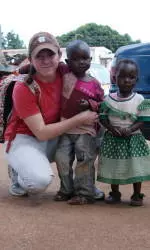
UNC Goalkeeper Headed Back To Africa
May 5, 2007 | Field Hockey
May 5, 2007
Brianna O'Donnell, a rising sophomore on the UNC field hockey team, will head to Africa in May for the second time in six months. As she prepared for her trip, during which she will volunteer at an orphanage in Kenya, she spoke to TarHeelBlue.com about her upcoming journey.
TarHeelBlue.com: You first traveled to Africa in December. How did that trip come about?
Brianna O'Donnell:"I've always been interested in travel and always been intrigued by those Feed the Children commercials. I'd always find myself watching them, but I felt wary about just donating to them - you don't know where the money is going, you don't know how it's having an impact on those children or families. So I thought, `I'd love to go and be part of the process, be a volunteer overseas.' I researched it, found a website, decided on Kenya ... and then I went."
THB: How did your family feel about the trip?
O'Donnell: "My parents were a little wary about it. I was 18 and I'm the youngest in my family, so they didn't like it at all. But I'm kind of the type of person where if I get something stuck in my mind I'm not going to let them tell me no. I just figured out everything myself then I told them my whole plan. They're still a little shaky about me going back, even though I've been there already.
THB: You went by yourself the first time?
O'Donnell: "Yes, I went over there through an organization called Global Volunteer Network. Your start dates are either the 1st or 15th of the month, so a whole group comes in with you. You find out at orientation where exactly you'll be going in Kenya. You get a list of orphanages and you get to decide where you'd like to be - rural, urban, what type of atmosphere. So you could be at an orphanage by yourself, but I ended up at one where there were four volunteers."
THB: As a member of U.S. Field Hockey national teams you've been to Chile, Puerto Rico and recently China. Did your field hockey travel make you any more comfortable with this kind of travel?
O'Donnell: "Going through U.S. Field Hockey sparked my wanting to travel, but it's so different traveling on your own as opposed to traveling with them. They do everything for you - lay out all your meals, make all the plans. Traveling by yourself is like coming to college - you have to learn to feed yourself, figure out where you're going to stay ... you really have to take a lot of responsibility for yourself."
THB: Why did you decide on Africa?
O'Donnell: "It's one of the big focuses in world poverty today. I eventually want to work in foreign relations, dealing with poverty situations in third world countries and working overseas, and I wanted to see if that's really what I wanted to do. So Africa was a good starting place. I know a lot of people who have gone to Africa and it totally changes their life."
THB: What was your first trip like?
O'Donnell: "I stayed in a homestay (a private home) about 15 minute walk from the orphanage. Every weekday we'd go to the orphanage about 9 and stay there until 1 or 2. Basically you're just there to be a support for these kids, give them love, play with them, interact with them. A lot of them are so detached from what's going on around them. The little ones especially - they just sit there and don't interact at all. So you just play with them and make friendships.
"The rest of the time is free time - we'd go to the internet café, hang out, visit other parts of the country. Weekends were for traveling - we went to a giraffe center, a baby elephant center. One weekend I took a long weekend and went four days on safari in Northern Kenya, which was really cool. You got to do a lot of stuff. They give you a lot of free time, since you are a volunteer.
"I got back from safari and had two days left at the orphanage and those last two days were my favorite days and the worst days because I realized how much more time I wished I would have spent at the orphanage with these kids. Five hours a day? I wish I had spent 10. I got so attached, I didn't want to leave. Next time I go I'm definitely going to spend a lot more time with the kids."
THB: Was there a moment in the first trip that made you really appreciate your decision to go?
O'Donnell: "We had a celebration day for the kids at the orphanage on the Friday before Christmas. One of the guys from Kibera brought his guitar and the kids were all singing and having a blast. That really touched me - I almost started bawling. I wasn't upset to be away from home on Christmas, but it was so touching to see these kids so enthusiastic about life. They only knew this one song but they loved it and they kept singing it. It was really touching."
THB: Were there some particular kids you really became attached to, that made you say, "I've got to go back"?
O'Donnell: "The second to last day I was there, we took three kids to the medical clinic to get treated for different things. A couple of them had chest colds, Mikey, the youngest at the orphanage, had worms, and nobody was going to take them unless we did. It cost, I think, $4 for the three of them. Everything is covered - it's not like you have to go to a pharmacy to get the medicine, they give everything to you there for less than $5.
"Two of the kids we took that day I absolutely fell in love with. There was one little girl, Agnes, who was about 7. She had a stroke when she was about 5. It paralyzed the right side of her body so she walks with a limp and is mentally behind now. But I realized how smart and willing to learn she was. She could do her numbers and ABC's. In the beginning of my trip I thought she just sat there and did nothing, but really it's because no one was interacting with her. She definitely has a possibility to develop.
"Mikey was the littlest one, and I absolutely fell in love with him. I wished I could have taken him with me. He's a little less than 2 I imagine, but they don't really know. I guess he was dropped off at the orphanage when he was around 1. When I first got there, he would just sit in a corner and do nothing. And he was easily frustrated - if he was playing with a toy and one of the other kids took it, he'd throw a temper tantrum like I've never seen. There was so much frustration built up in this kid. He's definitely experienced so much in his life. But I realized by the end of my trip that all he needed was somebody to interact with him. I would say the numbers, 1 through 10, and he'd say them back. It was really touching because for the first like 15 days of my trip he didn't say a word. He is the most loving kid and it was really hard to leave him. He definitely has a chance in life if people keep pushing him."
THB: So you had decided to go back before you'd even left?
O'Donnell: "That last day at the orphanage was really tough, leaving the kids. They sang a song to me, a thank you, goodbye song, and I walked out of there and said, `I cannot not come back. It's not possible.' So I had to convince my parents. They're still shaky about it, even though I have the trip back completely planned out.
THB: How will this trip be different - are you going on your own?
O'Donnell: "I'm not going through an organization this time because I felt like that money I was spending on the organization fees, about $1,000, could go to better purposes. When you go through the organization, you're paying them to set you up with a place to live, food, other things. You're paying to volunteer, which I always thought was an odd concept before I went, but really there are so many things that they set up.
It would be more secure to go through an organization, but since I've already been there I feel like I can handle it. I'm staying with a lady through Carolina for Kibera, an organization over there that works with community projects from UNC. She's hosting me and I'll pay her directly, so the money I would have paid to the organization can go straight to the orphanage. I'll be there for three weeks."
THB: Was there any language barrier for you?
O'Donnell: "English is the main language, but they also speak Kiswahili. I haven't taken that yet at UNC, but I'm going to take it in the fall and hopefully take four semesters and get able to speak decently. You pick it up pretty easily - everybody speaks Kiswahili and most people speak pretty good English. All education is in English, so all the older kids who are in school spoke English very well. The little kids were a different story - they'd break out in Kiswahili and you'd say, `Slow down, I don't know what you're saying!'"
THB: So if you're planning to study the language, you must already have plans to go back again after this trip.
O'Donnell: "I want to work in foreign relations overseas and before that maybe do the Peace Corps? But right now I'm not sure what my possibilities are with field hockey. That's first on my mind - if I can get on the National Team and go to the Olympics, that would be amazing, then there would be time later to join the Peace Corps."
THB: Being a varsity athlete takes up so much of your time. How have you been able to find the time to plan and do things like this?
O'Donnell: "You just have to find space for it. It took me a long time to actually get the planning going this semester, but you just have to fit it in somewhere, make sacrifices. While I'm there I'll be taking two summer school classes online, just to get ahead because I want to do like 50 million things while I'm here in college. I want to major (photojournalism) and double minor (African studies and German). If I wasn't going on the trip, I'd be in Chapel Hill in May doing stuff with U.S. Field Hockey, so I'm taking time off from that and I feel like that's best for me."