University of North Carolina Athletics
Tar Heel Alum Represents U.S. At Masters Hockey World Cup
June 27, 2014 | Field Hockey
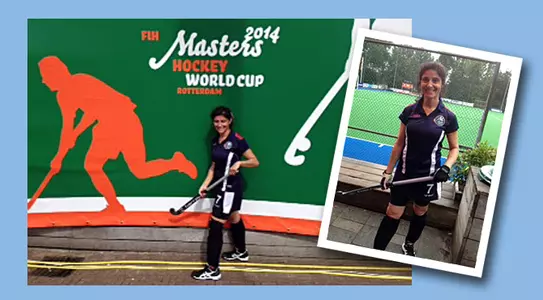
Nearly 30 years after her All-America field hockey career at UNC ended, Mary (Sentementes) Michailidis found herself competing at an elite level again. Earlier this month, she represented the U.S. as part of the 50+ team at the Masters Hockey World Cup in Rotterdam, the Netherlands.
"I never would have thought I'd get to do this at 50," Michailidis says. "Athletically and culturally it was an amazing opportunity."
Michailidis played at UNC from 1981-84 and was the first Tar Heel to earn All-America honors. She also was the program's first two-time All-America, earning a spot on the first team in 1983 and '84. She helped UNC to crowns in the first two Atlantic Coast Conference tournaments contested, in her junior and senior years, was the 1983 ACC Tournament MVP, and in 2002 was honored as one of the top 50 field hockey players in ACC history.
Her journey back to the playing field started early this year, when she received a cryptic email from a friend inquiring as to whether she'd turned 50 yet. When she confirmed having hit that milestone in December of 2013, he revealed the reason for his question: USA Field Hockey was looking for candidates for its women's Over 50 team to compete at the Masters Hockey World Cup.
Despite having just gotten over a back injury she incurred after slipping on black ice, Michailidis decided to give it a go. With tryouts just three weeks away, she had to work hard to get up to speed quickly. She had been involved in field hockey - coaching, referring and running camps -since graduating from UNC in 1986 but she hadn't played on a club team since 2000, leaving her with quite a challenge.
Three weeks later at a tryout in Philadelphia, she did well but felt like she could do better. So she went to another tryout in Washington, D.C., a week later and was much more pleased with her performance there. On March 12 she received a call letting her know she'd made the team. "Then I had to get serious," she says.
Because the team members were scattered and all had work and family responsibilities, the squad had just two practices together before departing for Holland. Michailidis, who lives in Stamford, Conn., had plenty to juggle while trying to fit in her training: She works as an assistant principal at Brien McMahon High School in Norwalk, Conn., and has two sons, Peter and Andy, both ice hockey players with busy schedules of their own.
After arriving in Europe, the team got in two more practices and a scrimmage before beginning competition. Otherwise, each player was responsible for her own training and fitness. Michailidis credits Pam Stuper, the head field hockey coach at Yale and a member of the Over 40 team, as the driving force behind the U.S. delegation. "She played and also was a key organizer," Michailidis says. "I don't know how she did it."
The U.S. women's teams were competing at the event for the first time, and that showed in the results. The 40+ women were 0-5-1 and the 50+ women were 0-6. "Clearly there were a lot of lessons learned," Michailidis says. "But the U.S. teams were complimented for their play - people knew how limited our training had been." (The men, veterans of the competition, fared better: The 50+ team finished fifth and the 40+ team ninth.)
In addition to playing in her own games, Michailidis was able to see the U.S. Women's National Team play at the Rabobank Hockey World Cup in The Hague.
"It was an unbelievable experience from start to finish," she says. "The only downside was coming back with a sore hamstring, but otherwise I was OK. It was two weeks of cultural and athletic richness."
Yet, it wasn't Michailidis's first exposure to international field hockey. She did extensive work with the with the Greek field hockey teams leading up to the 2004 Summer Olympics in Athens and then assisted at the field hockey venue during the Games. (She was born in the U.S., but both of her parents were born in Greece.) A decade later, she looks back on that as an amazing experience. "I thought that was the pinnacle of my field hockey career," she says, "until this."