


University of North Carolina Athletics
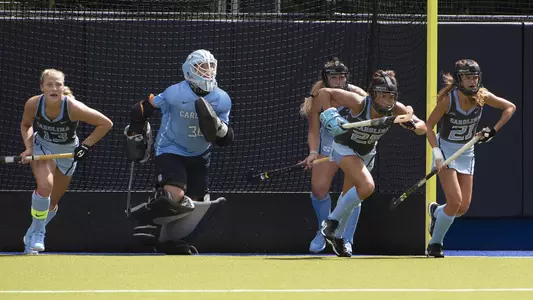
The Tar Heel corner defense in 2018. In a change this year, the game clock will stop when a corner is called.
Photo by: Jeffrey A. Camarati
New Rules In Play As Field Hockey Season Starts Friday
August 29, 2019 | Field Hockey
CHAPEL HILL, N.C. – As the NCAA field hockey season gets underway this weekend, there are a few rule changes that teams will be adapting to and fans will want to know about. Read on for a rundown on the new regulations, and thoughts from UNC coach Karen Shelton on each.
• Regulation now includes four 15-minute quarters instead of 35-minute halves. Halftime remains 10 minutes long, and there will be a two-minute break between the first and second and the third and fourth quarters.
"I think it's going to be interesting, a much faster paced game," Shelton said. "I think the fact that the whole period is only 15 minutes means there's more furiousness to it, instead of what you see in a longer period."
• With the breaks between quarters, timeouts are a thing of the past. Coaches used to be allotted one timeout per game (which often went unused), but no longer have the option to stop play.
"I never liked timeouts anyway and I think this is good," Shelton said. "I've always felt the game should be coached during the week and it's the players' game on gameday. I've always felt like preparation is the key and if you're coaching the right thing, they're ready to make decisions for themselves and problem solve on the fly."
One way that coaches often used timeouts was to pull the goalkeeper in a late-game situation. Now that substitution will have to be done during the action.
• The clock stops as soon as a penalty corner is called and resumes at the umpire's whistle when the inserter is ready to put the ball in play. Teams have a maximum of 40 seconds to resume play. Previously the clock continued to run after a corner was awarded and while the team was setting up.
"I don't think that really impacts the game," Shelton said. "It prevents people from shouting at the umpires and saying that the defense is stalling or the offense is stalling."
• After pulling the goalkeeper, teams used to have the option of playing with a kicking back, a designated field player who could play the ball according to the rules for goalkeepers. The kicking back was not wearing pads, but could stop the ball in the circle with her foot or – should she dare – her body, as a goalkeeper is allowed to do. Under the new rule, pulling the keeper does not change the function of any of the field players.
"I never wanted to tell a player, you've got to be the goalie with no padding, so for me it doesn't really change much," Shelton said. "In effect it really was dangerous."
The Tar Heels open play Friday at 6 p.m. at Michigan. Fans can follow the action via live stats and Twitter or watch on BTN+.
• Regulation now includes four 15-minute quarters instead of 35-minute halves. Halftime remains 10 minutes long, and there will be a two-minute break between the first and second and the third and fourth quarters.
"I think it's going to be interesting, a much faster paced game," Shelton said. "I think the fact that the whole period is only 15 minutes means there's more furiousness to it, instead of what you see in a longer period."
• With the breaks between quarters, timeouts are a thing of the past. Coaches used to be allotted one timeout per game (which often went unused), but no longer have the option to stop play.
"I never liked timeouts anyway and I think this is good," Shelton said. "I've always felt the game should be coached during the week and it's the players' game on gameday. I've always felt like preparation is the key and if you're coaching the right thing, they're ready to make decisions for themselves and problem solve on the fly."
One way that coaches often used timeouts was to pull the goalkeeper in a late-game situation. Now that substitution will have to be done during the action.
• The clock stops as soon as a penalty corner is called and resumes at the umpire's whistle when the inserter is ready to put the ball in play. Teams have a maximum of 40 seconds to resume play. Previously the clock continued to run after a corner was awarded and while the team was setting up.
"I don't think that really impacts the game," Shelton said. "It prevents people from shouting at the umpires and saying that the defense is stalling or the offense is stalling."
• After pulling the goalkeeper, teams used to have the option of playing with a kicking back, a designated field player who could play the ball according to the rules for goalkeepers. The kicking back was not wearing pads, but could stop the ball in the circle with her foot or – should she dare – her body, as a goalkeeper is allowed to do. Under the new rule, pulling the keeper does not change the function of any of the field players.
"I never wanted to tell a player, you've got to be the goalie with no padding, so for me it doesn't really change much," Shelton said. "In effect it really was dangerous."
The Tar Heels open play Friday at 6 p.m. at Michigan. Fans can follow the action via live stats and Twitter or watch on BTN+.



Thursday, July 30
Thursday, July 30
Tuesday, July 28
Saturday, July 18