University of North Carolina Athletics
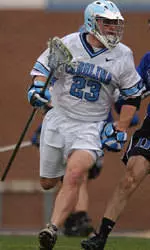
From Fetzer To Finley: Tar Heels Face Crossroads Year In Men's Lacrosse
December 19, 2005 | Men's Lacrosse
Dec. 19, 2005
By Dave Lohse
Associate Athletic Communications Director
University of North Carolina
The 2006 men's lacrosse season at the University of North Carolina is shaping up as a critical year in the future of the program head coach John Haus has worked so hard to rebuild since 2000. There is simply no getting past that and I doubt coach Haus disagrees with that assessment.
When Haus took over the UNC program in 2000 after Dave Klarmann's resignation as head coach after 10 seasons at the helm, the program was going through a period of adjustment. After six seasons in which UNC made the NCAA Tournament each year and won five Atlantic Coast Conference championships from 1991-96, the Tar Heels struggled in Klarmann's last four seasons, posting three successive losing campaigns before finishing 8-6 in 2000.
After two successful seasons at Johns Hopkins in 1999 and 2000 in which the Blue Jays made the NCAA semifinals each season, Haus left the head coaching position there to venture to Chapel Hill where he had played as an All-America defenseman on two NCAA championship teams from 1980-83.
The first three of Haus' squads at Carolina were good teams that flirted briefly with being very good. But challenged with extremely difficult schedules and a changing NCAA Tournament landscape that lessened the number of at-large teams in the championship bracket, the Tar Heels fell just short of making the tournament in each of those seasons.
In 2004, the Tar Heels elevated their game, however, and returned to the NCAA Tournament for the first time since 1998, finishing 10-5 overall, including three losses by a single goal. UNC ended up advancing to the NCAA quarterfinals before running into a buzz saw against Johns Hopkins, which arguably played its best game of that season against the Tar Heels in that NCAA setting.
Last year was a source of unending frustration for the Tar Heels as they fell back to 5-8 against a schedule that was ranked No. 1 in the nation in difficulty by LaxPower.com. What made the season even more hard to endure was the fact the Tar Heels were in a position in every one of those eight losses save one where they had possessions to tie games or come within one goal in the final five minutes of play. In every case, the Tar Heels came up just short. Conversely, each of UNC's five wins on the season came by a healthy margin of victory.
Carolina is now out to exorcise the demons of that campaign which put a hitch in the process of program building. It must be done without two four-year starters in the attack, two in the midfield, a starting defenseman and a four-year starter in the goal.
The Tar Heels do benefit from the fact this year's team includes a senior class with 13 players, making it as deep and experienced a team as Carolina has enjoyed in several seasons. Those facets of the team are also major reasons John Haus enters the season with a sense of heightened expectations as the Tar Heels again challenge themselves with a brutal schedule of 13 regular season matches, aslate which will certainly test the team's mettle.
"The biggest thing that stuck out in fall ball was the leadership of our two captains, Stephen McElduff and Hayward Howard," says Haus. "They really took control of the leadership of this team and so far have carried us in the right direction towards being a successful team in the spring.
"Our work ethic right now is as good as it has ever been since I've been here as the head coach. Our drive and our hunger to succeed are at as a high level as I've seen.
"Credit for that goes not only to the captains but you sense our whole senior class is stepping up," says Haus. "There's a realization on this team that we need to do some things differently coming off what was a disappointing season for us in 2005."
One of the differences Haus cites is that with the exception of just a handful of players no one on this team is certain at this point in time of their playing status this spring.
"We obviously have a lot of unknowns heading into this season," he says. "However, it's as competitive a situation as it's been in a long time viewing our depth chart from the top to the bottom at every position. There's real competition out there to earn playing time. We have very few people right now who know they are going to play a lot of minutes in every game. The rest of the players know they need to earn their time with what they do between now and the season opener."
That sense of healthy competition on the practice field leading up to this season may be exactly what the Tar Heels need in 2006 in what shapes up as a crossroads season for UNC. The question remains which road the Tar Heels will choose to take.