
University of North Carolina Athletics
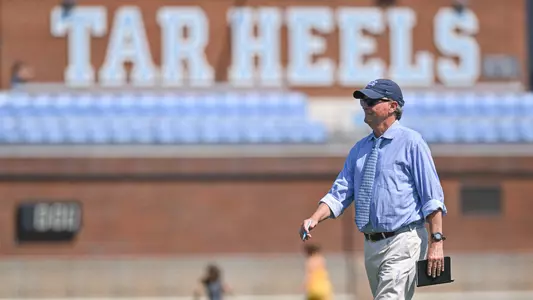
Photo by: AINSLEY E. FAUTH
Anson’s Impact Far Beyond Chapel Hill
August 12, 2024 | Women's Soccer
October 20, 1994. It was approximately 12 hours after Carolina women's soccer had lost at home to a college opponent for the first time ever (and it was Duke!), so I thought I'd check in on the head coach and see if he was as bummed out as the rest of Tar Heel nation.
Anson Dorrance was in his office, working up a plan for that afternoon's practice at Finley Fields. Hey, you lose at home for the first time in 15 years, I'm guessing the head coach was going to be at least a little angry or depressed. Instead, Anson (nobody calls him Mr. Dorrance and I don't think many people, even his players, call him coach…it's Anson) was almost giddy with anticipation.
'Why are you so happy?' I asked.
"This is a coach's dream," Anson said. "For the first time in years they are going to have to listen to me. Do you know how hard it is to coach when the players think they're going to win every game?"
Typical Anson. Always with an answer. Always finding ways to motivate, inspire and teach. It's no wonder another Hall of Fame Tar Heel coach, Roy Williams, holds Anson in such high regard, and folks, I mean really high regard.
"In many ways Anson is the greatest coach I've ever seen in my life," says Williams. "In any sport. Coach (Dean) Smith was my mentor and I idolized him, but Anson Dorrance takes a back seat to nobody. Coach Smith used to say Tiger Woods had no holes in his game and he was kind enough to say that about me. Well, Coach Smith really liked Anson, too, and he used to say Anson had no holes in his coaching. Tactics, game strategy, motivation, recruiting and representing the University of North Carolina, Anson had it all. And competitive, you know how I like competitive people, I loved Anson's competitiveness. He had it as much as anyone I have ever known. When I think of Carolina women's soccer I will always think of Anson."
If lofty praise from one Tar Heel legend doesn't move the needle for you, here's 10-time NCAA field hockey champion Karen Shelton, who spent all 42 years of her Hall of Fame coaching career alongside Anson at UNC.
"A giant among coaches, Anson is the epitome of a Carolina Priceless Gem," says Shelton. "He set the standard for our women's sports programs and motivated me personally to do better. I will forever be grateful for the opportunity to serve on the same staff, and to have learned powerful lessons from such a legendary man."
Trying to sum up someone's career who has been as successful as Anson has for 47 years of college coaching is a challenge. The numbers are so off the charts, and they have been for so long, it's almost easy to let them slide by.
Twenty-two national championships, almost 1,000 wins, 31 Final Fours, the home record, 47 combined ACC titles, 513 consecutive weeks in the polls and 600-plus consecutive games in which Carolina either won, tied or lost by only a goal.
Think of that last ridiculous stat (researched by longtime soccer SID Dave Lohse): for nearly a quarter century from 1986-2010, Carolina never lost a game by more than a goal, meaning UNC was in every game to the very last whistle, one of Anson's personal favorite milestones.
Mind-boggling history-in-the-making streaks are part of the DNA of Carolina women's soccer.
There are the nine consecutive NCAA titles from 1986-94; the 103-game unbeaten streak that ended in 1990 with a double overtime loss at UConn; a 92-game winning streak that began later that season and was the guts of another four-year, 101-game unbeaten stretch.
UConn ended the 103-game streak in Storrs in 1990, but the Tar Heels avenged that loss by thrashing the Huskies, 6-0, in the national championship game. Duke beat Carolina, 3-2, in 1994 to both end the 101-game unbeaten streak and deal UNC its first home loss since an all-star team from Virginia did the honors in 1980. However, later in 1994, the Tar Heels beat the Blue Devils in both the ACC championship game and NCAA quarterfinals.
Numbers can tell a lot of the story, but you don't coach a college program for more than 40 years unless developing relationships is the essence of what you are all about. Any time I watched Carolina play in the national championship game I wanted to see the team race out of the locker room, knowing Anson had just delivered a pregame speech in which he spoke from his soul about each and every senior.
It's remarkable how many times the Tar Heels were so charged up after that address that they scored within the first few minutes and took control of the biggest game of the season right from the kickoff.
Anson often talks how he watched Dean Smith's practices to pattern his own training methods. He preaches the program's 10 cornerstone beliefs and delights in building the competitive cauldron.
But no matter how great your coaching philosophies and tactical brilliance, it's a players game and Dorrance was blessed to recruit and develop so many of the best in the history of the sport. Early stars like Stephanie Zeh, Janet Rayfield and April Heinrichs were some of women's soccer's pioneers along with great players at schools like UConn, Central Florida, Cal, UMass and Colorado College.
But few people noticed or paid attention to women's soccer. Not until the early 1990s was there a confluence of people and events that were the beginnings of what you see now with the popularity of the United States Women's National Team and the rocket-fueled growth of women's soccer on the world stage.
Anson, who also was Carolina's men's soccer head coach from 1977-88, became head coach of the USWNT in 1986, simultaneously directing three programs.
In 1991, he and assistant coach Lauren Gregg, another former Tar Heel, took the U.S. team to China for the first-ever World Cup. With nine UNC players on the roster, the U.S. won (almost anonymously) the first of what is now five Olympic gold medals and four world championships.
While the U.S. was in China, Carolina beat Wisconsin in Chapel Hill to win the NCAA title. It was an evening that featured the first-ever phone call from China to the Fetzer Field press box as Dorrance called in to check on the score of the game.
The U.S. team returned from China to a massive throng (sarcasm intended) of approximately 50 friends and family at the Raleigh-Durham International Airport.
Anson gave up the National Team assignment in 1994, allowing that the duties at both the college and international levels had – thankfully – grown too large for one person. Two years later in Atlanta, the U.S. struck gold for the first time with another Tar Heel-heavy lineup.
Then in 1999, the United States hosted the World Cup, beating China in front of 90,000 fans at the Rose Bowl with eight of the 20 players having played for Anson at UNC. Kristine Lilly saved the game with a goal line stop, the U.S. won in penalties and the "99ers" became soccer immortals.
Players like Mia Hamm, Lilly, Cindy Parlow and Carla Werden were becoming as popular and recognizable as some NCAA football and basketball players.
Hamm emerged as an international superstar, teaming with such corporate megabrands as Nike and Gatorade, doing commercials with MJ and earning the title as the best player not only in the U.S. but the world.
So, when you see the ticker-tape parades for the World Cup champions (remember that quaint little reception at RDU), the late-night talk show appearances, corporate sponsorships, better salaries, professional leagues, equal pay for the National Team, packed stadiums and dizzying TV ratings, it is not a stretch in the least to look back at the massive impact Anson and the Tar Heel women's soccer players had on all that growth and popularity.
And with everything his teams have accomplished in the collegiate, professional and international game I wonder what it is that Anson is most proud of.
When he first began coaching women's soccer, he believed the players didn't like to compete as much as the men he coached. He thought he had to teach his players that beating your teammate in a practice drill was appropriate, that it was good to try and be better than a teammate so you could play more, and it was more than just okay to dominate the opposition on gameday.
Forty-five years later, if you watch the Olympics, the NWSL, WNBA, LPGA, etc. no such instruction needs to happen. Whether it's on the soccer field or the board room, competition is alive and well and that might just be one of Anson's most enduring legacies.
Anson Dorrance was in his office, working up a plan for that afternoon's practice at Finley Fields. Hey, you lose at home for the first time in 15 years, I'm guessing the head coach was going to be at least a little angry or depressed. Instead, Anson (nobody calls him Mr. Dorrance and I don't think many people, even his players, call him coach…it's Anson) was almost giddy with anticipation.
'Why are you so happy?' I asked.
"This is a coach's dream," Anson said. "For the first time in years they are going to have to listen to me. Do you know how hard it is to coach when the players think they're going to win every game?"
Typical Anson. Always with an answer. Always finding ways to motivate, inspire and teach. It's no wonder another Hall of Fame Tar Heel coach, Roy Williams, holds Anson in such high regard, and folks, I mean really high regard.
"In many ways Anson is the greatest coach I've ever seen in my life," says Williams. "In any sport. Coach (Dean) Smith was my mentor and I idolized him, but Anson Dorrance takes a back seat to nobody. Coach Smith used to say Tiger Woods had no holes in his game and he was kind enough to say that about me. Well, Coach Smith really liked Anson, too, and he used to say Anson had no holes in his coaching. Tactics, game strategy, motivation, recruiting and representing the University of North Carolina, Anson had it all. And competitive, you know how I like competitive people, I loved Anson's competitiveness. He had it as much as anyone I have ever known. When I think of Carolina women's soccer I will always think of Anson."
If lofty praise from one Tar Heel legend doesn't move the needle for you, here's 10-time NCAA field hockey champion Karen Shelton, who spent all 42 years of her Hall of Fame coaching career alongside Anson at UNC.
"A giant among coaches, Anson is the epitome of a Carolina Priceless Gem," says Shelton. "He set the standard for our women's sports programs and motivated me personally to do better. I will forever be grateful for the opportunity to serve on the same staff, and to have learned powerful lessons from such a legendary man."
Trying to sum up someone's career who has been as successful as Anson has for 47 years of college coaching is a challenge. The numbers are so off the charts, and they have been for so long, it's almost easy to let them slide by.
Twenty-two national championships, almost 1,000 wins, 31 Final Fours, the home record, 47 combined ACC titles, 513 consecutive weeks in the polls and 600-plus consecutive games in which Carolina either won, tied or lost by only a goal.
Think of that last ridiculous stat (researched by longtime soccer SID Dave Lohse): for nearly a quarter century from 1986-2010, Carolina never lost a game by more than a goal, meaning UNC was in every game to the very last whistle, one of Anson's personal favorite milestones.
Mind-boggling history-in-the-making streaks are part of the DNA of Carolina women's soccer.
There are the nine consecutive NCAA titles from 1986-94; the 103-game unbeaten streak that ended in 1990 with a double overtime loss at UConn; a 92-game winning streak that began later that season and was the guts of another four-year, 101-game unbeaten stretch.
UConn ended the 103-game streak in Storrs in 1990, but the Tar Heels avenged that loss by thrashing the Huskies, 6-0, in the national championship game. Duke beat Carolina, 3-2, in 1994 to both end the 101-game unbeaten streak and deal UNC its first home loss since an all-star team from Virginia did the honors in 1980. However, later in 1994, the Tar Heels beat the Blue Devils in both the ACC championship game and NCAA quarterfinals.
Numbers can tell a lot of the story, but you don't coach a college program for more than 40 years unless developing relationships is the essence of what you are all about. Any time I watched Carolina play in the national championship game I wanted to see the team race out of the locker room, knowing Anson had just delivered a pregame speech in which he spoke from his soul about each and every senior.
It's remarkable how many times the Tar Heels were so charged up after that address that they scored within the first few minutes and took control of the biggest game of the season right from the kickoff.
Anson often talks how he watched Dean Smith's practices to pattern his own training methods. He preaches the program's 10 cornerstone beliefs and delights in building the competitive cauldron.
But no matter how great your coaching philosophies and tactical brilliance, it's a players game and Dorrance was blessed to recruit and develop so many of the best in the history of the sport. Early stars like Stephanie Zeh, Janet Rayfield and April Heinrichs were some of women's soccer's pioneers along with great players at schools like UConn, Central Florida, Cal, UMass and Colorado College.
But few people noticed or paid attention to women's soccer. Not until the early 1990s was there a confluence of people and events that were the beginnings of what you see now with the popularity of the United States Women's National Team and the rocket-fueled growth of women's soccer on the world stage.
Anson, who also was Carolina's men's soccer head coach from 1977-88, became head coach of the USWNT in 1986, simultaneously directing three programs.
In 1991, he and assistant coach Lauren Gregg, another former Tar Heel, took the U.S. team to China for the first-ever World Cup. With nine UNC players on the roster, the U.S. won (almost anonymously) the first of what is now five Olympic gold medals and four world championships.
While the U.S. was in China, Carolina beat Wisconsin in Chapel Hill to win the NCAA title. It was an evening that featured the first-ever phone call from China to the Fetzer Field press box as Dorrance called in to check on the score of the game.
The U.S. team returned from China to a massive throng (sarcasm intended) of approximately 50 friends and family at the Raleigh-Durham International Airport.
Anson gave up the National Team assignment in 1994, allowing that the duties at both the college and international levels had – thankfully – grown too large for one person. Two years later in Atlanta, the U.S. struck gold for the first time with another Tar Heel-heavy lineup.
Then in 1999, the United States hosted the World Cup, beating China in front of 90,000 fans at the Rose Bowl with eight of the 20 players having played for Anson at UNC. Kristine Lilly saved the game with a goal line stop, the U.S. won in penalties and the "99ers" became soccer immortals.
Players like Mia Hamm, Lilly, Cindy Parlow and Carla Werden were becoming as popular and recognizable as some NCAA football and basketball players.
Hamm emerged as an international superstar, teaming with such corporate megabrands as Nike and Gatorade, doing commercials with MJ and earning the title as the best player not only in the U.S. but the world.
So, when you see the ticker-tape parades for the World Cup champions (remember that quaint little reception at RDU), the late-night talk show appearances, corporate sponsorships, better salaries, professional leagues, equal pay for the National Team, packed stadiums and dizzying TV ratings, it is not a stretch in the least to look back at the massive impact Anson and the Tar Heel women's soccer players had on all that growth and popularity.
And with everything his teams have accomplished in the collegiate, professional and international game I wonder what it is that Anson is most proud of.
When he first began coaching women's soccer, he believed the players didn't like to compete as much as the men he coached. He thought he had to teach his players that beating your teammate in a practice drill was appropriate, that it was good to try and be better than a teammate so you could play more, and it was more than just okay to dominate the opposition on gameday.
Forty-five years later, if you watch the Olympics, the NWSL, WNBA, LPGA, etc. no such instruction needs to happen. Whether it's on the soccer field or the board room, competition is alive and well and that might just be one of Anson's most enduring legacies.
Tuesday, June 16
Monday, June 15
Saturday, June 13
Saturday, June 13